
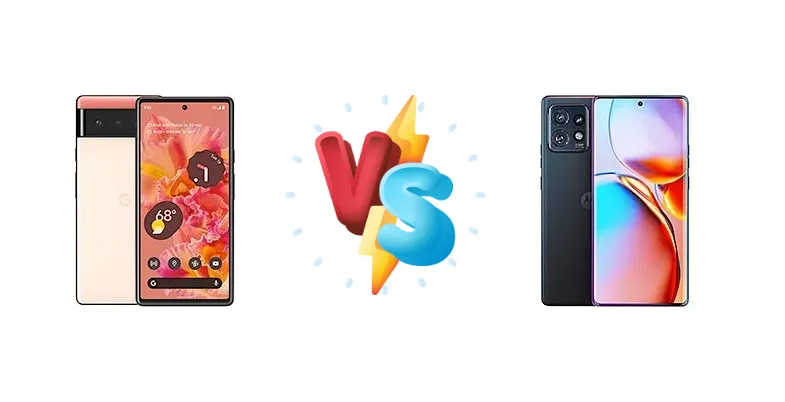
Google Pixel 6 vs Motorola Edge+ (2023): A Detailed Comparison of AI and Raw Power
| Phones Images | |||||
|---|---|---|---|---|---|
|
🏆 Quick Verdict
For most users, the Motorola Edge+ (2023) is the superior choice. Its Snapdragon 8 Gen 2 chipset provides a substantial performance advantage, particularly in demanding tasks like gaming, and its 68W charging significantly reduces downtime. While the Pixel 6's camera and software remain strong points, the Edge+ offers a more future-proof and versatile package.
| PHONES | ||
|---|---|---|
| Phone Names | Google Pixel 6 | Motorola Edge+ (2023) |
| Network | ||
|---|---|---|
| 2G bands | GSM 850 / 900 / 1800 / 1900 | GSM 850 / 900 / 1800 / 1900 |
| 3G bands | HSDPA 800 / 850 / 900 / 1700(AWS) / 1900 / 2100 | HSDPA 850 / 900 / 1700(AWS) / 1900 / 2100 |
| 4G bands | 1, 2, 3, 4, 5, 7, 8, 12, 13, 14, 17, 18, 19, 20, 25, 26, 28, 29, 30, 32, 38, 39, 40, 41, 42, 46, 48, 66, 71 - GB7N6, G9S9B16 | 1, 2, 3, 4, 5, 7, 8, 12, 13, 14, 17, 18, 20, 25, 26, 28, 29, 30, 38, 39, 40, 41, 41, 46, 48, 66, 71 |
| 5G bands | 1, 2, 3, 5, 7, 8, 12, 14, 20, 25, 28, 30, 38, 40, 41, 48, 66, 71, 77, 78, 257, 258, 260, 261 SA/NSA/Sub6/mmWave - G9S9B | 1, 2, 3, 5, 7, 12, 14, 20, 25, 26, 28, 29, 30, 38, 41, 41, 48, 66, 70, 71, 77, 78 SA/NSA/Sub6/mmWave |
| Speed | HSPA, LTE, 5G | HSPA, LTE, 5G |
| Technology | GSM / CDMA / HSPA / EVDO / LTE / 5G | GSM / HSPA / LTE / 5G |
| 1, 2, 3, 5, 7, 8, 12, 14, 20, 25, 28, 30, 38, 40, 41, 48, 66, 71, 77, 78 SA/NSA/Sub6 - GB7N6 | - | |
| Launch | ||
|---|---|---|
| Announced | 2021, October 19 | 2023, May 02 |
| Status | Available. Released 2021, October 28 | Available. Released 2023, May 19 |
| Body | ||
|---|---|---|
| Build | Glass front (Gorilla Glass Victus), glass back (Gorilla Glass 6), aluminum frame | Glass front (Gorilla Glass Victus), glass back (Gorilla Glass Victus), aluminum frame |
| Dimensions | 158.6 x 74.8 x 8.9 mm (6.24 x 2.94 x 0.35 in) | 161.2 x 74 x 8.6 mm (6.35 x 2.91 x 0.34 in) |
| SIM | Nano-SIM + eSIM | Nano-SIM + eSIM |
| Weight | 207 g (7.30 oz) | 203 g (7.16 oz) |
| IP68 dust/water resistant (up to 1.5m for 30 min) | IP68 dust/water resistant (up to 1.5m for 30 min) | |
| Display | ||
|---|---|---|
| Protection | Corning Gorilla Glass Victus | Corning Gorilla Glass Victus |
| Resolution | 1080 x 2400 pixels, 20:9 ratio (~411 ppi density) | 1080 x 2400 pixels, 20:9 ratio (~395 ppi density) |
| Size | 6.4 inches, 98.9 cm2 (~83.4% screen-to-body ratio) | 6.67 inches, 107.4 cm2 (~90.0% screen-to-body ratio) |
| Type | AMOLED, 90Hz, HDR10+ | OLED, 1B colors, 165Hz, HDR10+, Dolby Vision, 1300 nits (peak) |
| Always-on display | - | |
| Platform | ||
|---|---|---|
| CPU | Octa-core (2x2.80 GHz Cortex-X1 & 2x2.25 GHz Cortex-A76 & 4x1.80 GHz Cortex-A55) | Octa-core (1x3.2 GHz Cortex-X3 & 2x2.8 GHz Cortex-A715 & 2x2.8 GHz Cortex-A710 & 3x2.0 GHz Cortex-A510) |
| Chipset | Google Tensor (5 nm) | Qualcomm SM8550-AB Snapdragon 8 Gen 2 (4 nm) |
| GPU | Mali-G78 MP20 | Adreno 740 |
| OS | Android 12, upgradable to Android 15, up to 5 major Android upgrades | Android 13, upgradable to Android 14 |
| Memory | ||
|---|---|---|
| Card slot | No | No |
| Internal | 128GB 8GB RAM, 256GB 8GB RAM | 512GB 8GB RAM |
| UFS 3.1 | UFS 4.0 | |
| Main Camera | ||
|---|---|---|
| Dual | 50 MP, f/1.9, 25mm (wide), 1/1.31", 1.2µm, dual pixel PDAF, OIS 12 MP, f/2.2, 17mm, 114˚ (ultrawide), 1.25µm | - |
| Features | Laser AF, Dual-LED flash, Pixel Shift, Auto-HDR, panorama | Dual-LED flash, panorama, HDR |
| Single | 8 MP, f/2.0, 24mm (wide), 1.12µm | - |
| Triple | - | 50 MP, f/1.8, (wide), 1/1.55", 1.0µm, multi-directional PDAF, OIS 12 MP, f/1.6, (telephoto), 1/2.93", 1.22µm, PDAF, 2x optical zoom 50 MP, f/2.2, 114˚ (ultrawide), 1/2.76", 0.64µm, AF |
| Video | 4K@30/60fps, 1080p@30/60/120/240fps; gyro-EIS, OIS | 8K@30fps, 4K@30/60fps, 1080p@30/60/120/240/960fps, 10-bit HDR10+, gyro-EIS |
| Selfie camera | ||
|---|---|---|
| Features | HDR, panorama | HDR |
| Single | 8 MP, f/2.0, 24mm (wide), 1.12µm | 60 MP, f/2.2, (wide), 1/2.8", 0.61µm |
| Video | 1080p@30fps | 4K@30/60fps, 1080p@30/60/120/240fps |
| Sound | ||
|---|---|---|
| 3.5mm jack | No | No |
| 35mm jack | No | No |
| Loudspeaker | Yes, with stereo speakers | Yes, with stereo speakers |
| Comms | ||
|---|---|---|
| Bluetooth | 5.2, A2DP, LE, aptX HD | 5.3, A2DP, LE, aptX HD, aptX Adaptive |
| NFC | Yes | Yes |
| Positioning | GPS (L1+L5), GLONASS (G1), BDS (B1I+B1c+B2a), GALILEO (E1+E5a), QZSS (L1+L5) | GPS, GLONASS, GALILEO, BDS |
| Radio | No | No |
| USB | USB Type-C 3.1 | USB Type-C 3.2, OTG, DisplayPort 1.4 |
| WLAN | Wi-Fi 802.11 a/b/g/n/ac/6e, dual-band, Wi-Fi Direct | Wi-Fi 802.11 a/b/g/n/ac/6e/7, tri-band, Wi-Fi Direct |
| Features | ||
|---|---|---|
| Sensors | Fingerprint (under display, optical), accelerometer, gyro, proximity, compass, barometer | Fingerprint (under display, optical), accelerometer, gyro, proximity, compass, barometer |
| - | Ready For 3.5 support | |
| Battery | ||
|---|---|---|
| Charging | Wired (based on 30W charger), PD3.0, 50% in 30 min 21W wireless Reverse wireless | 68W wired 15W wireless 5W reverse wired 5W reverse wireless |
| Type | Li-Ion 4614 mAh | Li-Po 5100 mAh |
| Misc | ||
|---|---|---|
| Colors | Sorta Seafoam, Kinda Coral, Stormy Black | Interstellar Black |
| Models | GB7N6, G9S9B16, G9S9B, GR1YH | - |
| Price | $ 172.48 / C$ 238.84 / £ 169.99 / € 191.89 / ₹ 23,719 | $ 298.99 |
| Tests | ||
|---|---|---|
| Battery life | Endurance rating 86h | - |
| Camera | Photo / Video | - |
| Display | Contrast ratio: Infinite (nominal) | - |
| Loudspeaker | -26.9 LUFS (Good) | - |
| Performance | AnTuTu: 676831 (v9) GeekBench: 2899 (v5.1) GFXBench: 57fps (ES 3.1 onscreen) | - |
Google Pixel 6
- Excellent computational photography
- Clean Android experience with guaranteed updates
- Competitive price point (post-launch)
- Older chipset (Google Tensor)
- Slower charging speeds (30W)
- Potential for thermal throttling under heavy load
Motorola Edge+ (2023)
- Top-tier performance with Snapdragon 8 Gen 2
- Fast 68W wired charging
- More efficient processor for longer battery life under load
- Motorola's software experience isn't as refined as Pixel's
- May be more expensive than the Pixel 6
Display Comparison
Both phones feature displays with an 'Infinite' (nominal) contrast ratio, suggesting excellent black levels. However, detailed display specs like peak brightness and refresh rate are missing for the Pixel 6. The Edge+ benefits from the Snapdragon 8 Gen 2's display engine, potentially offering smoother animations and more efficient power consumption. Without specific Pixel 6 display data, it's difficult to assess its color accuracy or outdoor visibility compared to the Edge+.
Camera Comparison
Both phones are advertised as having strong camera capabilities (Photo/Video). However, without sensor size or aperture information for the Pixel 6, a direct comparison is limited. The Pixel 6 leverages Google’s renowned computational photography, excelling in dynamic range and image processing. The Edge+ likely relies more on hardware capabilities, potentially offering better low-light performance with a larger sensor (assuming a modern flagship sensor). The absence of detail regarding the Pixel 6’s camera hardware makes it difficult to assess its strengths beyond software processing.
Performance
The Motorola Edge+ (2023) unequivocally leads in performance. Its Snapdragon 8 Gen 2 (4nm) chipset, featuring a Cortex-X3 prime core clocked at 3.2 GHz, significantly outperforms the Google Tensor (5nm) in the Pixel 6. The Snapdragon's architecture – 1x Cortex-X3, 2x Cortex-A715, 2x Cortex-A710, and 3x Cortex-A510 – is more modern and efficient than the Pixel 6’s combination of Cortex-X1, A76, and A55 cores. The 4nm process node of the Snapdragon further enhances thermal efficiency, reducing the likelihood of throttling during sustained workloads. This translates to smoother gaming, faster app loading times, and a more responsive overall experience on the Edge+.
Battery Life
The Pixel 6 boasts an endurance rating of 86 hours, a respectable figure. However, the Motorola Edge+ (2023) compensates for potentially higher power draw from the Snapdragon 8 Gen 2 with significantly faster charging – 68W wired versus the Pixel 6’s 30W. This means the Edge+ can gain a substantial charge in a much shorter time. The Pixel 6 offers 21W wireless and reverse wireless charging, while the Edge+ provides 15W wireless and 5W reverse wireless. The Edge+'s faster wired charging is a key advantage for users who prioritize minimizing downtime.
Buying Guide
Buy the Google Pixel 6 if you prioritize computational photography, a clean Android experience with guaranteed updates, and are comfortable with potentially slower performance in graphically intensive applications. Buy the Motorola Edge+ (2023) if you demand top-tier performance for gaming and multitasking, faster charging speeds, and a more powerful processor for future software updates and demanding applications.