
Google Pixel 6 vs Pixel 7a: A Detailed Comparison
| Phones Images | |||||
|---|---|---|---|---|---|
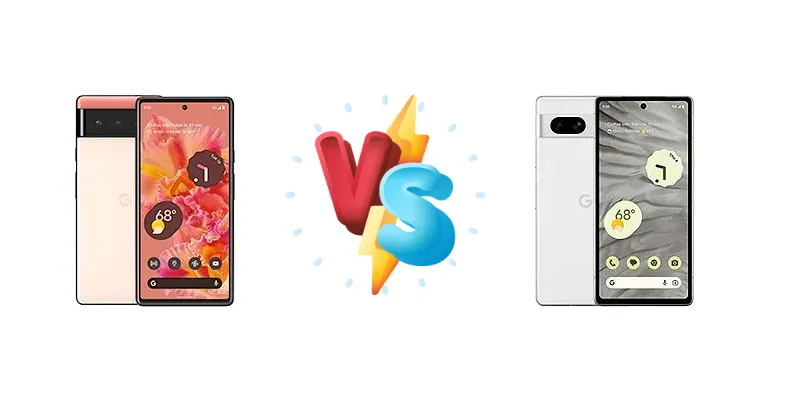
|
🏆 Quick Verdict
The Pixel 7a emerges as the winner, offering a brighter display, improved performance thanks to the Tensor G2, and faster charging, all at a competitive price. While the Pixel 6 boasts a slightly longer endurance rating, the 7a's upgrades make it the more compelling choice for most users.
| PHONES | ||
|---|---|---|
| Phone Names | Google Pixel 6 | Google Pixel 7a |
| Network | ||
|---|---|---|
| 2G bands | GSM 850 / 900 / 1800 / 1900 | GSM 850 / 900 / 1800 / 1900 |
| 3G bands | HSDPA 800 / 850 / 900 / 1700(AWS) / 1900 / 2100 | HSDPA 800 / 850 / 900 / 1700(AWS) / 1900 / 2100 |
| 4G bands | 1, 2, 3, 4, 5, 7, 8, 12, 13, 14, 17, 18, 19, 20, 25, 26, 28, 29, 30, 32, 38, 39, 40, 41, 42, 46, 48, 66, 71 - GB7N6, G9S9B16 | 1, 2, 3, 4, 5, 7, 8, 12, 13, 14, 17, 20, 25, 26, 28, 29, 30, 38, 40, 41, 48, 66, 71 - GWKK3, G0DZQ |
| 5G bands | 1, 2, 3, 5, 7, 8, 12, 14, 20, 25, 28, 30, 38, 40, 41, 48, 66, 71, 77, 78, 257, 258, 260, 261 SA/NSA/Sub6/mmWave - G9S9B | 1, 2, 3, 5, 7, 8, 12, 14, 20, 25, 28, 30, 38, 41, 48, 66, 71, 77, 78 SA/NSA/Sub6 - GWKK3 |
| Speed | HSPA, LTE, 5G | HSPA, LTE, 5G |
| Technology | GSM / CDMA / HSPA / EVDO / LTE / 5G | GSM / HSPA / LTE / 5G |
| 1, 2, 3, 5, 7, 8, 12, 14, 20, 25, 28, 30, 38, 40, 41, 48, 66, 71, 77, 78 SA/NSA/Sub6 - GB7N6 | 1, 2, 3, 5, 7, 8, 12, 20, 25, 28, 38, 40, 41, 66, 75, 76, 77, 78, 79 SA/NSA/Sub6 - GHL1X, G82U8 | |
| Launch | ||
|---|---|---|
| Announced | 2021, October 19 | 2023, May 10 |
| Status | Available. Released 2021, October 28 | Available. Released 2023, May 10 |
| Body | ||
|---|---|---|
| Build | Glass front (Gorilla Glass Victus), glass back (Gorilla Glass 6), aluminum frame | Glass front (Gorilla Glass 3), aluminum frame, plastic back |
| Dimensions | 158.6 x 74.8 x 8.9 mm (6.24 x 2.94 x 0.35 in) | 152 x 72.9 x 9 mm (5.98 x 2.87 x 0.35 in) |
| SIM | Nano-SIM + eSIM | Nano-SIM + eSIM |
| Weight | 207 g (7.30 oz) | 193.5 g (6.84 oz) |
| IP68 dust/water resistant (up to 1.5m for 30 min) | IP67 dust/water resistant (up to 1m for 30 min) | |
| Display | ||
|---|---|---|
| Protection | Corning Gorilla Glass Victus | Corning Gorilla Glass 3 |
| Resolution | 1080 x 2400 pixels, 20:9 ratio (~411 ppi density) | 1080 x 2400 pixels, 20:9 ratio (~429 ppi density) |
| Size | 6.4 inches, 98.9 cm2 (~83.4% screen-to-body ratio) | 6.1 inches, 90.7 cm2 (~81.8% screen-to-body ratio) |
| Type | AMOLED, 90Hz, HDR10+ | OLED, HDR, 90Hz |
| Always-on display | Always-on display | |
| Platform | ||
|---|---|---|
| CPU | Octa-core (2x2.80 GHz Cortex-X1 & 2x2.25 GHz Cortex-A76 & 4x1.80 GHz Cortex-A55) | Octa-core (2x2.85 GHz Cortex-X1 & 2x2.35 GHz Cortex-A78 & 4x1.80 GHz Cortex-A55) |
| Chipset | Google Tensor (5 nm) | Google Tensor G2 (5 nm) |
| GPU | Mali-G78 MP20 | Mali-G710 MP7 |
| OS | Android 12, upgradable to Android 15, up to 5 major Android upgrades | Android 13, upgradable to Android 15, up to 5 major Android upgrades |
| Memory | ||
|---|---|---|
| Card slot | No | No |
| Internal | 128GB 8GB RAM, 256GB 8GB RAM | 128GB 8GB RAM |
| UFS 3.1 | UFS 3.1 | |
| Main Camera | ||
|---|---|---|
| Dual | 50 MP, f/1.9, 25mm (wide), 1/1.31", 1.2µm, dual pixel PDAF, OIS 12 MP, f/2.2, 17mm, 114˚ (ultrawide), 1.25µm | 64 MP, f/1.9, 26mm (wide), 1/1.73", 0.8µm, dual pixel PDAF, OIS 13 MP, f/2.2, 120˚ (ultrawide), 1.12µm |
| Features | Laser AF, Dual-LED flash, Pixel Shift, Auto-HDR, panorama | Dual-LED flash, Pixel Shift, Auto-HDR, panorama |
| Single | 8 MP, f/2.0, 24mm (wide), 1.12µm | - |
| Video | 4K@30/60fps, 1080p@30/60/120/240fps; gyro-EIS, OIS | 4K@30/60fps, 1080p@30/60/120/240fps, OIS |
| Selfie camera | ||
|---|---|---|
| Features | HDR, panorama | HDR, panorama |
| Single | 8 MP, f/2.0, 24mm (wide), 1.12µm | 13 MP, f/2.2, 20mm (ultrawide), 1.12µm |
| Video | 1080p@30fps | 4K@30fps, 1080p@30fps |
| Sound | ||
|---|---|---|
| 3.5mm jack | No | No |
| 35mm jack | No | No |
| Loudspeaker | Yes, with stereo speakers | Yes, with stereo speakers |
| Comms | ||
|---|---|---|
| Bluetooth | 5.2, A2DP, LE, aptX HD | 5.3, A2DP, LE |
| NFC | Yes | Yes |
| Positioning | GPS (L1+L5), GLONASS (G1), BDS (B1I+B1c+B2a), GALILEO (E1+E5a), QZSS (L1+L5) | GPS, GLONASS, GALILEO, BDS, QZSS, NavIC |
| Radio | No | No |
| USB | USB Type-C 3.1 | USB Type-C 3.2 |
| WLAN | Wi-Fi 802.11 a/b/g/n/ac/6e, dual-band, Wi-Fi Direct | Wi-Fi 802.11 a/b/g/n/ac/6e, tri-band |
| Features | ||
|---|---|---|
| Sensors | Fingerprint (under display, optical), accelerometer, gyro, proximity, compass, barometer | Fingerprint (under display, optical), accelerometer, gyro, proximity, compass, barometer |
| Battery | ||
|---|---|---|
| Charging | Wired (based on 30W charger), PD3.0, 50% in 30 min 21W wireless Reverse wireless | 18W wired, PD3.0 7.5W wireless |
| Type | Li-Ion 4614 mAh | Li-Po 4385 mAh |
| Misc | ||
|---|---|---|
| Colors | Sorta Seafoam, Kinda Coral, Stormy Black | Charcoal, Snow, Sea, Coral |
| Models | GB7N6, G9S9B16, G9S9B, GR1YH | GWKK3, GHL1X, G0DZQ, G82U8 |
| Price | $ 172.48 / C$ 238.84 / £ 169.99 / € 191.89 / ₹ 23,719 | € 179.90 / $ 150.00 / £ 170.00 / ₹ 25,980 |
| Tests | ||
|---|---|---|
| Battery life | Endurance rating 86h | - |
| Camera | Photo / Video | - |
| Display | Contrast ratio: Infinite (nominal) | - |
| Loudspeaker | -26.9 LUFS (Good) | - |
| Performance | AnTuTu: 676831 (v9) GeekBench: 2899 (v5.1) GFXBench: 57fps (ES 3.1 onscreen) | - |
Google Pixel 6
- Larger display
- Slightly longer battery life (endurance rating)
- Potentially lower price on the used market
- Older chipset
- Slower charging
- Lower display brightness
Google Pixel 7a
- Brighter display
- Faster performance (Tensor G2)
- Faster charging
- More modern design
- Competitive price
- Slightly shorter battery life (endurance rating)
Display Comparison
The Pixel 7a takes a clear lead in the display department. While the Pixel 6's 'infinite' contrast ratio is a marketing term, the 7a's measured 1070 nits peak brightness provides significantly better visibility in outdoor conditions. Both offer excellent color accuracy, but the 7a's brightness is a noticeable advantage.
Camera Comparison
Both Pixels excel in camera performance, thanks to Google's computational photography prowess. The Pixel 7a benefits from software enhancements and potentially slightly improved sensors, resulting in consistently excellent image quality. Both offer impressive video recording capabilities, but the 7a may have a slight edge in dynamic range.
Performance
The Pixel 7a's Tensor G2 chip offers a performance bump over the Pixel 6's Tensor. While both phones handle everyday tasks with ease, the 7a demonstrates smoother multitasking and slightly faster app loading times. The Cortex-X1 core is clocked slightly higher on the 7a, and the move to Cortex-A78 cores contributes to the improved efficiency.
Battery Life
The Pixel 6 holds a slight advantage in battery endurance, with an 86h rating compared to the 7a's 76h. However, the Pixel 7a's faster 18W wired charging (vs. the Pixel 6's 21W) helps offset this difference. Wireless charging speeds are also faster on the 7a (7.5W vs 21W).
Buying Guide
The Google Pixel 6 is a good choice for those seeking a larger screen and slightly longer battery life, and who might find a good deal on a refurbished model. The Pixel 7a is ideal for users prioritizing a vibrant display, faster performance, and a more modern design, especially those on a tighter budget.