
Google Pixel 6 vs Pixel 7: A Detailed Comparison
| Phones Images | |||||
|---|---|---|---|---|---|
|
🏆 Quick Verdict
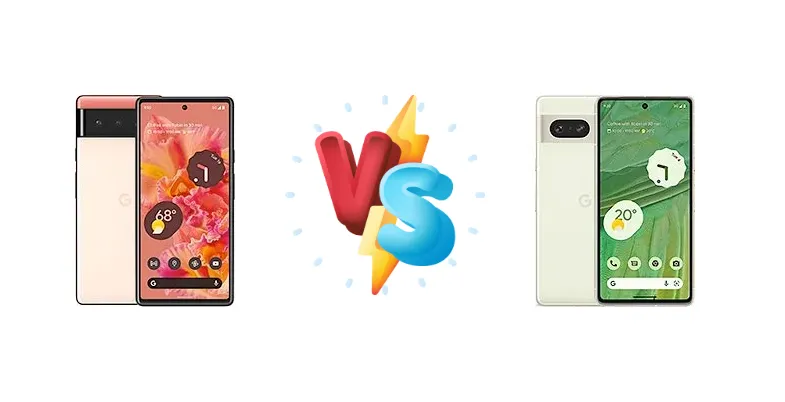
The Pixel 7 offers incremental but meaningful upgrades over the Pixel 6, including a brighter display, slightly improved performance, and a longer-lasting battery. While the Pixel 6 remains a capable device, the Pixel 7 is the clear winner for those seeking the latest and greatest from Google.
| PHONES | ||
|---|---|---|
| Phone Names | Google Pixel 6 | Google Pixel 7 |
| Network | ||
|---|---|---|
| 2G bands | GSM 850 / 900 / 1800 / 1900 | GSM 850 / 900 / 1800 / 1900 |
| 3G bands | HSDPA 800 / 850 / 900 / 1700(AWS) / 1900 / 2100 | HSDPA 800 / 850 / 900 / 1700(AWS) / 1900 / 2100 |
| 4G bands | 1, 2, 3, 4, 5, 7, 8, 12, 13, 14, 17, 18, 19, 20, 25, 26, 28, 29, 30, 32, 38, 39, 40, 41, 42, 46, 48, 66, 71 - GB7N6, G9S9B16 | 1, 2, 3, 4, 5, 7, 8, 12, 13, 14, 17, 18, 19, 20, 25, 26, 28, 29, 30, 38, 40, 41, 42, 46, 48, 66, 71 - GQML3 |
| 5G bands | 1, 2, 3, 5, 7, 8, 12, 14, 20, 25, 28, 30, 38, 40, 41, 48, 66, 71, 77, 78, 257, 258, 260, 261 SA/NSA/Sub6/mmWave - G9S9B | 1, 2, 3, 4, 5, 7, 8, 12, 13, 14, 17, 18, 19, 20, 25, 26, 28, 29, 30, 38, 40, 41, 46, 48, 66, 71, 260, 261 SA/NSA/Sub6/mmWave - GQML3 |
| Speed | HSPA, LTE, 5G | HSPA, LTE, 5G |
| Technology | GSM / CDMA / HSPA / EVDO / LTE / 5G | GSM / CDMA / HSPA / EVDO / LTE / 5G |
| 1, 2, 3, 5, 7, 8, 12, 14, 20, 25, 28, 30, 38, 40, 41, 48, 66, 71, 77, 78 SA/NSA/Sub6 - GB7N6 | 1, 2, 3, 5, 7, 8, 12, 14, 20, 25, 28, 30, 38, 40, 41, 48, 66, 71, 75, 76, 77, 78 SA/NSA/Sub6 - GVU6C | |
| Launch | ||
|---|---|---|
| Announced | 2021, October 19 | 2022, October 06 |
| Status | Available. Released 2021, October 28 | Available. Released 2022, October 13 |
| Body | ||
|---|---|---|
| Build | Glass front (Gorilla Glass Victus), glass back (Gorilla Glass 6), aluminum frame | Glass front (Gorilla Glass Victus), glass back (Gorilla Glass Victus), aluminum frame |
| Dimensions | 158.6 x 74.8 x 8.9 mm (6.24 x 2.94 x 0.35 in) | 155.6 x 73.2 x 8.7 mm (6.13 x 2.88 x 0.34 in) |
| SIM | Nano-SIM + eSIM | Nano-SIM + eSIM |
| Weight | 207 g (7.30 oz) | 197 g (6.95 oz) |
| IP68 dust/water resistant (up to 1.5m for 30 min) | IP68 dust/water resistant (up to 1.5m for 30 min) | |
| Display | ||
|---|---|---|
| Protection | Corning Gorilla Glass Victus | Corning Gorilla Glass Victus |
| Resolution | 1080 x 2400 pixels, 20:9 ratio (~411 ppi density) | 1080 x 2400 pixels, 20:9 ratio (~416 ppi density) |
| Size | 6.4 inches, 98.9 cm2 (~83.4% screen-to-body ratio) | 6.3 inches, 96.7 cm2 (~84.9% screen-to-body ratio) |
| Type | AMOLED, 90Hz, HDR10+ | AMOLED, 90Hz, HDR10+, 1000 nits (HBM), 1400 nits (peak) |
| Always-on display | Always-on display | |
| Platform | ||
|---|---|---|
| CPU | Octa-core (2x2.80 GHz Cortex-X1 & 2x2.25 GHz Cortex-A76 & 4x1.80 GHz Cortex-A55) | Octa-core (2x2.85 GHz Cortex-X1 & 2x2.35 GHz Cortex-A78 & 4x1.80 GHz Cortex-A55) |
| Chipset | Google Tensor (5 nm) | Google Tensor G2 (5 nm) |
| GPU | Mali-G78 MP20 | Mali-G710 MP7 |
| OS | Android 12, upgradable to Android 15, up to 5 major Android upgrades | Android 13, upgradable to Android 15, up to 5 major Android upgrades |
| Memory | ||
|---|---|---|
| Card slot | No | No |
| Internal | 128GB 8GB RAM, 256GB 8GB RAM | 128GB 8GB RAM, 256GB 8GB RAM |
| UFS 3.1 | UFS 3.1 | |
| Main Camera | ||
|---|---|---|
| Dual | 50 MP, f/1.9, 25mm (wide), 1/1.31", 1.2µm, dual pixel PDAF, OIS 12 MP, f/2.2, 17mm, 114˚ (ultrawide), 1.25µm | 50 MP, f/1.9, 25mm (wide), 1/1.31", 1.2µm, dual pixel PDAF, OIS 12 MP, f/2.2, 114˚ (ultrawide), 1/2.9", 1.25µm |
| Features | Laser AF, Dual-LED flash, Pixel Shift, Auto-HDR, panorama | Laser AF, Dual-LED flash, Pixel Shift, Auto-HDR, panorama |
| Single | 8 MP, f/2.0, 24mm (wide), 1.12µm | 10.8 MP, f/2.2, 21mm (ultrawide), 1/3.1", 1.22µm |
| Video | 4K@30/60fps, 1080p@30/60/120/240fps; gyro-EIS, OIS | 4K@30/60fps, 1080p@30/60/120/240fps; gyro-EIS, OIS, 10-bit HDR |
| Selfie camera | ||
|---|---|---|
| Features | HDR, panorama | HDR, panorama |
| Single | 8 MP, f/2.0, 24mm (wide), 1.12µm | 10.8 MP, f/2.2, 21mm (ultrawide), 1/3.1", 1.22µm |
| Video | 1080p@30fps | 4K@30/60fps, 1080p@30/60fps |
| Sound | ||
|---|---|---|
| 3.5mm jack | No | No |
| 35mm jack | No | No |
| Loudspeaker | Yes, with stereo speakers | Yes, with stereo speakers |
| Comms | ||
|---|---|---|
| Bluetooth | 5.2, A2DP, LE, aptX HD | 5.2, A2DP, LE, aptX HD |
| NFC | Yes | Yes |
| Positioning | GPS (L1+L5), GLONASS (G1), BDS (B1I+B1c+B2a), GALILEO (E1+E5a), QZSS (L1+L5) | GPS (L1+L5), GLONASS (G1), BDS (B1I+B1c+B2a), GALILEO (E1+E5a), QZSS (L1+L5) |
| Radio | No | No |
| USB | USB Type-C 3.1 | USB Type-C 3.2 |
| WLAN | Wi-Fi 802.11 a/b/g/n/ac/6e, dual-band, Wi-Fi Direct | Wi-Fi 802.11 a/b/g/n/ac/6e, tri-band, Wi-Fi Direct |
| Features | ||
|---|---|---|
| Sensors | Fingerprint (under display, optical), accelerometer, gyro, proximity, compass, barometer | Fingerprint (under display, optical), accelerometer, gyro, proximity, compass, barometer |
| Battery | ||
|---|---|---|
| Charging | Wired (based on 30W charger), PD3.0, 50% in 30 min 21W wireless Reverse wireless | 20W wired, PD3.0, 50% in 30 min 20W wireless Reverse wireless |
| Type | Li-Ion 4614 mAh | Li-Ion 4355 mAh |
| Misc | ||
|---|---|---|
| Colors | Sorta Seafoam, Kinda Coral, Stormy Black | Obsidian, Lemongrass, Snow |
| Models | GB7N6, G9S9B16, G9S9B, GR1YH | GVU6C, GQML3, GO3Z5 |
| Price | $ 172.48 / C$ 238.84 / £ 169.99 / € 191.89 / ₹ 23,719 | € 199.00 / $ 179.26 / £ 189.99 / ₹ 28,499 |
| Tests | ||
|---|---|---|
| Battery life | Endurance rating 86h | Endurance rating 96h |
| Camera | Photo / Video | Photo / Video |
| Display | Contrast ratio: Infinite (nominal) | Contrast ratio: Infinite (nominal) |
| Loudspeaker | -26.9 LUFS (Good) | -26.2 LUFS (Good) |
| Performance | AnTuTu: 676831 (v9) GeekBench: 2899 (v5.1) GFXBench: 57fps (ES 3.1 onscreen) | AnTuTu: 813114 (v9) GeekBench: 3288 (v5.1) GFXBench: 59fps (ES 3.1 onscreen) |
Google Pixel 6
- Excellent camera
- Clean Android experience
- Competitive price (now)
- Reverse wireless charging
- Slower charging speeds
- Less bright display
- Older chipset
- Battery life could be better
Google Pixel 7
- Brighter display
- Improved performance (Tensor G2)
- Longer battery life
- Refined design
- Enhanced camera features (Super Res Zoom, Photo Unblur)
- Higher price
- Charging speeds remain relatively slow
- Tensor G2 still has thermal limitations
Display Comparison
The Pixel 7 boasts a significant upgrade in display brightness, reaching 974 nits compared to the Pixel 6's unspecified (but likely lower) brightness. Both offer excellent contrast with their 'Infinite' contrast ratio (nominal), but the Pixel 7's increased brightness makes it more usable outdoors. The Pixel 7 also has a slightly smaller display size (6.3 inches vs 6.4 inches).
Camera Comparison
Both Pixels excel in photography, thanks to Google's computational photography prowess. The Pixel 7 introduces improvements to Super Res Zoom and Photo Unblur. Both have a 50MP main sensor and a 12MP ultrawide. Video recording capabilities are comparable, offering excellent stabilization and dynamic range. The Pixel 7's camera processing is slightly more refined.
Performance
Both phones utilize the Google Tensor chipset, but the Pixel 7 features the Tensor G2, offering a modest performance boost. The Cortex-X1 core clock speed is slightly higher on the Pixel 7 (2.85 GHz vs 2.80 GHz), and the A78 core is also faster. While day-to-day usage will feel similar, the Pixel 7 handles demanding tasks and games slightly better. Both phones have 8GB of RAM.
Battery Life
The Pixel 7 demonstrates a noticeable improvement in battery life, achieving an endurance rating of 96 hours compared to the Pixel 6's 86 hours. While both support 20W wireless charging and reverse wireless charging, the Pixel 7's larger battery provides more longevity throughout the day.
Buying Guide
Who should buy the Google Pixel 6? Those on a tighter budget who still want a fantastic camera and a smooth Android experience. Who should buy the Google Pixel 7? Users seeking a brighter display, slightly faster performance, and improved battery life, and who appreciate the refined design.