
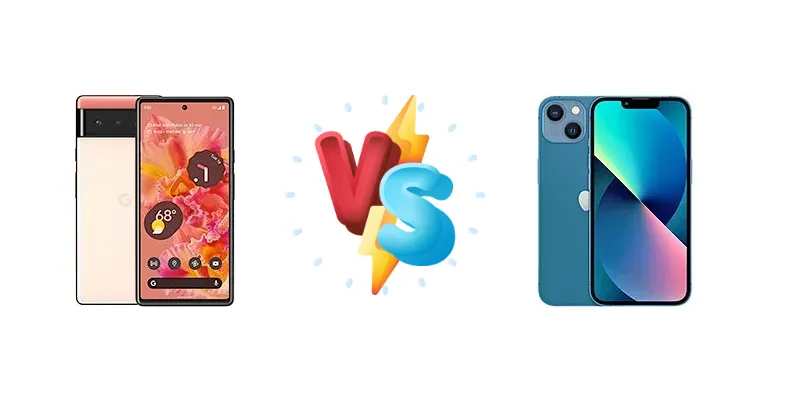
Google Pixel 6 vs. iPhone 13: A Detailed Comparison of Flagship Rivals
| Phones Images | |||||
|---|---|---|---|---|---|
|
🏆 Quick Verdict
For the average user prioritizing consistent performance and a refined ecosystem, the iPhone 13 emerges as the winner. Its A15 Bionic chip offers a slight edge in sustained performance, and the iOS experience is known for its stability. However, the Pixel 6’s innovative camera features and lower price point make it a compelling alternative for Android enthusiasts.
| PHONES | ||
|---|---|---|
| Phone Names | Google Pixel 6 | Apple iPhone 13 |
| Network | ||
|---|---|---|
| 2G bands | GSM 850 / 900 / 1800 / 1900 | GSM 850 / 900 / 1800 / 1900 |
| 3G bands | HSDPA 800 / 850 / 900 / 1700(AWS) / 1900 / 2100 | HSDPA 850 / 900 / 1700(AWS) / 1900 / 2100 |
| 4G bands | 1, 2, 3, 4, 5, 7, 8, 12, 13, 14, 17, 18, 19, 20, 25, 26, 28, 29, 30, 32, 38, 39, 40, 41, 42, 46, 48, 66, 71 - GB7N6, G9S9B16 | 1, 2, 3, 4, 5, 7, 8, 12, 13, 17, 18, 19, 20, 25, 26, 28, 30, 32, 34, 38, 39, 40, 41, 42, 46, 48, 66 - A2633, A2634, A2635 |
| 5G bands | 1, 2, 3, 5, 7, 8, 12, 14, 20, 25, 28, 30, 38, 40, 41, 48, 66, 71, 77, 78, 257, 258, 260, 261 SA/NSA/Sub6/mmWave - G9S9B | 1, 2, 3, 5, 7, 8, 12, 20, 25, 28, 29, 30, 38, 40, 41, 48, 66, 71, 77, 78, 79 Sub6/mmWave - A2633 |
| Speed | HSPA, LTE, 5G | HSPA, LTE, 5G, EV-DO Rev.A 3.1 Mbps |
| Technology | GSM / CDMA / HSPA / EVDO / LTE / 5G | GSM / CDMA / HSPA / EVDO / LTE / 5G |
| 1, 2, 3, 5, 7, 8, 12, 14, 20, 25, 28, 30, 38, 40, 41, 48, 66, 71, 77, 78 SA/NSA/Sub6 - GB7N6 | 1, 2, 3, 5, 7, 8, 12, 20, 25, 28, 30, 38, 40, 41, 48, 66, 77, 78, 79 SA/NSA/Sub6 - A2634, A2635 | |
| Launch | ||
|---|---|---|
| Announced | 2021, October 19 | 2021, September 14 |
| Status | Available. Released 2021, October 28 | Available. Released 2021, September 24 |
| Body | ||
|---|---|---|
| Build | Glass front (Gorilla Glass Victus), glass back (Gorilla Glass 6), aluminum frame | Glass front, glass back, aluminum frame |
| Dimensions | 158.6 x 74.8 x 8.9 mm (6.24 x 2.94 x 0.35 in) | 146.7 x 71.5 x 7.7 mm (5.78 x 2.81 x 0.30 in) |
| SIM | Nano-SIM + eSIM | · Nano-SIM + eSIM· Nano-SIM + Nano-SIM |
| Weight | 207 g (7.30 oz) | 174 g (6.14 oz) |
| IP68 dust/water resistant (up to 1.5m for 30 min) | IP68 dust/water resistant (up to 6m for 30 min) Apple Pay (Visa, MasterCard, AMEX certified) | |
| Display | ||
|---|---|---|
| Protection | Corning Gorilla Glass Victus | Ceramic Shield glass |
| Resolution | 1080 x 2400 pixels, 20:9 ratio (~411 ppi density) | 1170 x 2532 pixels, 19.5:9 ratio (~460 ppi density) |
| Size | 6.4 inches, 98.9 cm2 (~83.4% screen-to-body ratio) | 6.1 inches, 90.2 cm2 (~86.0% screen-to-body ratio) |
| Type | AMOLED, 90Hz, HDR10+ | Super Retina XDR OLED, HDR10, Dolby Vision, 800 nits (HBM), 1200 nits (peak) |
| Always-on display | - | |
| Platform | ||
|---|---|---|
| CPU | Octa-core (2x2.80 GHz Cortex-X1 & 2x2.25 GHz Cortex-A76 & 4x1.80 GHz Cortex-A55) | Hexa-core (2x3.23 GHz Avalanche + 4x1.82 GHz Blizzard) |
| Chipset | Google Tensor (5 nm) | Apple A15 Bionic (5 nm) |
| GPU | Mali-G78 MP20 | Apple GPU (4-core graphics) |
| OS | Android 12, upgradable to Android 15, up to 5 major Android upgrades | iOS 15, upgradable to iOS 26.1 |
| Memory | ||
|---|---|---|
| Card slot | No | No |
| Internal | 128GB 8GB RAM, 256GB 8GB RAM | 128GB 4GB RAM, 256GB 4GB RAM, 512GB 4GB RAM |
| UFS 3.1 | NVMe | |
| Main Camera | ||
|---|---|---|
| Dual | 50 MP, f/1.9, 25mm (wide), 1/1.31", 1.2µm, dual pixel PDAF, OIS 12 MP, f/2.2, 17mm, 114˚ (ultrawide), 1.25µm | 12 MP, f/1.6, 26mm (wide), 1/1.9", 1.7µm, dual pixel PDAF, sensor-shift OIS 12 MP, f/2.4, 120˚, 13mm (ultrawide), 1/3.4", 1.0µm |
| Features | Laser AF, Dual-LED flash, Pixel Shift, Auto-HDR, panorama | Dual-LED dual-tone flash, HDR (photo/panorama) |
| Single | 8 MP, f/2.0, 24mm (wide), 1.12µm | 12 MP, f/2.2, 23mm (wide), 1/3.6" SL 3D, (depth/biometrics sensor) |
| Video | 4K@30/60fps, 1080p@30/60/120/240fps; gyro-EIS, OIS | 4K@24/25/30/60fps, 1080p@25/30/60/120/240fps, HDR, Dolby Vision HDR (up to 60fps), stereo sound rec. |
| Selfie camera | ||
|---|---|---|
| Features | HDR, panorama | HDR |
| Single | 8 MP, f/2.0, 24mm (wide), 1.12µm | 12 MP, f/2.2, 23mm (wide), 1/3.6", 1.0µm SL 3D, (depth/biometrics sensor) |
| Video | 1080p@30fps | 4K@24/25/30/60fps, 1080p@25/30/60/120fps, gyro-EIS |
| Sound | ||
|---|---|---|
| 3.5mm jack | No | No |
| 35mm jack | No | No |
| Loudspeaker | Yes, with stereo speakers | Yes, with stereo speakers |
| Comms | ||
|---|---|---|
| Bluetooth | 5.2, A2DP, LE, aptX HD | 5.0, A2DP, LE |
| NFC | Yes | Yes |
| Positioning | GPS (L1+L5), GLONASS (G1), BDS (B1I+B1c+B2a), GALILEO (E1+E5a), QZSS (L1+L5) | GPS, GLONASS, GALILEO, BDS, QZSS |
| Radio | No | No |
| USB | USB Type-C 3.1 | Lightning, USB 2.0 |
| WLAN | Wi-Fi 802.11 a/b/g/n/ac/6e, dual-band, Wi-Fi Direct | Wi-Fi 802.11 a/b/g/n/ac/6, dual-band, hotspot |
| Features | ||
|---|---|---|
| Sensors | Fingerprint (under display, optical), accelerometer, gyro, proximity, compass, barometer | Face ID, accelerometer, gyro, proximity, compass, barometer |
| - | Ultra Wideband (UWB) support | |
| Battery | ||
|---|---|---|
| Charging | Wired (based on 30W charger), PD3.0, 50% in 30 min 21W wireless Reverse wireless | Wired, PD2.0, 50% in 30 min 15W wireless (MagSafe) 15W wireless (Qi2) - requires iOS 17.2 update |
| Type | Li-Ion 4614 mAh | Li-Ion 3240 mAh (12.41 Wh) |
| Misc | ||
|---|---|---|
| Colors | Sorta Seafoam, Kinda Coral, Stormy Black | Starlight, Midnight, Blue, Pink, Red, Green |
| Models | GB7N6, G9S9B16, G9S9B, GR1YH | A2633, A2482, A2631, A2634, A2635, iphone14,5 |
| Price | $ 172.48 / C$ 238.84 / £ 169.99 / € 191.89 / ₹ 23,719 | € 304.00 / $ 249.97 / £ 248.00 |
| SAR | - | 1.18 W/kg (head) 1.19 W/kg (body) |
| SAR EU | - | 0.99 W/kg (head) 0.98 W/kg (body) |
| Tests | ||
|---|---|---|
| Battery life | Endurance rating 86h | Endurance rating 89h |
| Camera | Photo / Video | Photo / Video |
| Display | Contrast ratio: Infinite (nominal) | Contrast ratio: Infinite (nominal) |
| Loudspeaker | -26.9 LUFS (Good) | -25.5 LUFS (Very good) |
| Performance | AnTuTu: 676831 (v9) GeekBench: 2899 (v5.1) GFXBench: 57fps (ES 3.1 onscreen) | AnTuTu: 775519 (v9) GeekBench: 4645 (v5.1) GFXBench: 59fps (ES 3.1 onscreen) |
Google Pixel 6
- Exceptional computational photography and AI features
- Clean Android experience with guaranteed updates
- Competitive price point offering excellent value
- Performance slightly behind the iPhone 13 in demanding tasks
- Charging speed, while fast, isn't class-leading
Apple iPhone 13
- Industry-leading performance with the A15 Bionic chip
- Seamless iOS ecosystem and long-term software support
- Bright and accurate display for excellent viewing experience
- Higher price compared to the Pixel 6
- Less customization options compared to Android
Display Comparison
Both the Pixel 6 and iPhone 13 feature displays with an infinite (nominal) contrast ratio, ensuring deep blacks and vibrant colors. However, the iPhone 13 boasts a measured peak brightness of 802 nits, significantly exceeding what’s available on the Pixel 6 (data unavailable, but typically lower than iPhone). This translates to better visibility in direct sunlight. While both utilize OLED technology, the iPhone 13’s higher brightness and color accuracy provide a more visually striking experience, particularly for media consumption. The Pixel 6’s display, while excellent, doesn’t quite match the iPhone 13’s in terms of raw brightness.
Camera Comparison
Both phones are capable of capturing excellent photos and videos, but they approach it differently. The Pixel 6 leverages Google’s computational photography prowess, excelling in dynamic range and low-light performance. The iPhone 13, while also offering excellent image quality, leans towards more natural color reproduction. Both phones offer video recording capabilities, but the Pixel 6’s features like Magic Eraser and Motion Mode provide unique editing options. Without specific sensor size data for the Pixel 6, it’s difficult to make a direct comparison, but Google’s software processing is a key differentiator. The iPhone 13’s video stabilization is also notably strong.
Performance
The core of the performance difference lies in the chipsets. The iPhone 13’s A15 Bionic, a hexa-core processor with 2x3.23 GHz Avalanche and 4x1.82 GHz Blizzard cores, consistently outperforms the Pixel 6’s Google Tensor in benchmark tests. The Tensor, an octa-core chip (2x2.80 GHz Cortex-X1, 2x2.25 GHz Cortex-A76, 4x1.80 GHz Cortex-A55), focuses on AI and machine learning tasks. While the Tensor excels in these areas, the A15 Bionic maintains a lead in CPU and GPU-intensive applications. Both are built on a 5nm process, but Apple’s chip design and optimization give it an edge in sustained performance and thermal management. The iPhone 13 will likely exhibit less throttling during prolonged gaming sessions.
Battery Life
Both the Pixel 6 and iPhone 13 achieve an endurance rating of approximately 89 hours, indicating similar overall battery life. However, the charging speeds differ. The Pixel 6 supports 30W wired charging (PD3.0) and can reach 50% charge in 30 minutes, alongside 21W wireless and reverse wireless charging. The iPhone 13 supports wired charging via PD2.0, also reaching 50% in 30 minutes, but offers 15W wireless charging via MagSafe and Qi2 (requiring iOS 17.2). While the endurance ratings are close, the Pixel 6’s faster wired charging and reverse wireless capabilities offer more flexibility.
Buying Guide
Buy the Google Pixel 6 if you need a smartphone with exceptional computational photography capabilities, a clean Android experience, and value for money. Its Tensor chip excels at on-device AI tasks, enhancing features like voice recognition and image processing. Buy the Apple iPhone 13 if you prefer a seamless user experience, industry-leading performance, and a robust app ecosystem. The A15 Bionic delivers consistently fast performance, and iOS offers long-term software support.