
Google Pixel 5 vs OnePlus 8T: A Detailed Comparison of Mid-Range Powerhouses
| Phones Images | |||||
|---|---|---|---|---|---|
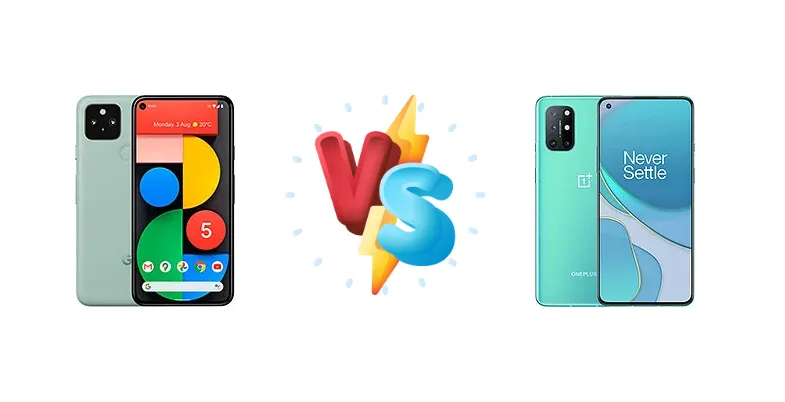
|
🏆 Quick Verdict
For most users, the OnePlus 8T offers a more compelling package. Its Snapdragon 865 chipset delivers noticeably faster performance, and the 65W charging is a game-changer. However, the Pixel 5 remains a strong contender for those deeply invested in the Google ecosystem and prioritizing software simplicity.
| PHONES | ||
|---|---|---|
| Phone Names | Google Pixel 5 | OnePlus 8T |
| Network | ||
|---|---|---|
| 2G bands | GSM 850 / 900 / 1800 / 1900 | GSM 850 / 900 / 1800 / 1900 |
| 3G bands | HSDPA 850 / 900 / 1700(AWS) / 1900 / 2100 | HSDPA 800 / 850 / 900 / 1700(AWS) / 1800 / 1900 / 2100 |
| 4G bands | 1, 2, 3, 4, 5, 7, 8, 12, 13, 14, 17, 18, 19, 20, 25, 26, 28, 29, 30, 32, 38, 39, 40, 41, 42, 46, 48, 66, 71 | 1, 2, 3, 4, 5, 7, 8, 12, 13, 17, 18, 19, 20, 25, 26, 28, 32, 34, 38, 39, 40, 41, 42, 66 - EU |
| 5G bands | 1, 2, 3, 5, 7, 8, 12, 28, 41, 66, 71, 77, 78, 258, 260, 261 Sub6/mmWave - GD1YQ | 1, 3, 7, 28, 41, 78 SA/NSA - EU |
| Speed | HSPA, LTE, 5G | HSPA 42.2/5.76 Mbps, LTE (5CA) Cat18 1200/200 Mbps, 5G 7.5 Gbps DL |
| Technology | GSM / CDMA / HSPA / EVDO / LTE / 5G | GSM / CDMA / HSPA / LTE / 5G |
| 1, 2, 3, 5, 7, 8, 12, 28, 41, 66, 71, 77, 78 Sub6 - GTT9Q | 41, 78, 79 SA/NSA - CN | |
| Launch | ||
|---|---|---|
| Announced | 2020, September 30 | 2020, October 14 |
| Status | Available. Released 2020, October 15 | Available. Released 2020, October 16 |
| Body | ||
|---|---|---|
| Build | Glass front (Gorilla Glass 6), aluminum back, aluminum frame | Glass front (Gorilla Glass 5), glass back (Gorilla Glass 5), aluminum frame |
| Dimensions | 144.7 x 70.4 x 8 mm (5.70 x 2.77 x 0.31 in) | 160.7 x 74.1 x 8.4 mm (6.33 x 2.92 x 0.33 in) |
| SIM | Nano-SIM + eSIM | Nano-SIM + Nano-SIM |
| Weight | 151 g (5.33 oz) | 188 g (6.63 oz) |
| IP68 dust/water resistant (up to 1.5m for 30 min) | - | |
| Display | ||
|---|---|---|
| Protection | Corning Gorilla Glass 6 | Corning Gorilla Glass 5 |
| Resolution | 1080 x 2340 pixels, 19.5:9 ratio (~432 ppi density) | 1080 x 2400 pixels, 20:9 ratio (~402 ppi density) |
| Size | 6.0 inches, 87.6 cm2 (~85.9% screen-to-body ratio) | 6.55 inches, 103.6 cm2 (~87.0% screen-to-body ratio) |
| Type | OLED, 90Hz, HDR10+ | Fluid AMOLED, 120Hz, HDR10+ |
| Always-on display | Always-on display | |
| Platform | ||
|---|---|---|
| CPU | Octa-core (1x2.4 GHz Kryo 475 Prime & 1x2.2 GHz Kryo 475 Gold & 6x1.8 GHz Kryo 475 Silver) | Octa-core (1x2.84 GHz Cortex-A77 & 3x2.42 GHz Cortex-A77 & 4x1.80 GHz Cortex-A55) |
| Chipset | Qualcomm SM7250 Snapdragon 765G 5G (7 nm) | Qualcomm SM8250 Snapdragon 865 5G (7 nm+) |
| GPU | Adreno 620 | Adreno 650 |
| OS | Android 11, upgradable to Android 14 | Android 11, upgradable to Android 14, OxygenOS 14 |
| Memory | ||
|---|---|---|
| Card slot | No | No |
| Internal | 128GB 8GB RAM | 128GB 8GB RAM, 256GB 12GB RAM |
| UFS 2.1 | UFS 3.1 | |
| Main Camera | ||
|---|---|---|
| Dual | 12.2 MP, f/1.7, 27mm (wide), 1/2.55", 1.4µm, dual pixel PDAF, OIS 16 MP, f/2.2, 117˚ (ultrawide), 1.0µm | - |
| Features | LED flash, Pixel Shift, Auto-HDR, panorama | Dual-LED flash, HDR, panorama |
| Quad | - | 48 MP, f/1.7, 26mm (wide), 1/2.0", 0.8µm, PDAF, OIS 16 MP, f/2.2, 14mm, 123˚ (ultrawide), 1/3.6", 1.0µm 5 MP (macro) 2 MP, f/2.4, (monochrome) |
| Video | 4K@30/60fps, 1080p@30/60/120/240fps; gyro-EIS | 4K@30/60fps, 1080p@30/60/240fps, Auto HDR, gyro-EIS |
| Selfie camera | ||
|---|---|---|
| Features | HDR | HDR |
| Single | 8 MP, f/2.0, 24mm (wide), 1/4.0", 1.12µm | 16 MP, f/2.4, (wide), 1/3.06", 1.0µm |
| Video | 1080p@30fps | 1080p@30fps, gyro-EIS |
| Sound | ||
|---|---|---|
| 3.5mm jack | No | No |
| 35mm jack | No | No |
| Loudspeaker | Yes, with stereo speakers | Yes, with stereo speakers |
| Comms | ||
|---|---|---|
| Bluetooth | 5.0, A2DP, LE, aptX HD | 5.1, A2DP, LE, aptX HD |
| NFC | Yes | Yes |
| Positioning | GPS, GLONASS, GALILEO, QZSS, BDS | GPS (L1+L5), GLONASS (G1), BDS (B1), GALILEO (E1+E5a) |
| Radio | No | No |
| USB | USB Type-C 3.1 | USB Type-C 3.1, OTG |
| WLAN | Wi-Fi 802.11 a/b/g/n/ac, dual-band, Wi-Fi Direct | Wi-Fi 802.11 a/b/g/n/ac/6, dual-band, Wi-Fi Direct, DLNA |
| Features | ||
|---|---|---|
| Sensors | Fingerprint (rear-mounted), accelerometer, gyro, proximity, compass, barometer | Fingerprint (under display, optical), accelerometer, gyro, proximity, compass, barometer (market dependant) |
| Battery | ||
|---|---|---|
| Charging | 18W wired, PD2.0 12W wireless 5W reverse wired | 65W wired, 100% in 39 min |
| Type | Li-Po 4080 mAh | Li-Po 4500 mAh |
| Misc | ||
|---|---|---|
| Colors | Just Black, Sorta Sage | Aquamarine Green, Lunar Silver, Cyberpunk 2077 Edition |
| Models | GD1YQ, GTT9Q, G5NZ6 | KB2001, KB2000, KB2003, KB2005 |
| Price | € 181.31 / $ 272.44 / £ 136.00 | € 130.75 |
| Pricing | ||
|---|---|---|
| 128GB 8GB RAM | $ 194.84 | - |
| RENEWED | $ 253.00 | - |
| Tests | ||
|---|---|---|
| Battery life | Endurance rating 95h | Endurance rating 104h |
| Camera | - | Photo / Video |
| Display | Contrast ratio: Infinite (nominal) | Contrast ratio: Infinite (nominal) |
| Loudspeaker | - | -24.0 LUFS (Very good) |
| Performance | - | AnTuTu: 586000 (v8) GeekBench: 3126 (v5.1) GFXBench: 46fps (ES 3.1 onscreen) |
Google Pixel 5
- Clean and bloatware-free Android experience
- Excellent camera software and image processing
- More compact and pocketable design
- Less powerful processor compared to the OnePlus 8T
- Slower charging speeds (18W)
- Lower peak display brightness
OnePlus 8T
- Significantly faster processor (Snapdragon 865)
- Blazing-fast 65W charging
- Brighter and potentially smoother (120Hz) display
- OxygenOS, while improved, isn't as minimalist as Pixel's Android
- Larger form factor may not suit all users
- Potentially less consistent camera performance in challenging conditions
Display Comparison
The OnePlus 8T boasts a brighter display, reaching 802 nits compared to the Pixel 5’s 699 nits. This translates to better visibility outdoors under direct sunlight. Both displays share an 'Infinite' (nominal) contrast ratio, suggesting excellent black levels. While neither specifies refresh rate in the provided data, the 8T is known to have a 120Hz panel, offering smoother scrolling and animations, a feature absent on the Pixel 5. This difference significantly impacts the user experience, particularly for gaming and video consumption.
Camera Comparison
Both phones are capable of capturing quality photos and videos, but their approaches differ. The provided data doesn't detail sensor sizes, but the Pixel 5 is renowned for its exceptional image processing, leveraging Google’s computational photography algorithms. The OnePlus 8T, while capable, relies more on hardware. The 865’s image signal processor (ISP) is more advanced, potentially offering better dynamic range and detail in certain scenarios. However, the Pixel 5’s software optimizations often compensate for any hardware limitations, resulting in consistently pleasing images, particularly in challenging lighting conditions. The lack of detail on lens apertures makes a precise comparison difficult.
Performance
The core difference lies in the chipsets. The OnePlus 8T’s Snapdragon 865 (7nm+) is a significant step up from the Pixel 5’s Snapdragon 765G (7nm). The 865 features a more powerful Cortex-A77 prime core clocked at 2.84 GHz versus the Pixel 5’s 2.4 GHz Kryo 475 Prime. This, combined with the 865’s more advanced GPU, results in substantially faster performance in benchmarks and real-world applications. The 8T’s chipset is built on a 7nm+ process, offering slight efficiency gains over the Pixel 5’s 7nm node. While the Pixel 5’s 8GB of RAM is sufficient, the 865’s raw processing power will be more noticeable for demanding tasks.
Battery Life
The OnePlus 8T edges out the Pixel 5 in battery endurance with a rating of 104 hours versus 95 hours. This is partially offset by the Pixel 5’s more efficient chipset. However, the 8T’s 65W wired charging is a game-changer, achieving a full charge in just 39 minutes. The Pixel 5’s 18W charging is comparatively slow. The 8T also offers 12W wireless and 5W reverse wired charging, features the Pixel 5 also shares, but the charging speed disparity remains a significant advantage for the OnePlus device.
Buying Guide
Buy the Google Pixel 5 if you need a clean, bloatware-free Android experience with guaranteed timely updates, and value efficient performance over outright speed. It's ideal for users who prioritize photography with Google's computational prowess and prefer a more compact form factor. Buy the OnePlus 8T if you prefer a more powerful processor for demanding tasks like gaming, require incredibly fast charging, and appreciate a vibrant, high-brightness display. It's the better choice for power users and those who frequently consume multimedia.