
Google Pixel 5 vs LG V60 ThinQ 5G UW: A Detailed Performance and Value Comparison
| Phones Images | |||||
|---|---|---|---|---|---|
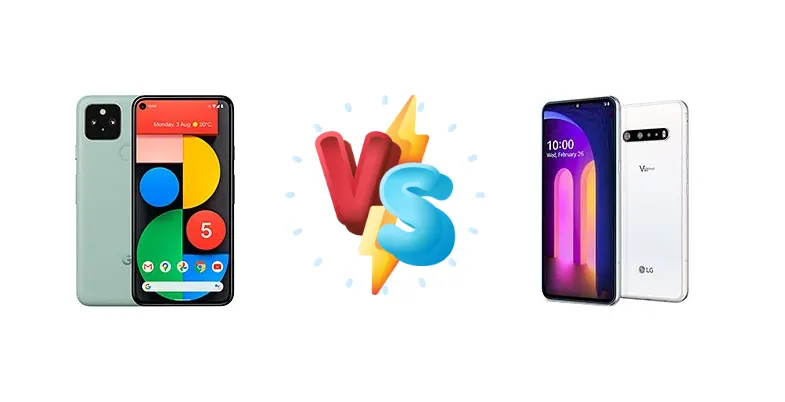
|
🏆 Quick Verdict
For the average user prioritizing software experience and consistent performance, the Google Pixel 5 is the better choice. While the LG V60 boasts a more powerful Snapdragon 865, the Pixel 5’s optimized software and excellent battery life offer a smoother, more reliable daily experience, especially given the current price difference.
| PHONES | ||
|---|---|---|
| Phone Names | Google Pixel 5 | LG V60 ThinQ 5G UW |
| Network | ||
|---|---|---|
| 2G bands | GSM 850 / 900 / 1800 / 1900 | GSM 850 / 900 / 1800 / 1900 |
| 3G bands | HSDPA 850 / 900 / 1700(AWS) / 1900 / 2100 | HSDPA 850 / 900 / 1700(AWS) / 1900 / 2100 |
| 4G bands | 1, 2, 3, 4, 5, 7, 8, 12, 13, 14, 17, 18, 19, 20, 25, 26, 28, 29, 30, 32, 38, 39, 40, 41, 42, 46, 48, 66, 71 | 2, 3, 4, 5, 7, 12, 13, 20, 28, 46, 48, 66 |
| 5G bands | 1, 2, 3, 5, 7, 8, 12, 28, 41, 66, 71, 77, 78, 258, 260, 261 Sub6/mmWave - GD1YQ | 260, 261 mmWave |
| Speed | HSPA, LTE, 5G | HSPA 42.2/5.76 Mbps, LTE (7CA) Cat22, 5G |
| Technology | GSM / CDMA / HSPA / EVDO / LTE / 5G | GSM / CDMA / HSPA / EVDO / LTE / 5G |
| 1, 2, 3, 5, 7, 8, 12, 28, 41, 66, 71, 77, 78 Sub6 - GTT9Q | CDMA2000 1xEV-DO | |
| Launch | ||
|---|---|---|
| Announced | 2020, September 30 | 2020, February 26. Released 2020, April 02 |
| Status | Available. Released 2020, October 15 | Discontinued |
| Body | ||
|---|---|---|
| Build | Glass front (Gorilla Glass 6), aluminum back, aluminum frame | Glass front (Gorilla Glass 5), glass back (Gorilla Glass 6), aluminum frame |
| Dimensions | 144.7 x 70.4 x 8 mm (5.70 x 2.77 x 0.31 in) | 169.3 x 77.6 x 8.9 mm (6.67 x 3.06 x 0.35 in) |
| SIM | Nano-SIM + eSIM | Nano-SIM (pre-installed) |
| Weight | 151 g (5.33 oz) | 218 g (7.69 oz) |
| IP68 dust/water resistant (up to 1.5m for 30 min) | IP68 dust/water resistant (up to 1.5m for 30 min) MIL-STD-810G compliant* Method 516.6, Procedure IV "Transit Drop" *does not guarantee ruggedness or use in extreme conditions | |
| Display | ||
|---|---|---|
| Protection | Corning Gorilla Glass 6 | Corning Gorilla Glass 5 |
| Resolution | 1080 x 2340 pixels, 19.5:9 ratio (~432 ppi density) | 1080 x 2460 pixels (~395 ppi density) |
| Size | 6.0 inches, 87.6 cm2 (~85.9% screen-to-body ratio) | 6.8 inches, 109.8 cm2 (~83.6% screen-to-body ratio) |
| Type | OLED, 90Hz, HDR10+ | P-OLED, HDR10+ |
| Always-on display | Always-on display | |
| Platform | ||
|---|---|---|
| CPU | Octa-core (1x2.4 GHz Kryo 475 Prime & 1x2.2 GHz Kryo 475 Gold & 6x1.8 GHz Kryo 475 Silver) | Octa-core (1x2.84 GHz Cortex-A77 & 3x2.42 GHz Cortex-A77 & 4x1.80 GHz Cortex-A55) |
| Chipset | Qualcomm SM7250 Snapdragon 765G 5G (7 nm) | Qualcomm SM8250 Snapdragon 865 5G (7 nm+) |
| GPU | Adreno 620 | Adreno 650 |
| OS | Android 11, upgradable to Android 14 | Android 10, upgradable to Android 13 |
| Memory | ||
|---|---|---|
| Card slot | No | microSDXC (uses shared SIM slot) - dual-SIM model |
| Internal | 128GB 8GB RAM | 128GB 8GB RAM |
| UFS 2.1 | UFS 2.1 | |
| Main Camera | ||
|---|---|---|
| Dual | 12.2 MP, f/1.7, 27mm (wide), 1/2.55", 1.4µm, dual pixel PDAF, OIS 16 MP, f/2.2, 117˚ (ultrawide), 1.0µm | 64 MP, f/1.8, 27mm (standard), 1/1.72", 0.8µm, dual pixel PDAF, OIS 13 MP, f/1.9, 12mm (ultrawide), 1/3.4", 1.0µm 0.3 MP, TOF 3D, f/1.4, (depth) |
| Features | LED flash, Pixel Shift, Auto-HDR, panorama | Dual-LED dual-tone flash, HDR, panorama |
| Video | 4K@30/60fps, 1080p@30/60/120/240fps; gyro-EIS | 8K@30fps, 4K@30/60fps, 1080p, HDR10+, 24-bit/192kHz stereo sound rec., gyro-EIS |
| Selfie camera | ||
|---|---|---|
| Features | HDR | HDR |
| Single | 8 MP, f/2.0, 24mm (wide), 1/4.0", 1.12µm | 10 MP, f/1.9, 30mm (standard), 1/3.1", 1.22µm |
| Video | 1080p@30fps | 4K@30fps, gyro-EIS |
| Sound | ||
|---|---|---|
| 3.5mm jack | No | Yes |
| 35mm jack | No | Yes |
| Loudspeaker | Yes, with stereo speakers | Yes, with stereo speakers |
| - | 32-bit/192kHz audio 24-bit/192kHz audio recording | |
| Comms | ||
|---|---|---|
| Bluetooth | 5.0, A2DP, LE, aptX HD | 5.1, A2DP, LE, aptX HD |
| NFC | Yes | Yes |
| Positioning | GPS, GLONASS, GALILEO, QZSS, BDS | GPS, GLONASS, GALILEO, BDS |
| Radio | No | FM radio (USA model only) |
| USB | USB Type-C 3.1 | USB Type-C 3.1, OTG |
| WLAN | Wi-Fi 802.11 a/b/g/n/ac, dual-band, Wi-Fi Direct | Wi-Fi 802.11 a/b/g/n/ac/6, dual-band, Wi-Fi Direct, DLNA |
| Features | ||
|---|---|---|
| Sensors | Fingerprint (rear-mounted), accelerometer, gyro, proximity, compass, barometer | Fingerprint (under display, optical), accelerometer, gyro, proximity, compass, barometer |
| Battery | ||
|---|---|---|
| Charging | 18W wired, PD2.0 12W wireless 5W reverse wired | Wired, PD2.0, QC4 Wireless |
| Type | Li-Po 4080 mAh | Li-Po 5000 mAh |
| Misc | ||
|---|---|---|
| Colors | Just Black, Sorta Sage | Classy Blue, Classy White |
| Models | GD1YQ, GTT9Q, G5NZ6 | LM-V600VML, LMV600VML |
| Price | € 181.31 / $ 272.44 / £ 136.00 | About 870 EUR |
| SAR | - | 0.85 W/kg (head) 1.12 W/kg (body) |
| Pricing | ||
|---|---|---|
| 128GB 8GB RAM | $ 194.84 | - |
| RENEWED | $ 253.00 | - |
| Tests | ||
|---|---|---|
| Battery life | Endurance rating 95h | - |
| Display | Contrast ratio: Infinite (nominal) | - |
Google Pixel 5
- Exceptional camera software and image quality
- Clean and bloatware-free Android experience
- Excellent battery life (95h endurance)
- Less powerful processor compared to the LG V60
- Limited charging speed (18W)
LG V60 ThinQ 5G UW
- More powerful Snapdragon 865 processor
- Faster charging support (QC4)
- Potentially larger display size
- Less refined software experience
- Potentially shorter software update lifespan
- Higher power consumption
Display Comparison
The LG V60 doesn't list its peak brightness, but given its flagship status, it likely matches or exceeds the Pixel 5’s measured 699 nits. However, the Pixel 5’s display benefits from Google’s color calibration, ensuring accurate and pleasing visuals. Both devices feature an 'infinite' contrast ratio, typical of OLED panels. The V60’s larger screen size (not specified in the data, but known from market specs) will appeal to media consumers, while the Pixel 5’s more compact form factor is preferable for one-handed use.
Camera Comparison
While both phones are capable, the Pixel 5’s strength lies in its computational photography. The data doesn’t provide sensor details, but Pixel phones are renowned for their image processing algorithms, delivering excellent dynamic range and detail. The LG V60, with its Snapdragon 865 ISP, can handle more complex image processing, but relies more on hardware than software optimization. Without sensor size information, it’s difficult to definitively declare a winner, but the Pixel 5’s software advantage is a significant factor.
Performance
The core difference lies in the chipsets: the Pixel 5 utilizes the Qualcomm SM7250 Snapdragon 765G, while the LG V60 packs the more potent SM8250 Snapdragon 865. The 865’s Cortex-A77 cores (2.84 GHz) offer a significant performance advantage over the 765G’s Kryo 475 cores (2.4 GHz). This translates to faster app loading times and smoother multitasking on the V60. However, the 7nm+ process of the 865 doesn’t guarantee sustained performance; thermal throttling could become a factor under heavy load. The Pixel 5’s 765G, while less powerful, is more efficient, potentially leading to better sustained performance in less demanding scenarios. The 8GB of RAM in both devices is sufficient for most users.
Battery Life
The Pixel 5 boasts an endurance rating of 95 hours, indicating excellent battery life. While the LG V60’s battery capacity isn’t specified, its more powerful processor will likely consume more power. The Pixel 5’s 18W wired charging with PD2.0 is adequate, while the LG V60 supports both PD2.0 and QC4, potentially offering faster charging speeds. The Pixel 5 also includes 12W wireless and 5W reverse wired charging, features not explicitly mentioned for the V60.
Buying Guide
Buy the Google Pixel 5 if you need a phone with a clean, bloatware-free Android experience, exceptional camera software, and long-term software support. It’s ideal for users who value simplicity and reliability over raw horsepower. Buy the LG V60 ThinQ 5G UW if you prioritize maximum processing power for demanding tasks like gaming or video editing, and are comfortable with a less refined software experience and potentially shorter software update lifespan.