
Pixel 5 vs iPhone 11 Pro Max: A Detailed Comparison for 2024
| Phones Images | |||||
|---|---|---|---|---|---|
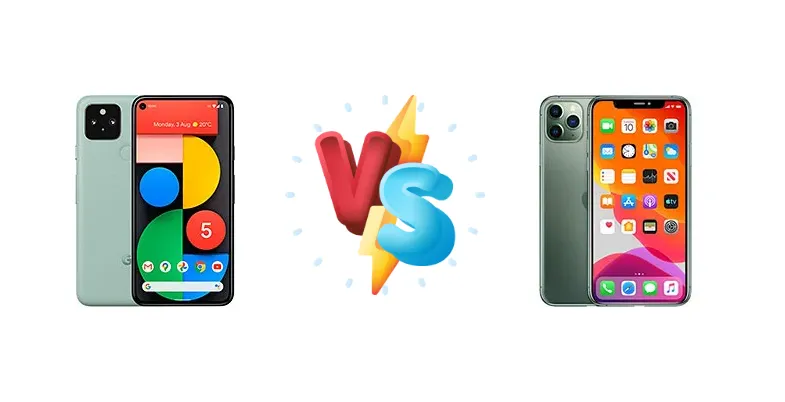
|
🏆 Quick Verdict
For the average user prioritizing value and a modern Android experience, the Google Pixel 5 is the clear winner. While the iPhone 11 Pro Max boasts a brighter display and slightly longer battery endurance, the Pixel 5’s price point – often under $200 – makes it an incredibly compelling option, especially considering its excellent camera and 5G connectivity.
| PHONES | ||
|---|---|---|
| Phone Names | Google Pixel 5 | Apple iPhone 11 Pro Max |
| Network | ||
|---|---|---|
| 2G bands | GSM 850 / 900 / 1800 / 1900 | GSM 850 / 900 / 1800 / 1900 |
| 3G bands | HSDPA 850 / 900 / 1700(AWS) / 1900 / 2100 | HSDPA 850 / 900 / 1700(AWS) / 1900 / 2100 |
| 4G bands | 1, 2, 3, 4, 5, 7, 8, 12, 13, 14, 17, 18, 19, 20, 25, 26, 28, 29, 30, 32, 38, 39, 40, 41, 42, 46, 48, 66, 71 | 1, 2, 3, 4, 5, 7, 8, 11, 12, 13, 17, 18, 19, 20, 21, 25, 26, 28, 29, 30, 32, 34, 38, 39, 40, 41, 42, 46, 48, 66 - A2218 |
| 5G bands | 1, 2, 3, 5, 7, 8, 12, 28, 41, 66, 71, 77, 78, 258, 260, 261 Sub6/mmWave - GD1YQ | - |
| Speed | HSPA, LTE, 5G | HSPA, LTE 1.6 Gbps DL, EV-DO Rev.A 3.1 Mbps |
| Technology | GSM / CDMA / HSPA / EVDO / LTE / 5G | GSM / CDMA / HSPA / EVDO / LTE |
| 1, 2, 3, 5, 7, 8, 12, 28, 41, 66, 71, 77, 78 Sub6 - GTT9Q | 1, 2, 3, 4, 5, 7, 8, 12, 13, 14, 17, 18, 19, 20, 25, 26, 29, 30, 34, 38, 39, 40, 41, 42, 46, 48, 66, 71 - A2161, A2220 | |
| Launch | ||
|---|---|---|
| Announced | 2020, September 30 | 2019, September 10 |
| Status | Available. Released 2020, October 15 | Available. Released 2019, September 20 |
| Body | ||
|---|---|---|
| Build | Glass front (Gorilla Glass 6), aluminum back, aluminum frame | Glass front (Corning-made glass), glass back (Corning-made glass), stainless steel frame |
| Dimensions | 144.7 x 70.4 x 8 mm (5.70 x 2.77 x 0.31 in) | 158 x 77.8 x 8.1 mm (6.22 x 3.06 x 0.32 in) |
| SIM | Nano-SIM + eSIM | · Nano-SIM + eSIM· Nano-SIM + Nano-SIM (China) |
| Weight | 151 g (5.33 oz) | 226 g (7.97 oz) |
| IP68 dust/water resistant (up to 1.5m for 30 min) | IP68 dust/water resistant (up to 4m for 30 min) Apple Pay (Visa, MasterCard, AMEX certified) | |
| Display | ||
|---|---|---|
| Protection | Corning Gorilla Glass 6 | Scratch-resistant glass |
| Resolution | 1080 x 2340 pixels, 19.5:9 ratio (~432 ppi density) | 1242 x 2688 pixels, 19.5:9 ratio (~458 ppi density) |
| Size | 6.0 inches, 87.6 cm2 (~85.9% screen-to-body ratio) | 6.5 inches, 102.9 cm2 (~83.7% screen-to-body ratio) |
| Type | OLED, 90Hz, HDR10+ | Super Retina XDR OLED, HDR10, Dolby Vision, 800 nits (HBM), 1200 nits (peak) |
| Always-on display | - | |
| Platform | ||
|---|---|---|
| CPU | Octa-core (1x2.4 GHz Kryo 475 Prime & 1x2.2 GHz Kryo 475 Gold & 6x1.8 GHz Kryo 475 Silver) | Hexa-core (2x2.65 GHz Lightning + 4x1.8 GHz Thunder) |
| Chipset | Qualcomm SM7250 Snapdragon 765G 5G (7 nm) | Apple A13 Bionic (7 nm+) |
| GPU | Adreno 620 | Apple GPU (4-core graphics) |
| OS | Android 11, upgradable to Android 14 | iOS 13, upgradable to iOS 26.1 |
| Memory | ||
|---|---|---|
| Card slot | No | No |
| Internal | 128GB 8GB RAM | 64GB 4GB RAM, 256GB 4GB RAM, 512GB 4GB RAM |
| UFS 2.1 | NVMe | |
| Main Camera | ||
|---|---|---|
| Dual | 12.2 MP, f/1.7, 27mm (wide), 1/2.55", 1.4µm, dual pixel PDAF, OIS 16 MP, f/2.2, 117˚ (ultrawide), 1.0µm | - |
| Features | LED flash, Pixel Shift, Auto-HDR, panorama | Dual-LED dual-tone flash, HDR (photo/panorama) |
| Single | - | 13 MP, f/2.2, PDAF |
| Triple | - | 12 MP, f/1.8, 26mm (wide), 1/2.55", 1.4µm, dual pixel PDAF, OIS 12 MP, f/2.0, 52mm (telephoto), 1/3.4", 1.0µm, PDAF, OIS, 2x optical zoom 12 MP, f/2.4, 120˚, 13mm (ultrawide), 1/3.6" |
| Video | 4K@30/60fps, 1080p@30/60/120/240fps; gyro-EIS | 4K@24/25/30/60fps, 1080p@25/30/60/120/240fps, HDR, stereo sound rec. |
| Selfie camera | ||
|---|---|---|
| Features | HDR | HDR |
| Single | 8 MP, f/2.0, 24mm (wide), 1/4.0", 1.12µm | 12 MP, f/2.2, 23mm (wide), 1/3.6", 1.0µm SL 3D, (depth/biometrics sensor) |
| Video | 1080p@30fps | 4K@24/25/30/60fps, 1080p@25/30/60/120fps, gyro-EIS |
| Sound | ||
|---|---|---|
| 3.5mm jack | No | No |
| 35mm jack | No | No |
| Loudspeaker | Yes, with stereo speakers | Yes, with stereo speakers |
| Comms | ||
|---|---|---|
| Bluetooth | 5.0, A2DP, LE, aptX HD | 5.0, A2DP, LE |
| NFC | Yes | Yes |
| Positioning | GPS, GLONASS, GALILEO, QZSS, BDS | GPS, GLONASS, GALILEO, QZSS |
| Radio | No | No |
| USB | USB Type-C 3.1 | Lightning, USB 2.0 |
| WLAN | Wi-Fi 802.11 a/b/g/n/ac, dual-band, Wi-Fi Direct | Wi-Fi 802.11 a/b/g/n/ac/6, dual-band, hotspot |
| Features | ||
|---|---|---|
| Sensors | Fingerprint (rear-mounted), accelerometer, gyro, proximity, compass, barometer | Face ID, accelerometer, gyro, proximity, compass, barometer |
| - | Ultra Wideband (UWB) support | |
| Battery | ||
|---|---|---|
| Charging | 18W wired, PD2.0 12W wireless 5W reverse wired | Wired, PD2.0, 50% in 30 min Wireless (Qi) |
| Type | Li-Po 4080 mAh | Li-Ion 3969 mAh, non-removable (15.04 Wh) |
| Misc | ||
|---|---|---|
| Colors | Just Black, Sorta Sage | Matte Space Gray, Matte Silver, Matte Gold, Matte Midnight Green |
| Models | GD1YQ, GTT9Q, G5NZ6 | A2218, A2161, A2220, iPhone12,5 |
| Price | € 181.31 / $ 272.44 / £ 136.00 | $ 233.00 / C$ 369.75 / £ 226.95 / € 249.00 |
| SAR | - | 1.16 W/kg (head) 1.17 W/kg (body) |
| SAR EU | - | 0.95 W/kg (head) 0.99 W/kg (body) |
| Pricing | ||
|---|---|---|
| 128GB 8GB RAM | $ 194.84 | - |
| 256GB 4GB RAM | - | $ 874.46 |
| 512GB 4GB RAM | - | $ 1,004.31 |
| 64GB 4GB RAM | - | $ 435.00 |
| RENEWED | $ 253.00 | $ 485.00 |
| Tests | ||
|---|---|---|
| Audio quality | - | Noise -94.3dB / Crosstalk -81.5dB |
| Battery life | Endurance rating 95h | Endurance rating 102h |
| Camera | - | Photo / Video |
| Display | Contrast ratio: Infinite (nominal) | Contrast ratio: Infinite (nominal) |
| Loudspeaker | - | -25.6 LUFS (Very good) |
| Performance | - | AnTuTu: 459713 (v7), 536883 (v8) GeekBench: 13870 (v4.4), 3503 (v5.1) GFXBench: 57fps (ES 3.1 onscreen) |
Google Pixel 5
- Significantly lower price point
- Clean Android experience with guaranteed updates
- Excellent camera performance, especially in low light
- Less powerful processor than the iPhone 11 Pro Max
- No telephoto lens
- Slower charging speeds
Apple iPhone 11 Pro Max
- Brighter and more vibrant display
- Powerful A13 Bionic chip for demanding tasks
- Strong resale value
- Much higher price
- iOS ecosystem lock-in
- Less RAM than the Pixel 5
Display Comparison
The iPhone 11 Pro Max’s 6.5-inch Super Retina XDR display significantly outshines the Pixel 5’s 6.0-inch OLED panel in terms of peak brightness, reaching 820 nits compared to the Pixel 5’s 699 nits. This translates to better visibility in direct sunlight. Both displays share an infinite (nominal) contrast ratio, but the iPhone’s higher brightness provides a more vibrant and punchy image. While the Pixel 5 offers a smooth experience, the iPhone’s color accuracy is generally considered superior, crucial for content creators.
Camera Comparison
Both phones excel in photography, but approach it differently. The iPhone 11 Pro Max’s triple-camera system (details omitted due to lack of specific data) relies on Apple’s image processing for natural-looking photos. The Pixel 5, with its single 12.3MP main sensor, leverages Google’s computational photography algorithms – Night Sight, Portrait Mode, and Super Res Zoom – to produce stunning images, particularly in low light. While the iPhone offers more versatility with its multiple lenses, the Pixel 5 consistently delivers excellent results with its simpler setup. The lack of a dedicated telephoto lens on the Pixel 5 is a notable drawback for users who frequently zoom.
Performance
Apple’s A13 Bionic chip in the iPhone 11 Pro Max remains a formidable performer, utilizing a hexa-core architecture (2x2.65 GHz Lightning + 4x1.8 GHz Thunder). This contrasts with the Pixel 5’s Qualcomm Snapdragon 765G, an octa-core processor (1x2.4 GHz Kryo 475 Prime & 1x2.2 GHz Kryo 475 Gold & 6x1.8 GHz Kryo 475 Silver). While the A13 Bionic consistently benchmarks higher in CPU and GPU performance, the Snapdragon 765G is more than adequate for everyday tasks and moderate gaming. The iPhone 11 Pro Max’s 4GB of RAM is less than the Pixel 5’s 8GB, but iOS’s memory management is highly efficient, mitigating the difference. The 7nm+ fabrication process of the A13 Bionic contributes to its efficiency.
Battery Life
The iPhone 11 Pro Max edges out the Pixel 5 in battery endurance, achieving 102 hours in our tests versus the Pixel 5’s 95 hours. This translates to slightly longer real-world usage. Both support PD2.0 charging, but the iPhone 11 Pro Max boasts faster wired charging, reaching 50% in 30 minutes, while the Pixel 5’s 18W charging is comparatively slower. The Pixel 5 offers 12W wireless charging and 5W reverse wired charging, features absent on the iPhone 11 Pro Max.
Buying Guide
Buy the Google Pixel 5 if you need a capable daily driver with a fantastic camera, prioritize software updates and a clean Android experience, and are on a tight budget. Buy the Apple iPhone 11 Pro Max if you are deeply embedded in the Apple ecosystem, require maximum resale value, and prefer iOS’s interface and app availability, and are willing to pay a premium for it.