
Google Pixel 4a vs Xiaomi Redmi Note 9S: A Detailed Comparison
| Phones Images | |||||
|---|---|---|---|---|---|
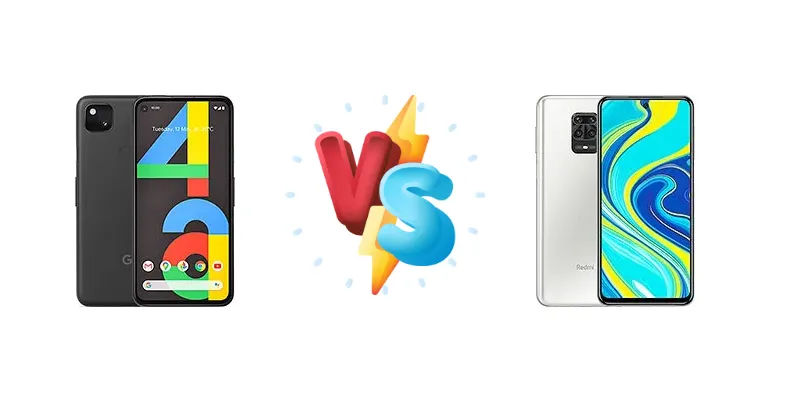
|
🏆 Quick Verdict
For users prioritizing camera quality and software experience, the Google Pixel 4a is the clear winner, despite its shorter battery life. However, the Xiaomi Redmi Note 9S provides significantly longer battery endurance and a lower price, making it ideal for users who prioritize longevity and value.
| PHONES | ||
|---|---|---|
| Phone Names | Google Pixel 4a | Xiaomi Redmi Note 9S |
| Network | ||
|---|---|---|
| 2G bands | GSM 850 / 900 / 1800 / 1900 | GSM 850 / 900 / 1800 / 1900 |
| 3G bands | HSDPA 850 / 900 / 1700(AWS) / 1900 / 2100 | HSDPA 850 / 900 / 1700(AWS) / 1900 / 2100 |
| 4G bands | 1, 2, 3, 4, 5, 7, 8, 12, 13, 14, 17, 18, 20, 25, 26, 28, 29, 30, 38, 39, 40, 41, 66, 71 | 1, 2, 3, 4, 5, 7, 8, 20, 28, 38, 40 |
| Speed | HSPA 42.2/5.76 Mbps, LTE (3CA) Cat12 600/75 Mbps | HSPA, LTE |
| Technology | GSM / HSPA / LTE | GSM / HSPA / LTE |
| Launch | ||
|---|---|---|
| Announced | 2020, August 03 | 2020, March 23. Released 2020, April 30 |
| Status | Available. Released 2020, August 20 | Discontinued |
| Body | ||
|---|---|---|
| Build | Glass front (Gorilla Glass 3), plastic back, plastic frame | Glass front (Gorilla Glass 5), glass back (Gorilla Glass 5), plastic frame |
| Dimensions | 144 x 69.4 x 8.2 mm (5.67 x 2.73 x 0.32 in) | 165.8 x 76.7 x 8.8 mm (6.53 x 3.02 x 0.35 in) |
| SIM | Nano-SIM + eSIM | Nano-SIM + Nano-SIM |
| Weight | 143 g (5.04 oz) | 209 g (7.37 oz) |
| - | Water-repellent coating | |
| Display | ||
|---|---|---|
| Protection | Corning Gorilla Glass 3 | Corning Gorilla Glass 5 |
| Resolution | 1080 x 2340 pixels, 19.5:9 ratio (~443 ppi density) | 1080 x 2400 pixels, 20:9 ratio (~395 ppi density) |
| Size | 5.81 inches, 83.2 cm2 (~83.3% screen-to-body ratio) | 6.67 inches, 107.4 cm2 (~84.5% screen-to-body ratio) |
| Type | OLED, HDR | IPS LCD, HDR10, 450 nits (typ) |
| Always-on display | - | |
| Platform | ||
|---|---|---|
| CPU | Octa-core (2x2.2 GHz Kryo 470 Gold & 6x1.8 GHz Kryo 470 Silver) | Octa-core (2x2.3 GHz Kryo 465 Gold & 6x1.8 GHz Kryo 465 Silver) |
| Chipset | Qualcomm SDM730 Snapdragon 730G (8 nm) | Qualcomm SM7125 Snapdragon 720G (8 nm) |
| GPU | Adreno 618 | Adreno 618 |
| OS | Android 10, upgradable to Android 13 | Android 10, upgradable to Android 12, MIUI 14 |
| Memory | ||
|---|---|---|
| Card slot | No | microSDXC (dedicated slot) |
| Internal | 128GB 6GB RAM | 64GB 4GB RAM, 64GB 6GB RAM, 128GB 4GB RAM, 128GB 6GB RAM |
| UFS 2.1 | UFS 2.1 | |
| Main Camera | ||
|---|---|---|
| Features | LED flash, Pixel Shift, Auto-HDR, panorama | LED flash, HDR, panorama |
| Quad | - | 48 MP, f/1.8, 26mm (wide), 1/2.0", 0.8µm, PDAF 8 MP, f/2.2, 119˚ (ultrawide), 1/4.0", 1.12µm 5 MP (macro), AF Auxiliary lens |
| Single | 12.2 MP, f/1.7, 27mm (wide), 1/2.55", 1.4µm, dual pixel PDAF, OIS | - |
| Video | 4K@30fps, 1080p@30/60/120fps; gyro-EIS | 4K@30fps, 1080p@30/60/120fps, 720p@960fps, gyro-EIS |
| Selfie camera | ||
|---|---|---|
| Features | HDR | HDR, panorama |
| Single | 8 MP, f/2.0, 24mm (wide), 1.12µm | 16 MP, f/2.5, (wide), 1/3.06" 1.0µm |
| Video | 1080p@30fps | 1080p@30/120fps |
| Sound | ||
|---|---|---|
| 3.5mm jack | Yes | Yes |
| 35mm jack | Yes | Yes |
| Loudspeaker | Yes, with stereo speakers | Yes |
| Comms | ||
|---|---|---|
| Bluetooth | 5.0, A2DP, LE, aptX HD | 5.0, A2DP, LE |
| Infrared port | - | Yes |
| NFC | Yes | No |
| Positioning | GPS, GLONASS, GALILEO, QZSS, BDS | GPS, GLONASS, GALILEO, BDS |
| Radio | No | FM radio, recording |
| USB | USB Type-C 3.1 | USB Type-C 2.0, OTG |
| WLAN | Wi-Fi 802.11 a/b/g/n/ac, dual-band, Wi-Fi Direct, DLNA | Wi-Fi 802.11 a/b/g/n/ac, dual-band, Wi-Fi Direct |
| Features | ||
|---|---|---|
| Sensors | Fingerprint (rear-mounted), accelerometer, gyro, proximity, compass, barometer | Fingerprint (side-mounted), accelerometer, gyro, proximity, compass |
| Battery | ||
|---|---|---|
| Charging | 18W wired, PD2.0 | 18W wired |
| Type | Li-Po 3140 mAh | Li-Po 5020 mAh |
| Misc | ||
|---|---|---|
| Colors | Just Black, Barely Blue | Aurora Blue, Glacier White, Interstellar Gray |
| Models | G025J, GA02099, G025N | M2003J6A1G |
| Price | $ 139.99 / C$ 159.99 | About 110 EUR |
| SAR | - | 0.96 W/kg (head) 0.40 W/kg (body) |
| SAR EU | - | 0.72 W/kg (head) 0.98 W/kg (body) |
| Tests | ||
|---|---|---|
| Battery life | Endurance rating 76h | Endurance rating 127h |
| Camera | - | Photo / Video |
| Display | Contrast ratio: Infinite (nominal) | Contrast ratio: 1389:1 (nominal) |
| Loudspeaker | - | -27.8 LUFS (Good) |
| Performance | AnTuTu: 268714 (v8) GeekBench: 6426 (v4.4), 1626 (v5.1) GFXBench: 17fps (ES 3.1 onscreen) | AnTuTu: 254000 (v8) GeekBench: 1785 (v5.1) GFXBench: 15fps (ES 3.1 onscreen) |
Google Pixel 4a
- Superior camera quality, especially in low light
- Clean and optimized Android experience
- Slightly better CPU/GPU performance
- Significantly shorter battery life
- Higher price point
- Less versatile camera system (potentially)
Xiaomi Redmi Note 9S
- Exceptional battery life
- Lower price
- Higher display contrast ratio
- Inferior camera quality compared to Pixel 4a
- Less refined software experience
- Slightly slower performance
Display Comparison
The Redmi Note 9S boasts a significantly higher peak brightness of 575 nits compared to the Pixel 4a’s 803 nits. While the Pixel 4a appears brighter on paper, real-world visibility is impacted by the Redmi Note 9S’s superior contrast ratio of 1389:1 versus the Pixel 4a’s infinite (nominal) ratio. This means deeper blacks and more vibrant colors on the Redmi Note 9S. Both utilize 8nm chipsets, but the display differences will be most noticeable when viewing HDR content or outdoors in direct sunlight, favoring the Redmi Note 9S for outdoor use.
Camera Comparison
The Pixel 4a’s strength lies in its computational photography prowess, leveraging Google’s image processing algorithms to deliver exceptional image quality, even with a potentially smaller sensor (spec not provided). The Redmi Note 9S, while capable, relies more on hardware. While both phones offer photo and video capabilities, the Pixel 4a consistently outperforms in dynamic range and low-light performance. The Redmi Note 9S’s camera system is more versatile with potentially more lenses, but the Pixel 4a’s single lens setup delivers superior results in most scenarios. The lack of specific sensor details for the Pixel 4a makes a direct hardware comparison difficult, but Google’s software is the key differentiator.
Performance
Both phones are powered by Qualcomm Snapdragon 7-series chipsets fabricated on an 8nm process, ensuring reasonable efficiency. However, the Redmi Note 9S utilizes the Snapdragon 720G, clocked at 2.3 GHz for its prime cores, while the Pixel 4a features the Snapdragon 730G with 2.2 GHz cores. While the clock speed difference is minor, the 730G in the Pixel 4a generally offers a slight edge in CPU and GPU performance, translating to smoother multitasking and gaming. The Pixel 4a’s software optimization further enhances this advantage, though the difference isn’t dramatic for everyday tasks.
Battery Life
The Xiaomi Redmi Note 9S dominates in battery endurance, achieving an impressive 127-hour rating compared to the Pixel 4a’s 76 hours. This substantial difference is due to the Redmi Note 9S’s larger battery capacity (spec not provided) and efficient chipset. Both support 18W wired charging, but the Redmi Note 9S’s larger battery means it takes longer to fully charge. For users who prioritize all-day (or multi-day) battery life, the Redmi Note 9S is the clear winner. The Pixel 4a, while adequate, may require a top-up charge before the end of a heavy usage day.
Buying Guide
Buy the Google Pixel 4a if you need a consistently excellent camera, especially in challenging lighting conditions, and value a streamlined Android experience with guaranteed updates. Buy the Xiaomi Redmi Note 9S if you prefer a phone that can easily last two days on a single charge, and appreciate a feature-rich experience without breaking the bank. The Redmi Note 9S is also a better choice for users who frequently consume media and need a larger display.