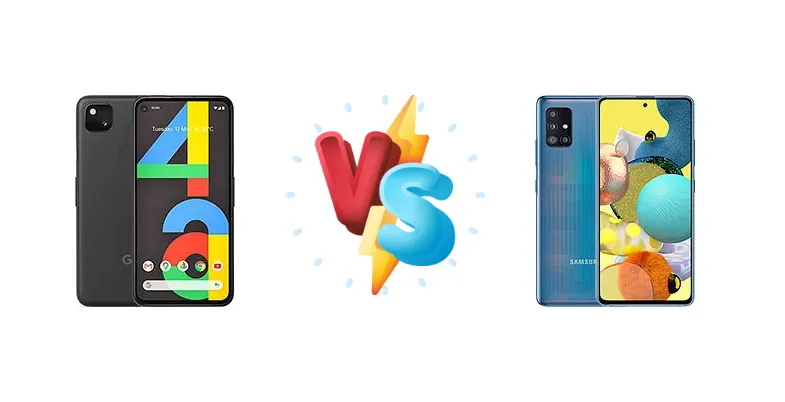
The Google Pixel 4a and Samsung Galaxy A51 5G UW represent compelling options in the mid-range smartphone market, but cater to different priorities. The Pixel 4a, a successor to a beloved line, focuses on delivering a flagship-level camera experience at a more accessible price. The A51 5G UW, meanwhile, prioritizes 5G connectivity and a larger display, aiming for broader appeal. This comparison dissects their key differences to help you choose the right device.
🏆 Quick Verdict
For most users, the Google Pixel 4a is the better choice. Its superior camera, driven by Google’s computational photography, consistently delivers better image quality. While the A51 5G UW offers 5G and a larger screen, the Pixel 4a’s overall refinement and software experience provide a more polished user experience.
| Network |
|---|
| 2G bands | GSM 850 / 900 / 1800 / 1900 | GSM 850 / 900 / 1800 / 1900 |
| 3G bands | HSDPA 850 / 900 / 1700(AWS) / 1900 / 2100 | HSDPA 850 / 900 / 1900 / 2100 |
| 4G bands | 1, 2, 3, 4, 5, 7, 8, 12, 13, 14, 17, 18, 20, 25, 26, 28, 29, 30, 38, 39, 40, 41, 66, 71 | 2, 4, 5, 13, 66 |
| 5G bands | - | 260, 261 mmWave |
| Speed | HSPA 42.2/5.76 Mbps, LTE (3CA) Cat12 600/75 Mbps | HSPA, LTE, 5G |
| Technology | GSM / HSPA / LTE | GSM / HSPA / LTE / 5G |
| Launch |
|---|
| Announced | 2020, August 03 | 2020, August 14 |
| Status | Available. Released 2020, August 20 | Available. Released 2020, August 14 |
| Body |
|---|
| Build | Glass front (Gorilla Glass 3), plastic back, plastic frame | Glass front (Gorilla Glass 3), plastic back, aluminum frame |
| Dimensions | 144 x 69.4 x 8.2 mm (5.67 x 2.73 x 0.32 in) | 158.8 x 73.4 x 8.6 mm (6.25 x 2.89 x 0.34 in) |
| SIM | Nano-SIM + eSIM | Nano-SIM (pre-installed) |
| Weight | 143 g (5.04 oz) | 188.8 g (6.67 oz) |
| Display |
|---|
| Protection | Corning Gorilla Glass 3 | Corning Gorilla Glass 3 |
| Resolution | 1080 x 2340 pixels, 19.5:9 ratio (~443 ppi density) | 1080 x 2400 pixels, 20:9 ratio (~405 ppi density) |
| Size | 5.81 inches, 83.2 cm2 (~83.3% screen-to-body ratio) | 6.5 inches, 102.0 cm2 (~87.5% screen-to-body ratio) |
| Type | OLED, HDR | Super AMOLED |
| | Always-on display | - |
| Platform |
|---|
| CPU | Octa-core (2x2.2 GHz Kryo 470 Gold & 6x1.8 GHz Kryo 470 Silver) | Octa-core (1x2.4 GHz Kryo 475 Prime & 1x2.2 GHz Kryo 475 Gold & 6x1.8 GHz Kryo 475 Silver) |
| Chipset | Qualcomm SDM730 Snapdragon 730G (8 nm) | Qualcomm SM7250 Snapdragon 765G 5G (7 nm) |
| GPU | Adreno 618 | Adreno 620 |
| OS | Android 10, upgradable to Android 13 | Android 10, One UI 2 |
| Memory |
|---|
| Card slot | No | microSDXC (uses shared SIM slot) |
| Internal | 128GB 6GB RAM | 128GB 6GB RAM |
| | UFS 2.1 | UFS 2.1 |
| Main Camera |
|---|
| Features | LED flash, Pixel Shift, Auto-HDR, panorama | LED flash, panorama, HDR |
| Quad | - | 48 MP, f/2.0, 26mm (wide), 1/2.0", 0.8µm, PDAF
12 MP, f/2.2, 123˚ (ultrawide)
5 MP (macro)
Auxiliary lens |
| Single | 12.2 MP, f/1.7, 27mm (wide), 1/2.55", 1.4µm, dual pixel PDAF, OIS | 5 MP, AF |
| Video | 4K@30fps, 1080p@30/60/120fps; gyro-EIS | 4K@30fps, 1080p@30/120fps; gyro-EIS |
| Selfie camera |
|---|
| Features | HDR | HDR |
| Single | 8 MP, f/2.0, 24mm (wide), 1.12µm | 32 MP, f/2.2, 26mm (wide), 1/2.8", 0.8µm |
| Video | 1080p@30fps | 4K@30fps, 1080p@30fps |
| Sound |
|---|
| 3.5mm jack | Yes | Yes |
| 35mm jack | Yes | Yes |
| Loudspeaker | Yes, with stereo speakers | Yes |
| Comms |
|---|
| Bluetooth | 5.0, A2DP, LE, aptX HD | 5.0, A2DP, LE |
| NFC | Yes | Yes |
| Positioning | GPS, GLONASS, GALILEO, QZSS, BDS | GPS, GLONASS, GALILEO, BDS |
| Radio | No | FM radio, RDS, recording |
| USB | USB Type-C 3.1 | USB Type-C 2.0, OTG |
| WLAN | Wi-Fi 802.11 a/b/g/n/ac, dual-band, Wi-Fi Direct, DLNA | Wi-Fi 802.11 a/b/g/n/ac, dual-band, Wi-Fi Direct |
| Features |
|---|
| Sensors | Fingerprint (rear-mounted), accelerometer, gyro, proximity, compass, barometer | Fingerprint (under display, optical), accelerometer, gyro, proximity, compass |
| | - | ANT+ |
| Battery |
|---|
| Charging | 18W wired, PD2.0 | 15W wired |
| Stand-by | - | Up to 672 h |
| Talk time | - | Up to 5 h |
| Type | Li-Po 3140 mAh | Li-Po 4500 mAh |
| Misc |
|---|
| Colors | Just Black, Barely Blue | Prism Bricks Blue |
| Models | G025J, GA02099, G025N | SM-A516V |
| Price | $ 139.99 / C$ 159.99 | About 470 EUR |
| SAR | - | 0.70 W/kg (head) 1.25 W/kg (body) |
| SAR EU | - | 0.59 W/kg (head) 1.32 W/kg (body) |
| Tests |
|---|
| Battery life | Endurance rating 76h | - |
| Display |
Contrast ratio: Infinite (nominal) | - |
| Performance |
AnTuTu: 268714 (v8)
GeekBench: 6426 (v4.4), 1626 (v5.1)
GFXBench: 17fps (ES 3.1 onscreen) | - |
Google Pixel 4a
- Exceptional camera quality with Google’s software
- Clean and fast Android experience
- Faster 18W charging with PD2.0
- Smaller display size
- No 5G connectivity
Samsung Galaxy A51 5G UW
- 5G connectivity for faster data speeds
- Larger display for immersive media consumption
- Samsung’s One UI offers extensive customization
- Slower 15W charging
- Potentially less refined camera performance
Display Comparison
The Pixel 4a boasts a measured peak brightness of 803 nits, ensuring excellent visibility even outdoors. While the A51 5G UW’s display specs aren’t provided, Samsung typically employs vibrant AMOLED panels. However, the Pixel 4a’s ‘infinite’ contrast ratio (typical of OLED) provides deeper blacks and a more dynamic image. The A51 5G UW’s larger screen size is a benefit for media consumption, but the Pixel 4a’s more compact form factor may appeal to users who prefer one-handed operation.
Camera Comparison
The Pixel 4a’s camera is its standout feature. While specific sensor details aren’t provided, Google’s computational photography algorithms consistently outperform competitors, even with similar hardware. The A51 5G UW’s camera specs are unavailable, but Samsung often relies on high megapixel counts rather than prioritizing sensor size or image processing. The Pixel 4a’s strength lies in its ability to capture excellent dynamic range and detail in various lighting conditions, making it the clear winner for photography enthusiasts. We can safely assume the A51 5G UW includes multiple lenses, but the Pixel 4a’s single lens, coupled with Google’s software, is likely to deliver superior results.
Performance
Both phones utilize Qualcomm Snapdragon chipsets, but differ in generation and model. The Galaxy A51 5G UW features the Snapdragon 765G (7nm), while the Pixel 4a uses the Snapdragon 730G (8nm). The 7nm process node of the 765G *should* offer slightly better power efficiency, but the 730G’s Kryo 470 Gold cores clocked at 2.2 GHz provide a strong performance base. The A51 5G UW’s CPU configuration (1x2.4 GHz Kryo 475 Prime + 1x2.2 GHz Kryo 475 Gold) suggests a slight edge in single-core performance, but real-world differences will likely be minimal for everyday tasks. Thermal management is a key consideration; the 8nm process of the 730G in the Pixel 4a may result in less throttling during sustained workloads.
Battery Life
The Pixel 4a achieves an endurance rating of 76 hours, indicating solid battery life. The A51 5G UW’s battery capacity is unknown, but its 15W charging is significantly slower than the Pixel 4a’s 18W charging with PD2.0 support. While the A51 5G UW’s 5G connectivity may consume more power, the Pixel 4a’s more efficient chipset and optimized software likely contribute to its longer endurance. The faster charging on the Pixel 4a also provides a convenience advantage.
Buying Guide
Buy the Google Pixel 4a if you prioritize camera quality, a clean Android experience, and timely software updates. It’s ideal for photography enthusiasts and those who value simplicity. Buy the Samsung Galaxy A51 5G UW if you absolutely need 5G connectivity on a budget, prefer a larger display for media consumption, and are comfortable with Samsung’s One UI software.
Frequently Asked Questions
❓ Does the Snapdragon 765G in the Galaxy A51 5G UW offer a noticeable gaming performance boost over the Snapdragon 730G in the Pixel 4a?
While the Snapdragon 765G is a newer chipset, the performance difference in gaming is unlikely to be dramatic. Both chips are capable of handling most mobile games at medium settings. The Pixel 4a’s 8nm process may offer better thermal management, potentially preventing throttling during extended gaming sessions, which could give it an edge in sustained performance.
❓ How does the software update policy differ between the Pixel 4a and the Galaxy A51 5G UW, and why is this important?
Google guarantees at least 3 years of Android OS updates and 5 years of security updates for the Pixel 4a. Samsung’s update policy for the A51 5G UW is less consistent, typically offering 2-3 years of OS updates and 3-4 years of security patches. Timely updates are crucial for security and accessing new features, making the Pixel 4a the better choice for long-term software support.
❓ Is the 5G connectivity on the Galaxy A51 5G UW truly beneficial for most users right now?
The availability and speed of 5G networks vary significantly by location. While 5G offers potential for faster download and streaming speeds, widespread coverage is still limited. For many users, the benefits of 5G may not be immediately noticeable, and the Pixel 4a’s reliable 4G LTE connectivity may be sufficient.