
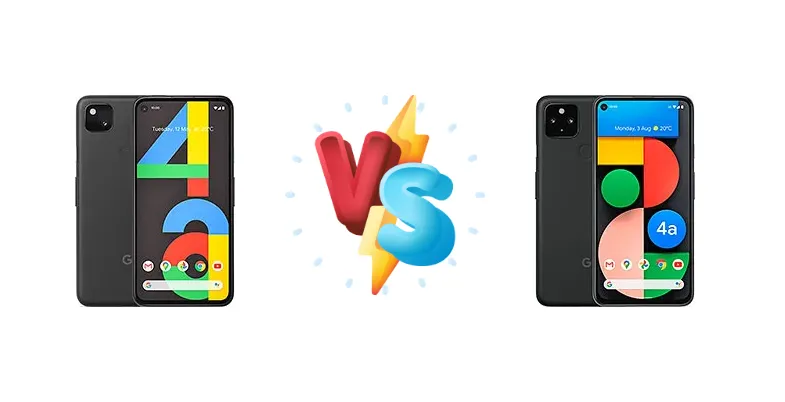
Google Pixel 4a vs. 4a 5G: A Deep Dive into Google's Budget Champions
| Phones Images | |||||
|---|---|---|---|---|---|
|
🏆 Quick Verdict
For most users, the Pixel 4a remains the better value. Its excellent camera and solid performance, coupled with a lower price point, outweigh the 4a 5G’s 5G capabilities and slightly faster processor. However, if 5G is a priority and you frequently engage in demanding tasks, the 4a 5G is a worthwhile upgrade.
| PHONES | ||
|---|---|---|
| Phone Names | Google Pixel 4a | Google Pixel 4a 5G |
| Network | ||
|---|---|---|
| 2G bands | GSM 850 / 900 / 1800 / 1900 | GSM 850 / 900 / 1800 / 1900 |
| 3G bands | HSDPA 850 / 900 / 1700(AWS) / 1900 / 2100 | HSDPA 850 / 900 / 1700(AWS) / 1900 / 2100 |
| 4G bands | 1, 2, 3, 4, 5, 7, 8, 12, 13, 14, 17, 18, 20, 25, 26, 28, 29, 30, 38, 39, 40, 41, 66, 71 | 1, 2, 3, 4, 5, 7, 8, 12, 13, 14, 17, 18, 19, 20, 25, 26, 28, 29, 30, 32, 38, 39, 40, 41, 42, 46, 48, 66, 71 |
| 5G bands | - | 1, 2, 3, 5, 7, 8, 12, 28, 41, 66, 71, 77, 78 Sub6, mmWave (market dependant) |
| Speed | HSPA 42.2/5.76 Mbps, LTE (3CA) Cat12 600/75 Mbps | HSPA, LTE, 5G |
| Technology | GSM / HSPA / LTE | GSM / HSPA / LTE / 5G |
| Launch | ||
|---|---|---|
| Announced | 2020, August 03 | 2020, September 30 |
| Status | Available. Released 2020, August 20 | Available. Released 2020, November 05 |
| Body | ||
|---|---|---|
| Build | Glass front (Gorilla Glass 3), plastic back, plastic frame | Glass front (Gorilla Glass 3), plastic back, plastic frame |
| Dimensions | 144 x 69.4 x 8.2 mm (5.67 x 2.73 x 0.32 in) | 153.9 x 74 x 8.2 mm (Sub-6) or 8.5 mm (Sub-6 and mmWave) |
| SIM | Nano-SIM + eSIM | Nano-SIM + eSIM |
| Weight | 143 g (5.04 oz) | 168 g (5G Sub-6); 171 g ( 5G Sub-6 and mmWave) (5.93 oz) |
| Display | ||
|---|---|---|
| Protection | Corning Gorilla Glass 3 | Corning Gorilla Glass 3 |
| Resolution | 1080 x 2340 pixels, 19.5:9 ratio (~443 ppi density) | 1080 x 2340 pixels, 19.5:9 ratio (~413 ppi density) |
| Size | 5.81 inches, 83.2 cm2 (~83.3% screen-to-body ratio) | 6.2 inches, 95.7 cm2 (~84.1% screen-to-body ratio) |
| Type | OLED, HDR | OLED, HDR |
| Always-on display | Always-on display | |
| Platform | ||
|---|---|---|
| CPU | Octa-core (2x2.2 GHz Kryo 470 Gold & 6x1.8 GHz Kryo 470 Silver) | Octa-core (1x2.4 GHz Kryo 475 Prime & 1x2.2 GHz Kryo 475 Gold & 6x1.8 GHz Kryo 475 Silver) |
| Chipset | Qualcomm SDM730 Snapdragon 730G (8 nm) | Qualcomm SM7250 Snapdragon 765G 5G (7 nm) |
| GPU | Adreno 618 | Adreno 620 |
| OS | Android 10, upgradable to Android 13 | Android 11, upgradable to Android 14 |
| Memory | ||
|---|---|---|
| Card slot | No | No |
| Internal | 128GB 6GB RAM | 128GB 6GB RAM |
| UFS 2.1 | UFS 2.1 | |
| Main Camera | ||
|---|---|---|
| Dual | - | 12.2 MP, f/1.7, 27mm (wide), 1/2.55", 1.4µm, dual pixel PDAF, OIS 16 MP, f/2.2, 107˚ (ultrawide), 1.0µm |
| Features | LED flash, Pixel Shift, Auto-HDR, panorama | LED flash, Pixel Shift, Auto-HDR, panorama |
| Single | 12.2 MP, f/1.7, 27mm (wide), 1/2.55", 1.4µm, dual pixel PDAF, OIS | - |
| Video | 4K@30fps, 1080p@30/60/120fps; gyro-EIS | 4K@30/60fps, 1080p@30/60/120/240fps; gyro-EIS |
| Selfie camera | ||
|---|---|---|
| Features | HDR | HDR |
| Single | 8 MP, f/2.0, 24mm (wide), 1.12µm | 8 MP, f/2.0, 24mm (wide), 1/4.0", 1.12µm |
| Video | 1080p@30fps | 1080p@30fps |
| Sound | ||
|---|---|---|
| 3.5mm jack | Yes | Yes |
| 35mm jack | Yes | Yes |
| Loudspeaker | Yes, with stereo speakers | Yes, with stereo speakers |
| Comms | ||
|---|---|---|
| Bluetooth | 5.0, A2DP, LE, aptX HD | 5.0, A2DP, LE, aptX HD |
| NFC | Yes | Yes |
| Positioning | GPS, GLONASS, GALILEO, QZSS, BDS | GPS, GLONASS, GALILEO, QZSS, BDS |
| Radio | No | No |
| USB | USB Type-C 3.1 | USB Type-C 3.1 |
| WLAN | Wi-Fi 802.11 a/b/g/n/ac, dual-band, Wi-Fi Direct, DLNA | Wi-Fi 802.11 a/b/g/n/ac, dual-band, Wi-Fi Direct |
| Features | ||
|---|---|---|
| Sensors | Fingerprint (rear-mounted), accelerometer, gyro, proximity, compass, barometer | Fingerprint (rear-mounted), accelerometer, gyro, proximity, compass, barometer |
| Battery | ||
|---|---|---|
| Charging | 18W wired, PD2.0 | 18W wired, PD2.0 |
| Type | Li-Po 3140 mAh | Li-Po 3885 mAh |
| Misc | ||
|---|---|---|
| Colors | Just Black, Barely Blue | Just Black, Clearly White |
| Models | G025J, GA02099, G025N | GD1YQ, G025I, G025E, G025H, G6QU3 |
| Price | $ 139.99 / C$ 159.99 | About 140 EUR |
| Tests | ||
|---|---|---|
| Battery life | Endurance rating 76h | - |
| Display | Contrast ratio: Infinite (nominal) | - |
| Performance | AnTuTu: 268714 (v8) GeekBench: 6426 (v4.4), 1626 (v5.1) GFXBench: 17fps (ES 3.1 onscreen) | - |
Google Pixel 4a
- More affordable price point
- Excellent camera performance
- Compact and pocketable design
- Lacks 5G connectivity
- No ultrawide lens
Google Pixel 4a 5G
- 5G connectivity for faster data speeds
- Slightly faster processor for demanding tasks
- Includes an ultrawide lens for added versatility
- Higher price tag
- Potentially shorter battery life
Display Comparison
Both the Pixel 4a and 4a 5G feature OLED displays, but the 4a boasts a measured peak brightness of 803 nits. While the 4a 5G’s display specs aren’t provided, it’s reasonable to assume similar performance. The 'infinite' contrast ratio, typical of OLED panels, ensures deep blacks and vibrant colors on both devices. The 4a’s smaller 5.81-inch screen contributes to a higher pixel density, potentially offering a slightly sharper image, though this difference is likely imperceptible to most users.
Camera Comparison
Both Pixels share Google’s renowned computational photography prowess. While detailed sensor specs are not provided, both are expected to feature a 12.2MP main sensor. The 4a 5G benefits from the more powerful Snapdragon 765G ISP, potentially leading to slightly faster image processing and improved low-light performance. However, the core image processing algorithms remain consistent, ensuring similar color science and dynamic range across both devices. The inclusion of a secondary ultrawide lens on the 4a 5G provides added versatility, a feature absent on the standard 4a.
Performance
The core difference lies in the chipsets. The Pixel 4a utilizes the Qualcomm Snapdragon 730G, built on an 8nm process, with an octa-core CPU configuration (2x2.2 GHz Kryo 470 Gold & 6x1.8 GHz Kryo 470 Silver). The 4a 5G steps up to the Snapdragon 765G 5G, fabricated on a more efficient 7nm process, and features a slightly revised CPU layout (1x2.4 GHz Kryo 475 Prime & 1x2.2 GHz Kryo 475 Gold & 6x1.8 GHz Kryo 475 Silver). The 7nm process and the addition of the Kryo 475 Prime core in the 4a 5G translate to a modest performance increase, particularly in sustained workloads, but the real-world difference for everyday tasks will be minimal. The 4a 5G’s integrated 5G modem also adds to its power consumption.
Battery Life
The Pixel 4a boasts an endurance rating of 76 hours, indicating respectable battery life. The 4a 5G’s battery capacity isn’t specified, but its more power-hungry chipset and 5G modem likely result in slightly shorter battery life. Both devices support 18W wired charging with PD2.0, offering similar charging speeds. The 7nm process of the 4a 5G’s chipset *should* offer better efficiency, but the 5G radio will offset some of those gains.
Buying Guide
Buy the Google Pixel 4a if you prioritize a consistently excellent camera experience, long-term software support, and a compact form factor, all while staying within a tighter budget. Buy the Google Pixel 4a 5G if you require 5G connectivity for faster data speeds, anticipate heavier multitasking, and are willing to spend a bit more for a marginal performance boost.