
Google Pixel 4a vs. Pixel 4 XL: A Deep Dive into Google's 2020 Flagships
| Phones Images | |||||
|---|---|---|---|---|---|
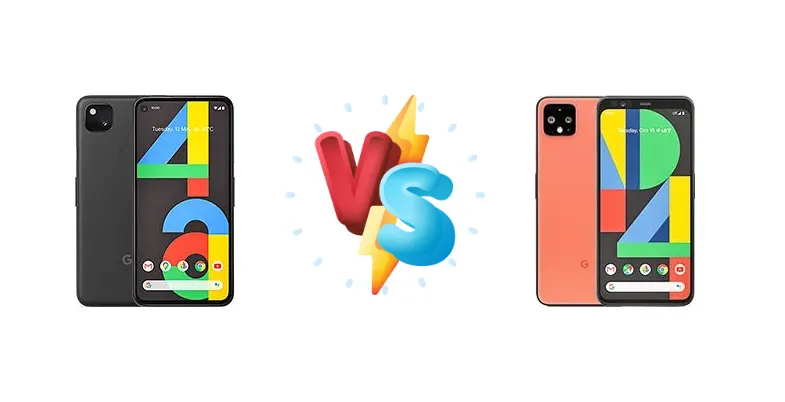
|
🏆 Quick Verdict
For most users, the Google Pixel 4a emerges as the stronger recommendation. Its excellent camera, coupled with a more manageable size and comparable battery endurance (76h vs 73h), makes it a compelling choice. While the Pixel 4 XL boasts a more powerful Snapdragon 855, the performance gains don't justify the price premium for typical daily use.
| PHONES | ||
|---|---|---|
| Phone Names | Google Pixel 4a | Google Pixel 4 XL |
| Network | ||
|---|---|---|
| 2G bands | GSM 850 / 900 / 1800 / 1900 | GSM 850 / 900 / 1800 / 1900 |
| 3G bands | HSDPA 850 / 900 / 1700(AWS) / 1900 / 2100 | HSDPA 850 / 900 / 1700(AWS) / 1900 / 2100 |
| 4G bands | 1, 2, 3, 4, 5, 7, 8, 12, 13, 14, 17, 18, 20, 25, 26, 28, 29, 30, 38, 39, 40, 41, 66, 71 | 1, 2, 3, 4, 5, 7, 8, 12, 13, 17, 20, 25, 26, 28, 32, 38, 39, 40, 41, 66, 71 - Global |
| Speed | HSPA 42.2/5.76 Mbps, LTE (3CA) Cat12 600/75 Mbps | HSPA 42.2/5.76 Mbps, LTE (5CA) Cat18 1200/150 Mbps |
| Technology | GSM / HSPA / LTE | GSM / CDMA / HSPA / EVDO / LTE |
| - | 1, 2, 3, 4, 5, 7, 8, 12, 13, 14, 17, 18, 19, 20, 25, 26, 28, 29, 30, 38, 39, 40, 41, 46, 48, 66, 71 - USA | |
| Launch | ||
|---|---|---|
| Announced | 2020, August 03 | 2019, October 15 |
| Status | Available. Released 2020, August 20 | Available. Released 2019, October 22 |
| Body | ||
|---|---|---|
| Build | Glass front (Gorilla Glass 3), plastic back, plastic frame | Glass front (Gorilla Glass 5), glass back (Gorilla Glass 5), aluminum frame |
| Dimensions | 144 x 69.4 x 8.2 mm (5.67 x 2.73 x 0.32 in) | 160.4 x 75.1 x 8.2 mm (6.31 x 2.96 x 0.32 in) |
| SIM | Nano-SIM + eSIM | Nano-SIM + eSIM |
| Weight | 143 g (5.04 oz) | 193 g (6.81 oz) |
| - | IP68 dust/water resistant (up to 1.5m for 30 min) | |
| Display | ||
|---|---|---|
| Protection | Corning Gorilla Glass 3 | Corning Gorilla Glass 5 |
| Resolution | 1080 x 2340 pixels, 19.5:9 ratio (~443 ppi density) | 1440 x 3040 pixels, 19:9 ratio (~537 ppi density) |
| Size | 5.81 inches, 83.2 cm2 (~83.3% screen-to-body ratio) | 6.3 inches, 98.0 cm2 (~81.3% screen-to-body ratio) |
| Type | OLED, HDR | P-OLED, 90Hz, HDR |
| Always-on display | Always-on display | |
| Platform | ||
|---|---|---|
| CPU | Octa-core (2x2.2 GHz Kryo 470 Gold & 6x1.8 GHz Kryo 470 Silver) | Octa-core (1x2.84 GHz Kryo 485 & 3x2.42 GHz Kryo 485 & 4x1.78 GHz Kryo 485) |
| Chipset | Qualcomm SDM730 Snapdragon 730G (8 nm) | Qualcomm SM8150 Snapdragon 855 (7 nm) |
| GPU | Adreno 618 | Adreno 640 |
| OS | Android 10, upgradable to Android 13 | Android 10, upgradable to Android 13 |
| Memory | ||
|---|---|---|
| Card slot | No | No |
| Internal | 128GB 6GB RAM | 64GB 6GB RAM, 128GB 6GB RAM |
| UFS 2.1 | UFS 2.1 | |
| Main Camera | ||
|---|---|---|
| Dual | - | 12.2 MP, f/1.7, 27mm (wide), 1/2.55", 1.4µm, dual pixel PDAF, OIS 16 MP, f/2.4, 50mm (telephoto), 1/3.6", 1.0µm, PDAF, OIS, 2x optical zoom |
| Features | LED flash, Pixel Shift, Auto-HDR, panorama | Dual-LED flash, Pixel Shift, Auto-HDR, panorama |
| Single | 12.2 MP, f/1.7, 27mm (wide), 1/2.55", 1.4µm, dual pixel PDAF, OIS | - |
| Video | 4K@30fps, 1080p@30/60/120fps; gyro-EIS | 4K@30fps, 1080p@30/60/120fps, 1080p@30fps (gyro-EIS) |
| Selfie camera | ||
|---|---|---|
| Features | HDR | HDR |
| Single | 8 MP, f/2.0, 24mm (wide), 1.12µm | 8 MP, f/2.0, 22mm (wide), 1.22µm, no AF TOF 3D, (depth/biometrics sensor) |
| Video | 1080p@30fps | 1080p@30fps |
| Sound | ||
|---|---|---|
| 3.5mm jack | Yes | No |
| 35mm jack | Yes | No |
| Loudspeaker | Yes, with stereo speakers | Yes, with stereo speakers |
| Comms | ||
|---|---|---|
| Bluetooth | 5.0, A2DP, LE, aptX HD | 5.0, A2DP, LE, aptX HD |
| NFC | Yes | Yes |
| Positioning | GPS, GLONASS, GALILEO, QZSS, BDS | GPS, GLONASS, BDS, GALILEO |
| Radio | No | No |
| USB | USB Type-C 3.1 | USB Type-C 3.1 |
| WLAN | Wi-Fi 802.11 a/b/g/n/ac, dual-band, Wi-Fi Direct, DLNA | Wi-Fi 802.11 a/b/g/n/ac, dual-band, Wi-Fi Direct, DLNA |
| Features | ||
|---|---|---|
| Sensors | Fingerprint (rear-mounted), accelerometer, gyro, proximity, compass, barometer | Face ID, accelerometer, gyro, proximity, compass, barometer |
| Battery | ||
|---|---|---|
| Charging | 18W wired, PD2.0 | 18W wired, PD2.0 Wireless |
| Type | Li-Po 3140 mAh | Li-Po 3700 mAh, non-removable |
| Misc | ||
|---|---|---|
| Colors | Just Black, Barely Blue | Clearly White, Just Black, Oh So Orange |
| Models | G025J, GA02099, G025N | G020P, G020, GA01181-US, GA01182-US, GA01180-US |
| Price | $ 139.99 / C$ 159.99 | About 180 EUR |
| Pricing | ||
|---|---|---|
| 128GB 6GB RAM | - | $ 364.52 |
| 64GB 6GB RAM | - | $ 274.99 |
| RENEWED | - | $ 149.00 |
| Tests | ||
|---|---|---|
| Audio quality | - | Noise -93.9 / Crosstalk -94.1 |
| Battery life | Endurance rating 76h | Endurance rating 73h |
| Camera | - | Photo / Video |
| Display | Contrast ratio: Infinite (nominal) | - |
| Loudspeaker | - | Voice 80dB / Noise 78dB / Ring 88dB |
| Performance | AnTuTu: 268714 (v8) GeekBench: 6426 (v4.4), 1626 (v5.1) GFXBench: 17fps (ES 3.1 onscreen) | AnTuTu: 323305 (v7), 403267 (v8) GeekBench: 10171 (v4.4), 2267 (v5.1) GFXBench: 21fps (ES 3.1 onscreen) |
Google Pixel 4a
- More affordable price point
- Compact and pocketable design
- Excellent camera performance for the price
- Less powerful processor
- No wireless charging
Google Pixel 4 XL
- Faster Snapdragon 855 processor
- Larger display for immersive viewing
- Wireless charging support
- Higher price
- Larger and less manageable size
Display Comparison
The Pixel 4a features a display capable of reaching 803 nits of peak brightness, ensuring excellent visibility even in direct sunlight. The 4 XL, while lacking a specified peak brightness in the provided data, likely surpasses this due to its flagship positioning. Both devices offer an 'Infinite' contrast ratio, typical of OLED panels. The 4 XL’s larger screen size is the most significant difference, catering to users who consume more media or prefer a more immersive experience. However, the 4a’s smaller size makes it more pocketable and easier to use one-handed.
Camera Comparison
Both the Pixel 4a and 4 XL share Google’s renowned computational photography prowess. While specific sensor details are absent, the Pixel lineage guarantees excellent image quality from both devices. The 4 XL’s higher processing power may allow for slightly faster image processing and potentially more complex computational photography algorithms. However, the core image quality will be remarkably similar, leveraging Google’s software expertise. The 'Photo / Video' designation for both indicates a focus on all-around camera capabilities, rather than specialized features.
Performance
The core difference lies in the chipsets: the Pixel 4a utilizes the Qualcomm Snapdragon 730G (8nm), while the 4 XL packs the Snapdragon 855 (7nm). The 855, with its Kryo 485 cores clocked up to 2.84 GHz, offers a noticeable performance advantage in CPU-intensive tasks and gaming. The 730G’s octa-core configuration (2x2.2 GHz Kryo 470 Gold & 6x1.8 GHz Kryo 470 Silver) is still capable, but will exhibit more slowdown under sustained load. The 7nm process node of the 855 also contributes to potentially better thermal efficiency, though both phones share the same 18W charging capabilities.
Battery Life
Despite a difference in chipsets, both phones achieve a similar endurance rating of 73-76 hours. This suggests that the more efficient Snapdragon 730G in the 4a compensates for its smaller battery capacity. Both support 18W wired charging with PD2.0, meaning charging times will be comparable. The 4 XL also adds wireless charging, a convenience feature absent on the 4a.
Buying Guide
Buy the Google Pixel 4a if you prioritize value, a compact form factor, and a consistently excellent camera experience without breaking the bank. It’s ideal for everyday users, students, and anyone who wants a reliable smartphone without unnecessary frills. Buy the Google Pixel 4 XL if you absolutely require the fastest possible performance for demanding tasks like gaming or video editing, and the larger display is a priority, and you can find it at a substantial discount.