
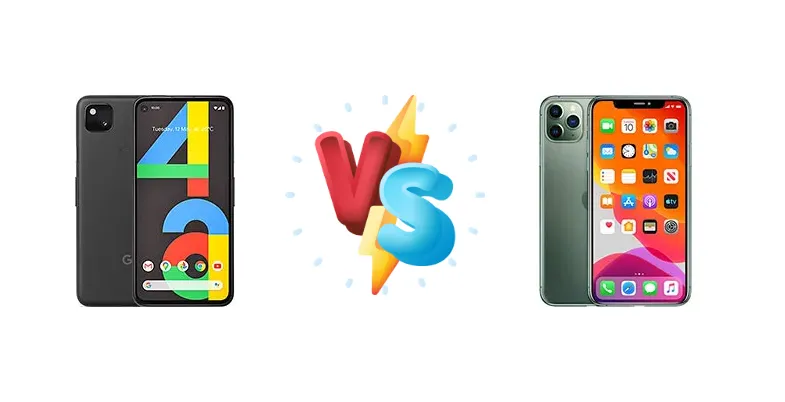
Pixel 4a vs iPhone 11 Pro Max: A Detailed Comparison of Two Distinct Approaches
| Phones Images | |||||
|---|---|---|---|---|---|
|
🏆 Quick Verdict
For the average user prioritizing battery life and a consistently polished experience, the iPhone 11 Pro Max is the superior choice. Its A13 Bionic chip and 102-hour endurance rating significantly outperform the Pixel 4a. However, the Pixel 4a remains a compelling option for budget-conscious users who value Google’s computational photography.
| PHONES | ||
|---|---|---|
| Phone Names | Google Pixel 4a | Apple iPhone 11 Pro Max |
| Network | ||
|---|---|---|
| 2G bands | GSM 850 / 900 / 1800 / 1900 | GSM 850 / 900 / 1800 / 1900 |
| 3G bands | HSDPA 850 / 900 / 1700(AWS) / 1900 / 2100 | HSDPA 850 / 900 / 1700(AWS) / 1900 / 2100 |
| 4G bands | 1, 2, 3, 4, 5, 7, 8, 12, 13, 14, 17, 18, 20, 25, 26, 28, 29, 30, 38, 39, 40, 41, 66, 71 | 1, 2, 3, 4, 5, 7, 8, 11, 12, 13, 17, 18, 19, 20, 21, 25, 26, 28, 29, 30, 32, 34, 38, 39, 40, 41, 42, 46, 48, 66 - A2218 |
| Speed | HSPA 42.2/5.76 Mbps, LTE (3CA) Cat12 600/75 Mbps | HSPA, LTE 1.6 Gbps DL, EV-DO Rev.A 3.1 Mbps |
| Technology | GSM / HSPA / LTE | GSM / CDMA / HSPA / EVDO / LTE |
| - | 1, 2, 3, 4, 5, 7, 8, 12, 13, 14, 17, 18, 19, 20, 25, 26, 29, 30, 34, 38, 39, 40, 41, 42, 46, 48, 66, 71 - A2161, A2220 | |
| Launch | ||
|---|---|---|
| Announced | 2020, August 03 | 2019, September 10 |
| Status | Available. Released 2020, August 20 | Available. Released 2019, September 20 |
| Body | ||
|---|---|---|
| Build | Glass front (Gorilla Glass 3), plastic back, plastic frame | Glass front (Corning-made glass), glass back (Corning-made glass), stainless steel frame |
| Dimensions | 144 x 69.4 x 8.2 mm (5.67 x 2.73 x 0.32 in) | 158 x 77.8 x 8.1 mm (6.22 x 3.06 x 0.32 in) |
| SIM | Nano-SIM + eSIM | · Nano-SIM + eSIM· Nano-SIM + Nano-SIM (China) |
| Weight | 143 g (5.04 oz) | 226 g (7.97 oz) |
| - | IP68 dust/water resistant (up to 4m for 30 min) Apple Pay (Visa, MasterCard, AMEX certified) | |
| Display | ||
|---|---|---|
| Protection | Corning Gorilla Glass 3 | Scratch-resistant glass |
| Resolution | 1080 x 2340 pixels, 19.5:9 ratio (~443 ppi density) | 1242 x 2688 pixels, 19.5:9 ratio (~458 ppi density) |
| Size | 5.81 inches, 83.2 cm2 (~83.3% screen-to-body ratio) | 6.5 inches, 102.9 cm2 (~83.7% screen-to-body ratio) |
| Type | OLED, HDR | Super Retina XDR OLED, HDR10, Dolby Vision, 800 nits (HBM), 1200 nits (peak) |
| Always-on display | - | |
| Platform | ||
|---|---|---|
| CPU | Octa-core (2x2.2 GHz Kryo 470 Gold & 6x1.8 GHz Kryo 470 Silver) | Hexa-core (2x2.65 GHz Lightning + 4x1.8 GHz Thunder) |
| Chipset | Qualcomm SDM730 Snapdragon 730G (8 nm) | Apple A13 Bionic (7 nm+) |
| GPU | Adreno 618 | Apple GPU (4-core graphics) |
| OS | Android 10, upgradable to Android 13 | iOS 13, upgradable to iOS 26.1 |
| Memory | ||
|---|---|---|
| Card slot | No | No |
| Internal | 128GB 6GB RAM | 64GB 4GB RAM, 256GB 4GB RAM, 512GB 4GB RAM |
| UFS 2.1 | NVMe | |
| Main Camera | ||
|---|---|---|
| Features | LED flash, Pixel Shift, Auto-HDR, panorama | Dual-LED dual-tone flash, HDR (photo/panorama) |
| Single | 12.2 MP, f/1.7, 27mm (wide), 1/2.55", 1.4µm, dual pixel PDAF, OIS | 13 MP, f/2.2, PDAF |
| Triple | - | 12 MP, f/1.8, 26mm (wide), 1/2.55", 1.4µm, dual pixel PDAF, OIS 12 MP, f/2.0, 52mm (telephoto), 1/3.4", 1.0µm, PDAF, OIS, 2x optical zoom 12 MP, f/2.4, 120˚, 13mm (ultrawide), 1/3.6" |
| Video | 4K@30fps, 1080p@30/60/120fps; gyro-EIS | 4K@24/25/30/60fps, 1080p@25/30/60/120/240fps, HDR, stereo sound rec. |
| Selfie camera | ||
|---|---|---|
| Features | HDR | HDR |
| Single | 8 MP, f/2.0, 24mm (wide), 1.12µm | 12 MP, f/2.2, 23mm (wide), 1/3.6", 1.0µm SL 3D, (depth/biometrics sensor) |
| Video | 1080p@30fps | 4K@24/25/30/60fps, 1080p@25/30/60/120fps, gyro-EIS |
| Sound | ||
|---|---|---|
| 3.5mm jack | Yes | No |
| 35mm jack | Yes | No |
| Loudspeaker | Yes, with stereo speakers | Yes, with stereo speakers |
| Comms | ||
|---|---|---|
| Bluetooth | 5.0, A2DP, LE, aptX HD | 5.0, A2DP, LE |
| NFC | Yes | Yes |
| Positioning | GPS, GLONASS, GALILEO, QZSS, BDS | GPS, GLONASS, GALILEO, QZSS |
| Radio | No | No |
| USB | USB Type-C 3.1 | Lightning, USB 2.0 |
| WLAN | Wi-Fi 802.11 a/b/g/n/ac, dual-band, Wi-Fi Direct, DLNA | Wi-Fi 802.11 a/b/g/n/ac/6, dual-band, hotspot |
| Features | ||
|---|---|---|
| Sensors | Fingerprint (rear-mounted), accelerometer, gyro, proximity, compass, barometer | Face ID, accelerometer, gyro, proximity, compass, barometer |
| - | Ultra Wideband (UWB) support | |
| Battery | ||
|---|---|---|
| Charging | 18W wired, PD2.0 | Wired, PD2.0, 50% in 30 min Wireless (Qi) |
| Type | Li-Po 3140 mAh | Li-Ion 3969 mAh, non-removable (15.04 Wh) |
| Misc | ||
|---|---|---|
| Colors | Just Black, Barely Blue | Matte Space Gray, Matte Silver, Matte Gold, Matte Midnight Green |
| Models | G025J, GA02099, G025N | A2218, A2161, A2220, iPhone12,5 |
| Price | $ 139.99 / C$ 159.99 | $ 233.00 / C$ 369.75 / £ 226.95 / € 249.00 |
| SAR | - | 1.16 W/kg (head) 1.17 W/kg (body) |
| SAR EU | - | 0.95 W/kg (head) 0.99 W/kg (body) |
| Pricing | ||
|---|---|---|
| 256GB 4GB RAM | - | $ 874.46 |
| 512GB 4GB RAM | - | $ 1,004.31 |
| 64GB 4GB RAM | - | $ 435.00 |
| RENEWED | - | $ 485.00 |
| Tests | ||
|---|---|---|
| Audio quality | - | Noise -94.3dB / Crosstalk -81.5dB |
| Battery life | Endurance rating 76h | Endurance rating 102h |
| Camera | - | Photo / Video |
| Display | Contrast ratio: Infinite (nominal) | Contrast ratio: Infinite (nominal) |
| Loudspeaker | - | -25.6 LUFS (Very good) |
| Performance | AnTuTu: 268714 (v8) GeekBench: 6426 (v4.4), 1626 (v5.1) GFXBench: 17fps (ES 3.1 onscreen) | AnTuTu: 459713 (v7), 536883 (v8) GeekBench: 13870 (v4.4), 3503 (v5.1) GFXBench: 57fps (ES 3.1 onscreen) |
Google Pixel 4a
- Significantly more affordable price point.
- Excellent camera performance, especially in low light.
- Compact and comfortable design for one-handed use.
- Noticeably slower processor compared to the iPhone.
- Shorter battery life.
- Less premium build quality.
Apple iPhone 11 Pro Max
- Exceptional performance with the A13 Bionic chip.
- Outstanding battery life.
- Premium build quality and design.
- Higher price tag.
- Larger size may be unwieldy for some users.
- Locked into the Apple ecosystem.
Display Comparison
Both the Pixel 4a and iPhone 11 Pro Max feature displays with an 'Infinite' (nominal) contrast ratio, indicating excellent black levels. However, the iPhone 11 Pro Max edges out the Pixel 4a with a measured peak brightness of 820 nits versus 803 nits. While the difference is subtle, it translates to slightly better visibility in direct sunlight. Both utilize OLED technology, but Apple’s display benefits from its larger size and higher resolution, resulting in a sharper image. The Pixel 4a’s smaller 5.81-inch display is more manageable for one-handed use, a trade-off for the iPhone’s immersive viewing experience.
Camera Comparison
Both phones excel in photography, but approach it differently. The iPhone 11 Pro Max’s camera system, while details are limited in the provided data, is renowned for its consistent image quality and excellent video recording capabilities. The Pixel 4a leverages Google’s computational photography prowess to deliver stunning images, particularly in low-light conditions. While the Pixel 4a’s sensor size isn’t specified, Google’s software algorithms compensate for hardware limitations. The iPhone 11 Pro Max’s advantage lies in its video capabilities and overall versatility, offering a more complete camera experience. The Pixel 4a’s strength is its ability to produce exceptional still photos with minimal effort.
Performance
The performance gap between these devices is substantial. The iPhone 11 Pro Max’s Apple A13 Bionic, built on a 7nm+ process, boasts a hexa-core CPU configuration (2x2.65 GHz Lightning + 4x1.8 GHz Thunder) and delivers significantly faster processing speeds than the Pixel 4a’s Qualcomm Snapdragon 730G (8 nm). The Snapdragon 730G’s octa-core setup (2x2.2 GHz Kryo 470 Gold & 6x1.8 GHz Kryo 470 Silver) is capable for everyday tasks, but struggles with demanding applications and multitasking compared to the A13 Bionic. While both phones have 4GB of RAM, the A13 Bionic’s superior architecture and memory management provide a smoother, more responsive user experience.
Battery Life
Battery life is a clear win for the iPhone 11 Pro Max. Its endurance rating of 102 hours dwarfs the Pixel 4a’s 76 hours. This translates to significantly longer usage between charges, especially for power users. While the Pixel 4a supports 18W wired charging with PD2.0, the iPhone 11 Pro Max offers faster charging with 50% charge in 30 minutes, alongside wireless charging (Qi). The larger battery capacity and more efficient chipset in the iPhone 11 Pro Max provide a substantial advantage in real-world battery performance.
Buying Guide
Buy the Google Pixel 4a if you need a fantastic camera experience on a tight budget and prioritize Google’s software features. It’s ideal for users who frequently use Google Photos and appreciate a clean Android interface. Buy the Apple iPhone 11 Pro Max if you prefer a premium build quality, exceptional battery life, and a powerful processor for demanding tasks like video editing or gaming, and are willing to invest in the Apple ecosystem.