
Google Pixel 4 vs Samsung Galaxy S20 FE 2022: A Detailed Comparison of Two Android Flagships
| Phones Images | |||||
|---|---|---|---|---|---|
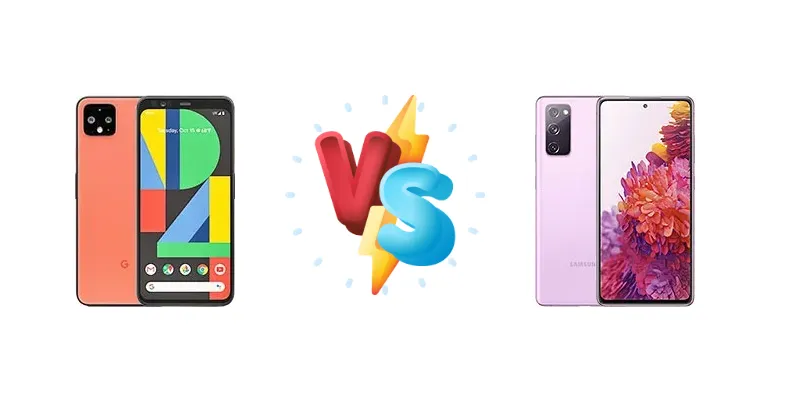
|
🏆 Quick Verdict
For most users, the Samsung Galaxy S20 FE 2022 is the better buy. Its Snapdragon 865 chipset provides a noticeable performance boost over the Pixel 4’s Snapdragon 855, and the 25W charging significantly reduces downtime. While the Pixel 4 excels in software and camera processing, the S20 FE 2022 offers a more well-rounded experience.
| PHONES | ||
|---|---|---|
| Phone Names | Google Pixel 4 | Samsung Galaxy S20 FE 2022 |
| Network | ||
|---|---|---|
| 2G bands | GSM 850 / 900 / 1800 / 1900 | GSM 850 / 900 / 1800 / 1900 |
| 3G bands | HSDPA 850 / 900 / 1700(AWS) / 1900 / 2100 | HSDPA 850 / 900 / 1700(AWS) / 1900 / 2100 |
| 4G bands | 1, 2, 3, 4, 5, 7, 8, 12, 13, 17, 20, 25, 26, 28, 32, 38, 39, 40, 41, 66, 71 - Global | LTE |
| 5G bands | - | SA/NSA/Sub6 |
| Speed | HSPA 42.2/5.76 Mbps, LTE (5CA) Cat18 1200/150 Mbps | HSPA 42.2/5.76 Mbps, LTE (5CA) Cat19 1800/200 Mbps, 5G |
| Technology | GSM / CDMA / HSPA / EVDO / LTE | GSM / CDMA / HSPA / EVDO / LTE / 5G |
| 1, 2, 3, 4, 5, 7, 8, 12, 13, 14, 17, 18, 19, 20, 25, 26, 28, 29, 30, 38, 39, 40, 41, 46, 48, 66, 71 - USA | CDMA2000 1xEV-DO | |
| Launch | ||
|---|---|---|
| Announced | 2019, October 15 | 2022, April 01 |
| Status | Available. Released 2019, October 22 | Available. Released 2022, April 01 |
| Body | ||
|---|---|---|
| Build | Glass front (Gorilla Glass 5), glass back (Gorilla Glass 5), aluminum frame | Glass front (Gorilla Glass 3), plastic back, aluminum frame |
| Dimensions | 147.1 x 68.8 x 8.2 mm (5.79 x 2.71 x 0.32 in) | 159.8 x 74.5 x 8.4 mm (6.29 x 2.93 x 0.33 in) |
| SIM | Nano-SIM + eSIM | Nano-SIM + Nano-SIM |
| Weight | 162 g (5.71 oz) | 190 g (6.70 oz) |
| IP68 dust/water resistant (up to 1.5m for 30 min) | IP68 dust/water resistant (up to 1.5m for 30 min) | |
| Display | ||
|---|---|---|
| Protection | Corning Gorilla Glass 5 | Corning Gorilla Glass 3 |
| Resolution | 1080 x 2280 pixels, 19:9 ratio (~444 ppi density) | 1080 x 2400 pixels, 20:9 ratio (~405 ppi density) |
| Size | 5.7 inches, 80.7 cm2 (~79.8% screen-to-body ratio) | 6.5 inches, 102.0 cm2 (~85.7% screen-to-body ratio) |
| Type | P-OLED, 90Hz, HDR | Super AMOLED, 120Hz, HDR10+ |
| Always-on display | Always-on display | |
| Platform | ||
|---|---|---|
| CPU | Octa-core (1x2.84 GHz Kryo 485 & 3x2.42 GHz Kryo 485 & 4x1.78 GHz Kryo 485) | Octa-core (1x2.84 GHz Cortex-A77 & 3x2.42 GHz Cortex-A77 & 4x1.80 GHz Cortex-A55) |
| Chipset | Qualcomm SM8150 Snapdragon 855 (7 nm) | Qualcomm SM8250 Snapdragon 865 5G (7 nm+) |
| GPU | Adreno 640 | Adreno 650 |
| OS | Android 10, upgradable to Android 13 | Android 12, One UI 4.1 |
| Memory | ||
|---|---|---|
| Card slot | No | microSDXC (uses shared SIM slot) |
| Internal | 64GB 6GB RAM, 128GB 6GB RAM | 128GB 6GB RAM |
| UFS 2.1 | UFS 3.1 | |
| Main Camera | ||
|---|---|---|
| Dual | 12.2 MP, f/1.7, 27mm (wide), 1/2.55", 1.4µm, dual pixel PDAF, OIS 16 MP, f/2.4, 50mm (telephoto), 1/3.6", 1.0µm, PDAF, OIS, 2x optical zoom | - |
| Features | Dual-LED flash, Pixel Shift, Auto-HDR, panorama | LED flash, auto-HDR, panorama |
| Triple | - | 12 MP, f/1.8, 26mm (wide), 1/1.76", 1.8µm, dual pixel PDAF, OIS 8 MP, f/2.4, 76mm (telephoto), 1/4.5", 1.0µm, PDAF, OIS, 3x optical zoom 12 MP, f/2.2, 13mm, 123˚ (ultrawide), 1/3.0", 1.12µm |
| Video | 4K@30fps, 1080p@30/60/120fps, 1080p@30fps (gyro-EIS) | 4K@30/60fps, 1080p@30/60fps, gyro-EIS |
| Selfie camera | ||
|---|---|---|
| Features | HDR | HDR |
| Single | 8 MP, f/2.0, 22mm (wide), 1.22µm, no AF TOF 3D, (depth/biometrics sensor) | 32 MP, f/2.2, 26mm (wide), 1/2.74", 0.8µm |
| Video | 1080p@30fps | 4K@30/60fps, 1080p@30/60fps, gyro-EIS |
| Sound | ||
|---|---|---|
| 3.5mm jack | No | No |
| 35mm jack | No | No |
| Loudspeaker | Yes, with stereo speakers | Yes, with stereo speakers |
| - | 32-bit/384kHz audio Tuned by AKG | |
| Comms | ||
|---|---|---|
| Bluetooth | 5.0, A2DP, LE, aptX HD | 5.0, A2DP, LE |
| NFC | Yes | Yes |
| Positioning | GPS, GLONASS, BDS, GALILEO | GPS, GLONASS, BDS, GALILEO |
| Radio | No | No |
| USB | USB Type-C 3.1 | USB Type-C 3.2, OTG |
| WLAN | Wi-Fi 802.11 a/b/g/n/ac, dual-band, Wi-Fi Direct, DLNA | Wi-Fi 802.11 a/b/g/n/ac/6, dual-band, Wi-Fi Direct |
| Features | ||
|---|---|---|
| Sensors | Face ID, accelerometer, gyro, proximity, compass, barometer | Fingerprint (under display, optical), accelerometer, gyro, compass |
| - | Virtual proximity sensing Bixby natural language commands and dictation Samsung Pay (Visa, MasterCard certified) | |
| Battery | ||
|---|---|---|
| Charging | 18W wired, PD2.0 Wireless | 25W wired, PD3.0 15W wireless (Qi) 4.5W reverse wireless |
| Type | Li-Po 2800 mAh, non-removable | Li-Ion 4500 mAh |
| Misc | ||
|---|---|---|
| Colors | Clearly White, Just Black, Oh So Orange | Cloud White, Cloud Lavender, Cloud Navy |
| Models | G020M, G020I, GA01188-US, GA01187-US, GA01189-US, GA01191-US, GA01189-US | SM-G781NK, SM-G781NK22 |
| Price | About 200 EUR | About 520 EUR |
| Tests | ||
|---|---|---|
| Audio quality | Noise -71.5dB / Crosstalk -69.8dB | - |
| Battery life | Endurance rating 62h | - |
| Camera | Photo / Video | - |
| Display | Contrast ratio: Infinite (nominal) | - |
| Loudspeaker | Voice 79dB / Noise 71dB / Ring 83dB | - |
| Performance | AnTuTu: 395351 (v8) GeekBench: 2542 (v5.1) GFXBench: 31fps (ES 3.1 onscreen) | - |
Google Pixel 4
- Compact and pocketable design
- Exceptional computational photography
- Clean and bloatware-free Android experience
- Outdated Snapdragon 855 chipset
- Slow 18W charging
- Below-average battery life
Samsung Galaxy S20 FE 2022
- Faster Snapdragon 865 5G chipset
- 25W fast charging and wireless charging
- Larger and more immersive display
- Larger form factor may not suit all users
- Samsung’s One UI can be divisive
- May receive fewer software updates than the Pixel 4
Display Comparison
The Pixel 4 boasts an infinite (nominal) contrast ratio, typical of OLED panels, and a measured peak brightness of 423 nits. While adequate for indoor use, this falls short of modern displays. The S20 FE 2022’s display specifications are not provided, but Samsung’s history with AMOLED technology suggests comparable contrast and likely higher peak brightness, benefiting outdoor visibility. The S20 FE’s larger screen size also provides a more immersive viewing experience, though the Pixel 4’s smaller size is preferable for one-handed use.
Camera Comparison
Both devices are equipped with capable camera systems, but their approaches differ. The Pixel 4 is renowned for its computational photography prowess, leveraging Google’s software algorithms to produce stunning images, particularly in challenging lighting conditions. The S20 FE 2022, while also offering excellent image quality, relies more on hardware – specifically, a larger main sensor (specifications not provided, but typical for the S20 FE line) – to capture detail. Both support photo and video recording, but the S20 FE 2022’s more modern ISP likely offers improved video stabilization and processing capabilities. The Pixel 4’s strength lies in its consistent image quality across all lighting scenarios, while the S20 FE 2022 may excel in specific situations where its hardware advantage shines.
Performance
The core difference lies in the chipsets: the Pixel 4 utilizes the Qualcomm Snapdragon 855 (7nm), while the S20 FE 2022 features the Snapdragon 865 5G (7nm+). The 865 represents a generational leap, offering improved CPU and GPU performance. Both CPUs share the same peak clock speed (2.84 GHz) on their prime cores, but the 865’s Cortex-A77 cores are architecturally superior to the Kryo 485 cores in the 855. This translates to faster app loading, smoother multitasking, and better gaming performance on the S20 FE 2022. The 7nm+ process node also contributes to improved thermal efficiency, potentially reducing throttling during sustained workloads.
Battery Life
The Pixel 4 has an endurance rating of 62 hours, indicating a relatively modest battery life. Its 18W wired charging with PD2.0 is slow by today’s standards. The S20 FE 2022, with 25W wired charging (PD3.0) and 15W wireless charging (Qi), offers significantly faster charging speeds. While battery capacity isn’t specified for either device, the S20 FE 2022’s faster charging mitigates concerns about battery life, allowing users to quickly top up when needed. The inclusion of 4.5W reverse wireless charging on the S20 FE 2022 is a convenient feature absent on the Pixel 4.
Buying Guide
Buy the Google Pixel 4 if you prioritize a truly compact form factor, Google’s clean Android experience, and exceptional computational photography, and are willing to accept older hardware and limited battery life. Buy the Samsung Galaxy S20 FE 2022 if you prefer a larger display, faster performance for demanding tasks like gaming, quicker charging speeds, and a more versatile feature set, even if it means sacrificing the Pixel’s software purity.