
Google Pixel 4 vs. Samsung Galaxy Note 10.1 (2014): A Generational Divide
| Phones Images | |||||
|---|---|---|---|---|---|
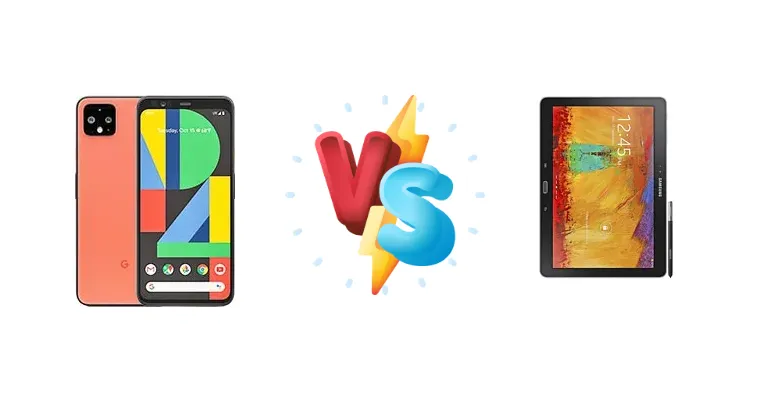
|
🏆 Quick Verdict
For the vast majority of users, the Google Pixel 4 is the clear winner. Its significantly faster Snapdragon 855 chipset, brighter display, and modern software experience outweigh the Note 10.1's larger screen. However, the Note 10.1 remains a viable option for dedicated media consumers on a tight budget.
| PHONES | ||
|---|---|---|
| Phone Names | Google Pixel 4 | Samsung Galaxy Note 10.1 (2014) |
| Network | ||
|---|---|---|
| 2G bands | GSM 850 / 900 / 1800 / 1900 | GSM 850 / 900 / 1800 / 1900 - all versions |
| 3G bands | HSDPA 850 / 900 / 1700(AWS) / 1900 / 2100 | HSDPA 850 / 900 / 1900 / 2100 - all versions |
| 4G bands | 1, 2, 3, 4, 5, 7, 8, 12, 13, 17, 20, 25, 26, 28, 32, 38, 39, 40, 41, 66, 71 - Global | 1, 3, 5, 7, 8, 20 - SM-P605 |
| Speed | HSPA 42.2/5.76 Mbps, LTE (5CA) Cat18 1200/150 Mbps | HSPA 42.2(LTE)/21.1(3G)/5.76 Mbps, LTE Cat4 150/50 Mbps - cellular model only |
| Technology | GSM / CDMA / HSPA / EVDO / LTE | GSM / HSPA / LTE |
| 1, 2, 3, 4, 5, 7, 8, 12, 13, 14, 17, 18, 19, 20, 25, 26, 28, 29, 30, 38, 39, 40, 41, 46, 48, 66, 71 - USA | - | |
| Launch | ||
|---|---|---|
| Announced | 2019, October 15 | 2013, September. Released 2013, October |
| Status | Available. Released 2019, October 22 | Discontinued |
| Body | ||
|---|---|---|
| Build | Glass front (Gorilla Glass 5), glass back (Gorilla Glass 5), aluminum frame | - |
| Dimensions | 147.1 x 68.8 x 8.2 mm (5.79 x 2.71 x 0.32 in) | 243.1 x 171.4 x 7.9 mm (9.57 x 6.75 x 0.31 in) |
| SIM | Nano-SIM + eSIM | Micro-SIM - cellular model only |
| Weight | 162 g (5.71 oz) | 540g (WIFI)/ 535 g (3G)/ 547g (LTE) (1.18 lb) |
| IP68 dust/water resistant (up to 1.5m for 30 min) | Stylus | |
| Display | ||
|---|---|---|
| Protection | Corning Gorilla Glass 5 | - |
| Resolution | 1080 x 2280 pixels, 19:9 ratio (~444 ppi density) | 2560 x 1600 pixels, 16:10 ratio (~299 ppi density) |
| Size | 5.7 inches, 80.7 cm2 (~79.8% screen-to-body ratio) | 10.1 inches, 295.8 cm2 (~71.0% screen-to-body ratio) |
| Type | P-OLED, 90Hz, HDR | Super clear LCD |
| Always-on display | - | |
| Platform | ||
|---|---|---|
| CPU | Octa-core (1x2.84 GHz Kryo 485 & 3x2.42 GHz Kryo 485 & 4x1.78 GHz Kryo 485) | Quad-core 2.3 GHz Krait 400 - LTE modelOcta-core (4x1.9 GHz Cortex-A15 & 4x1.3 GHz Cortex-A7) - 3G model |
| Chipset | Qualcomm SM8150 Snapdragon 855 (7 nm) | Qualcomm Snapdragon 800 (28 nm) |
| GPU | Adreno 640 | Adreno 330 (LTE model) |
| OS | Android 10, upgradable to Android 13 | Android 4.3 (Jelly Bean), upgradable to 5.1.1 (Lollipop), TouchWiz UI |
| Memory | ||
|---|---|---|
| Card slot | No | microSDXC (dedicated slot) |
| Internal | 64GB 6GB RAM, 128GB 6GB RAM | 16GB 3GB RAM, 32GB 3GB RAM, 64GB 3GB RAM |
| UFS 2.1 | eMMC 4.5 | |
| Main Camera | ||
|---|---|---|
| Dual | 12.2 MP, f/1.7, 27mm (wide), 1/2.55", 1.4µm, dual pixel PDAF, OIS 16 MP, f/2.4, 50mm (telephoto), 1/3.6", 1.0µm, PDAF, OIS, 2x optical zoom | - |
| Features | Dual-LED flash, Pixel Shift, Auto-HDR, panorama | LED flash |
| Single | - | 8 MP, AF |
| Video | 4K@30fps, 1080p@30/60/120fps, 1080p@30fps (gyro-EIS) | 1080p@60fps (LTE model) |
| Selfie camera | ||
|---|---|---|
| Features | HDR | - |
| Single | 8 MP, f/2.0, 22mm (wide), 1.22µm, no AF TOF 3D, (depth/biometrics sensor) | 2 MP |
| Video | 1080p@30fps | 1080p@30fps |
| Sound | ||
|---|---|---|
| 3.5mm jack | No | Yes |
| 35mm jack | No | Yes |
| Loudspeaker | Yes, with stereo speakers | Yes, with stereo speakers |
| Comms | ||
|---|---|---|
| Bluetooth | 5.0, A2DP, LE, aptX HD | 4.0, A2DP |
| Infrared port | - | Yes |
| NFC | Yes | No |
| Positioning | GPS, GLONASS, BDS, GALILEO | GPS, GLONASS - cellular model only |
| Radio | No | No |
| USB | USB Type-C 3.1 | microUSB 2.0 (MHL TV-out), OTG |
| WLAN | Wi-Fi 802.11 a/b/g/n/ac, dual-band, Wi-Fi Direct, DLNA | Wi-Fi 802.11 a/b/g/n/ac, dual-band, Wi-Fi Direct, hotspot |
| Features | ||
|---|---|---|
| Sensors | Face ID, accelerometer, gyro, proximity, compass, barometer | Accelerometer, gyro, proximity, compass |
| Battery | ||
|---|---|---|
| Charging | 18W wired, PD2.0 Wireless | - |
| Music play | - | Up to 98 h |
| Stand-by | - | Up to 2230 h |
| Talk time | - | Up to 10 h (multimedia) (2G) / Up to 49 h (3G) |
| Type | Li-Po 2800 mAh, non-removable | Li-Po 8220 mAh, non-removable |
| Misc | ||
|---|---|---|
| Colors | Clearly White, Just Black, Oh So Orange | Black, White |
| Models | G020M, G020I, GA01188-US, GA01187-US, GA01189-US, GA01191-US, GA01189-US | SM-P600, SM-P601, SM-P605 |
| Price | About 200 EUR | About 370 EUR |
| SAR | - | 1.59 W/kg (body) |
| SAR EU | - | 0.64 W/kg (body) |
| Tests | ||
|---|---|---|
| Audio quality | Noise -71.5dB / Crosstalk -69.8dB | Noise -95.5dB / Crosstalk -97.3dB |
| Battery life | Endurance rating 62h | - |
| Camera | Photo / Video | Photo / Video |
| Display | Contrast ratio: Infinite (nominal) | Contrast ratio: 821:1 (nominal) |
| Loudspeaker | Voice 79dB / Noise 71dB / Ring 83dB | Voice 75dB / Noise 66dB / Ring 77dB |
| Performance | AnTuTu: 395351 (v8) GeekBench: 2542 (v5.1) GFXBench: 31fps (ES 3.1 onscreen) | - |
Google Pixel 4
- Significantly faster processor and graphics
- Superior camera performance and image processing
- Brighter, higher-contrast display
- Modern software and security updates
- Smaller screen size compared to the Note 10.1
- Battery life is average
Samsung Galaxy Note 10.1 (2014)
- Larger screen size ideal for media consumption
- Integrated S Pen stylus for note-taking and drawing
- Potentially longer battery life for basic tasks
- Lower price point (due to age)
- Outdated processor and graphics
- Limited software support and security updates
- Inferior camera performance
- Lower display quality
Display Comparison
The Pixel 4 boasts a significantly more advanced display experience. While both devices offer video playback, the Pixel 4’s measured 423 nits of brightness far surpasses what the Note 10.1 likely achieved (data unavailable, but typical for the era). More importantly, the Pixel 4’s ‘infinite’ (nominal) contrast ratio, indicative of an OLED panel, delivers richer blacks and more vibrant colors compared to the Note 10.1’s 821:1 contrast ratio, suggesting an LCD panel. This difference is crucial for HDR content and overall visual fidelity.
Camera Comparison
Both devices offer photo and video capabilities, but the Pixel 4’s camera system benefits from years of computational photography advancements. While specific sensor details are missing, the Pixel 4’s image processing algorithms, powered by the Snapdragon 855’s ISP, deliver superior image quality, particularly in low-light conditions. The Note 10.1’s camera, while respectable for its time, lacks the dynamic range and detail capture of the Pixel 4. The Pixel 4’s video capabilities are also likely more advanced, offering features like improved stabilization and higher frame rate options.
Performance
The performance gap is substantial. The Pixel 4’s Qualcomm Snapdragon 855 (7nm) is a generational leap over the Note 10.1’s Snapdragon 800 (28nm). The 7nm process node allows for significantly higher transistor density and improved thermal efficiency, meaning the Pixel 4 can sustain peak performance for longer periods. The Pixel 4’s octa-core CPU, with its Kryo 485 architecture, also offers a more sophisticated and efficient design than the Note 10.1’s quad-core Krait 400 or octa-core Cortex-A15/A7 configuration. This translates to faster app loading times, smoother multitasking, and a more responsive user experience.
Battery Life
The Pixel 4’s endurance rating of 62 hours suggests a reasonable battery life, despite its relatively small battery capacity (data unavailable). The Note 10.1’s battery life is unknown, but tablets generally prioritize endurance over fast charging. The Pixel 4 supports 18W wired charging with PD2.0 and wireless charging, offering greater convenience and faster top-ups than the Note 10.1 likely provided. The Snapdragon 855’s improved power efficiency also contributes to the Pixel 4’s overall battery performance.
Buying Guide
Buy the Google Pixel 4 if you prioritize performance, camera quality, and a compact form factor with the latest Android features. Buy the Samsung Galaxy Note 10.1 (2014) if you specifically need a larger screen for media consumption, note-taking with the S Pen, and are willing to compromise on processing power and software updates.