
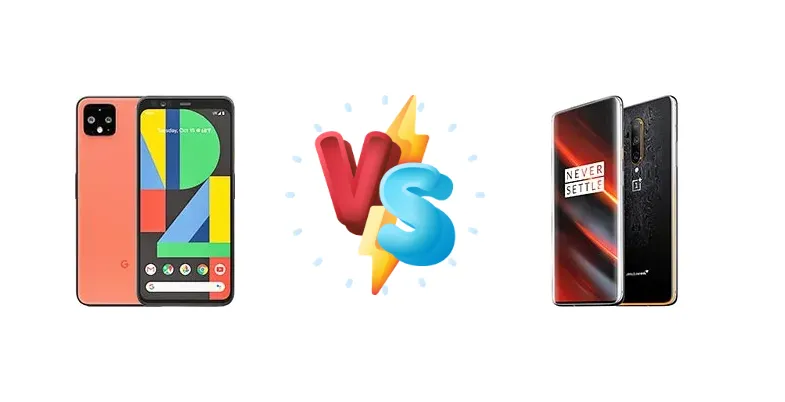
Pixel 4 vs OnePlus 7T Pro 5G McLaren: A Detailed Comparison of 2019 Flagships
| Phones Images | |||||
|---|---|---|---|---|---|
|
🏆 Quick Verdict
For the average user, the OnePlus 7T Pro 5G McLaren emerges as the stronger choice. Its Snapdragon 855+ chipset offers a slight performance edge, and the 30W charging significantly reduces downtime. While the Pixel 4 boasts a superior camera experience, the 7T Pro 5G McLaren’s overall package delivers more value.
| PHONES | ||
|---|---|---|
| Phone Names | Google Pixel 4 | OnePlus 7T Pro 5G McLaren |
| Network | ||
|---|---|---|
| 2G bands | GSM 850 / 900 / 1800 / 1900 | GSM 850 / 900 / 1800 / 1900 |
| 3G bands | HSDPA 850 / 900 / 1700(AWS) / 1900 / 2100 | HSDPA 850 / 900 / 1700(AWS) / 1900 / 2100 |
| 4G bands | 1, 2, 3, 4, 5, 7, 8, 12, 13, 17, 20, 25, 26, 28, 32, 38, 39, 40, 41, 66, 71 - Global | 1, 2, 3, 4, 5, 1, 2, 3, 4, 5, 7, 8, 12, 13, 17, 18, 19, 20, 25, 26, 28, 29, 30, 34, 38, 39, 40, 41, 46, 48, 66, 71 |
| 5G bands | - | 71 SA |
| Speed | HSPA 42.2/5.76 Mbps, LTE (5CA) Cat18 1200/150 Mbps | HSPA 42.2/5.76 Mbps, LTE (5CA) Cat18 1200/150 Mbps, 5G (2+ Gbps DL) |
| Technology | GSM / CDMA / HSPA / EVDO / LTE | GSM / CDMA / HSPA / LTE / 5G |
| 1, 2, 3, 4, 5, 7, 8, 12, 13, 14, 17, 18, 19, 20, 25, 26, 28, 29, 30, 38, 39, 40, 41, 46, 48, 66, 71 - USA | CDMA 800 / 1900 & TD-SCDMA | |
| Launch | ||
|---|---|---|
| Announced | 2019, October 15 | 2019, October 23. Released 2019, November 05 |
| Status | Available. Released 2019, October 22 | Discontinued |
| Body | ||
|---|---|---|
| Build | Glass front (Gorilla Glass 5), glass back (Gorilla Glass 5), aluminum frame | Glass front (Gorilla Glass 6), glass back (Gorilla Glass 5), aluminum frame |
| Dimensions | 147.1 x 68.8 x 8.2 mm (5.79 x 2.71 x 0.32 in) | 162.6 x 75.9 x 8.8 mm (6.40 x 2.99 x 0.35 in) |
| SIM | Nano-SIM + eSIM | Nano-SIM + Nano-SIM |
| Weight | 162 g (5.71 oz) | 206 g (7.27 oz) |
| IP68 dust/water resistant (up to 1.5m for 30 min) | - | |
| Display | ||
|---|---|---|
| Protection | Corning Gorilla Glass 5 | Corning Gorilla Glass 6 |
| Resolution | 1080 x 2280 pixels, 19:9 ratio (~444 ppi density) | 1440 x 3120 pixels, 19.5:9 ratio (~516 ppi density) |
| Size | 5.7 inches, 80.7 cm2 (~79.8% screen-to-body ratio) | 6.67 inches, 108.8 cm2 (~88.1% screen-to-body ratio) |
| Type | P-OLED, 90Hz, HDR | Fluid AMOLED, 90Hz, HDR10+ |
| Always-on display | - | |
| Platform | ||
|---|---|---|
| CPU | Octa-core (1x2.84 GHz Kryo 485 & 3x2.42 GHz Kryo 485 & 4x1.78 GHz Kryo 485) | Octa-core (1x2.96 GHz Kryo 485 & 3x2.42 GHz Kryo 485 & 4x1.78 GHz Kryo 485) |
| Chipset | Qualcomm SM8150 Snapdragon 855 (7 nm) | Qualcomm SM8150 Snapdragon 855+ (7 nm) |
| GPU | Adreno 640 | Adreno 640 (700 MHz) |
| OS | Android 10, upgradable to Android 13 | Android 10, OxygenOS 10.0 |
| Memory | ||
|---|---|---|
| Card slot | No | No |
| Internal | 64GB 6GB RAM, 128GB 6GB RAM | 256GB 12GB RAM |
| UFS 2.1 | UFS 3.0 | |
| Main Camera | ||
|---|---|---|
| Dual | 12.2 MP, f/1.7, 27mm (wide), 1/2.55", 1.4µm, dual pixel PDAF, OIS 16 MP, f/2.4, 50mm (telephoto), 1/3.6", 1.0µm, PDAF, OIS, 2x optical zoom | - |
| Features | Dual-LED flash, Pixel Shift, Auto-HDR, panorama | Laser AF, Dual-LED flash, HDR, panorama |
| Triple | - | 48 MP, f/1.6, (wide), 1/2.0", 0.8µm, PDAF, OIS 8 MP, f/2.4, (telephoto), 1.0µm, PDAF, OIS, 3x optical zoom 16 MP, f/2.2, 13mm (ultrawide), AF |
| Video | 4K@30fps, 1080p@30/60/120fps, 1080p@30fps (gyro-EIS) | 4K@30/60fps, 1080p@30/60/240fps, 720p@960fps, Auto HDR, gyro-EIS |
| Selfie camera | ||
|---|---|---|
| Features | HDR | HDR |
| Single | 8 MP, f/2.0, 22mm (wide), 1.22µm, no AF TOF 3D, (depth/biometrics sensor) | Motorized pop-up 16 MP, f/2.0, 25mm (wide), 1/3.06", 1.0µm |
| Video | 1080p@30fps | 1080p@30fps, gyro-EIS |
| Sound | ||
|---|---|---|
| 3.5mm jack | No | No |
| 35mm jack | No | No |
| Loudspeaker | Yes, with stereo speakers | Yes, with stereo speakers |
| Comms | ||
|---|---|---|
| Bluetooth | 5.0, A2DP, LE, aptX HD | 5.1, A2DP, LE, aptX HD |
| NFC | Yes | Yes |
| Positioning | GPS, GLONASS, BDS, GALILEO | GPS (L1+L5), GLONASS (G1), BDS (B1), GALILEO (E1+E5a) |
| Radio | No | No |
| USB | USB Type-C 3.1 | USB Type-C 3.1, OTG |
| WLAN | Wi-Fi 802.11 a/b/g/n/ac, dual-band, Wi-Fi Direct, DLNA | Wi-Fi 802.11 a/b/g/n/ac, dual-band, Wi-Fi Direct, DLNA |
| Features | ||
|---|---|---|
| Sensors | Face ID, accelerometer, gyro, proximity, compass, barometer | Fingerprint (under display, optical), accelerometer, gyro, compass |
| - | Virtual proximity sensing | |
| Battery | ||
|---|---|---|
| Charging | 18W wired, PD2.0 Wireless | 30W wired |
| Type | Li-Po 2800 mAh, non-removable | Li-Po 4085 mAh, non-removable |
| Misc | ||
|---|---|---|
| Colors | Clearly White, Just Black, Oh So Orange | Papaya Orange |
| Models | G020M, G020I, GA01188-US, GA01187-US, GA01189-US, GA01191-US, GA01189-US | HD1925 |
| Price | About 200 EUR | About 800 EUR |
| Tests | ||
|---|---|---|
| Audio quality | Noise -71.5dB / Crosstalk -69.8dB | - |
| Battery life | Endurance rating 62h | - |
| Camera | Photo / Video | - |
| Display | Contrast ratio: Infinite (nominal) | - |
| Loudspeaker | Voice 79dB / Noise 71dB / Ring 83dB | - |
| Performance | AnTuTu: 395351 (v8) GeekBench: 2542 (v5.1) GFXBench: 31fps (ES 3.1 onscreen) | - |
Google Pixel 4
- Exceptional camera quality and computational photography
- Clean and bloatware-free Android experience
- Compact and pocketable design
- Relatively slow charging speed (18W)
- Moderate battery life (62h endurance)
- Smaller display size may not appeal to all users
OnePlus 7T Pro 5G McLaren
- Faster Snapdragon 855+ processor
- Significantly faster charging (30W)
- Larger display for immersive media consumption
- Camera quality doesn't match the Pixel 4
- Larger size may be less comfortable for some
- OxygenOS, while clean, isn't as minimalist as stock Android
Display Comparison
The Pixel 4 features a 5.7-inch display capable of reaching 423 nits of peak brightness, while the OnePlus 7T Pro 5G McLaren boasts a larger 6.65-inch screen. While the OnePlus doesn't publish peak brightness, its AMOLED panel generally performs well in direct sunlight. Both displays offer an 'infinite' (nominal) contrast ratio typical of OLED technology. The Pixel 4’s smaller size makes it more pocketable, appealing to users who prefer a compact flagship. However, the 7T Pro 5G McLaren’s larger screen is better suited for media consumption and gaming.
Camera Comparison
The Pixel 4’s camera system is its defining feature, renowned for its exceptional image processing. While specific sensor details aren't provided in the context data, Google’s computational photography algorithms excel in dynamic range and low-light performance. The OnePlus 7T Pro 5G McLaren’s camera, while capable, doesn’t match the Pixel 4’s consistency. The 7T Pro 5G McLaren focuses on versatility with multiple lenses, but the Pixel 4’s single lens, coupled with software magic, often delivers superior results. Video quality is comparable, but the Pixel 4’s software stabilization is a standout feature.
Performance
Both phones utilize the Qualcomm Snapdragon 855, but the OnePlus 7T Pro 5G McLaren steps up to the Snapdragon 855+ variant. This 'plus' version features slightly higher clock speeds – 2.96 GHz on the McLaren versus 2.84 GHz on the Pixel 4 – resulting in a marginal performance boost in CPU-intensive tasks. Both share the same octa-core configuration (1x2.84/2.96 GHz Kryo 485, 3x2.42 GHz Kryo 485, 4x1.78 GHz Kryo 485). The 7T Pro 5G McLaren’s advantage is more noticeable in sustained workloads, where the improved thermal management of the 855+ can mitigate throttling. While both likely use LPDDR4X RAM, the 7T Pro 5G McLaren’s larger capacity (typically 12GB) provides better multitasking capabilities.
Battery Life
The Pixel 4 has an endurance rating of 62 hours, indicating moderate battery life. Its 18W wired charging with PD2.0 support is relatively slow compared to the OnePlus 7T Pro 5G McLaren’s 30W wired charging. The 7T Pro 5G McLaren can replenish its battery much faster, reducing downtime significantly. While the 7T Pro 5G McLaren’s battery capacity isn’t specified, the faster charging speed compensates for any potential capacity difference, making it the more convenient option for users who frequently need to top up their battery.
Buying Guide
Buy the Google Pixel 4 if you prioritize computational photography, a minimalist software experience, and timely Android updates. Its strength lies in consistently delivering excellent photos, even in challenging conditions. Buy the OnePlus 7T Pro 5G McLaren if you value raw performance, fast charging, and a more customizable Android experience. It’s the better option for power users and gamers who demand responsiveness and minimal interruptions.