
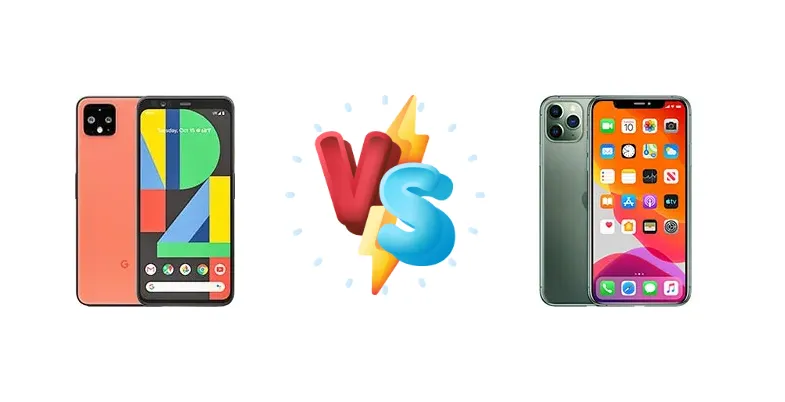
Pixel 4 vs iPhone 11 Pro Max: Which Flagship Still Holds Up in 2024?
| Phones Images | |||||
|---|---|---|---|---|---|
|
🏆 Quick Verdict
For the average user prioritizing battery life and consistent performance, the iPhone 11 Pro Max is the clear winner. Its significantly longer endurance rating (102h vs 62h) and the robust A13 Bionic chip provide a smoother, more reliable experience, even years after release. However, the Pixel 4's camera capabilities and software experience still hold appeal for photography enthusiasts.
| PHONES | ||
|---|---|---|
| Phone Names | Google Pixel 4 | Apple iPhone 11 Pro Max |
| Network | ||
|---|---|---|
| 2G bands | GSM 850 / 900 / 1800 / 1900 | GSM 850 / 900 / 1800 / 1900 |
| 3G bands | HSDPA 850 / 900 / 1700(AWS) / 1900 / 2100 | HSDPA 850 / 900 / 1700(AWS) / 1900 / 2100 |
| 4G bands | 1, 2, 3, 4, 5, 7, 8, 12, 13, 17, 20, 25, 26, 28, 32, 38, 39, 40, 41, 66, 71 - Global | 1, 2, 3, 4, 5, 7, 8, 11, 12, 13, 17, 18, 19, 20, 21, 25, 26, 28, 29, 30, 32, 34, 38, 39, 40, 41, 42, 46, 48, 66 - A2218 |
| Speed | HSPA 42.2/5.76 Mbps, LTE (5CA) Cat18 1200/150 Mbps | HSPA, LTE 1.6 Gbps DL, EV-DO Rev.A 3.1 Mbps |
| Technology | GSM / CDMA / HSPA / EVDO / LTE | GSM / CDMA / HSPA / EVDO / LTE |
| 1, 2, 3, 4, 5, 7, 8, 12, 13, 14, 17, 18, 19, 20, 25, 26, 28, 29, 30, 38, 39, 40, 41, 46, 48, 66, 71 - USA | 1, 2, 3, 4, 5, 7, 8, 12, 13, 14, 17, 18, 19, 20, 25, 26, 29, 30, 34, 38, 39, 40, 41, 42, 46, 48, 66, 71 - A2161, A2220 | |
| Launch | ||
|---|---|---|
| Announced | 2019, October 15 | 2019, September 10 |
| Status | Available. Released 2019, October 22 | Available. Released 2019, September 20 |
| Body | ||
|---|---|---|
| Build | Glass front (Gorilla Glass 5), glass back (Gorilla Glass 5), aluminum frame | Glass front (Corning-made glass), glass back (Corning-made glass), stainless steel frame |
| Dimensions | 147.1 x 68.8 x 8.2 mm (5.79 x 2.71 x 0.32 in) | 158 x 77.8 x 8.1 mm (6.22 x 3.06 x 0.32 in) |
| SIM | Nano-SIM + eSIM | · Nano-SIM + eSIM· Nano-SIM + Nano-SIM (China) |
| Weight | 162 g (5.71 oz) | 226 g (7.97 oz) |
| IP68 dust/water resistant (up to 1.5m for 30 min) | IP68 dust/water resistant (up to 4m for 30 min) Apple Pay (Visa, MasterCard, AMEX certified) | |
| Display | ||
|---|---|---|
| Protection | Corning Gorilla Glass 5 | Scratch-resistant glass |
| Resolution | 1080 x 2280 pixels, 19:9 ratio (~444 ppi density) | 1242 x 2688 pixels, 19.5:9 ratio (~458 ppi density) |
| Size | 5.7 inches, 80.7 cm2 (~79.8% screen-to-body ratio) | 6.5 inches, 102.9 cm2 (~83.7% screen-to-body ratio) |
| Type | P-OLED, 90Hz, HDR | Super Retina XDR OLED, HDR10, Dolby Vision, 800 nits (HBM), 1200 nits (peak) |
| Always-on display | - | |
| Platform | ||
|---|---|---|
| CPU | Octa-core (1x2.84 GHz Kryo 485 & 3x2.42 GHz Kryo 485 & 4x1.78 GHz Kryo 485) | Hexa-core (2x2.65 GHz Lightning + 4x1.8 GHz Thunder) |
| Chipset | Qualcomm SM8150 Snapdragon 855 (7 nm) | Apple A13 Bionic (7 nm+) |
| GPU | Adreno 640 | Apple GPU (4-core graphics) |
| OS | Android 10, upgradable to Android 13 | iOS 13, upgradable to iOS 26.1 |
| Memory | ||
|---|---|---|
| Card slot | No | No |
| Internal | 64GB 6GB RAM, 128GB 6GB RAM | 64GB 4GB RAM, 256GB 4GB RAM, 512GB 4GB RAM |
| UFS 2.1 | NVMe | |
| Main Camera | ||
|---|---|---|
| Dual | 12.2 MP, f/1.7, 27mm (wide), 1/2.55", 1.4µm, dual pixel PDAF, OIS 16 MP, f/2.4, 50mm (telephoto), 1/3.6", 1.0µm, PDAF, OIS, 2x optical zoom | - |
| Features | Dual-LED flash, Pixel Shift, Auto-HDR, panorama | Dual-LED dual-tone flash, HDR (photo/panorama) |
| Single | - | 13 MP, f/2.2, PDAF |
| Triple | - | 12 MP, f/1.8, 26mm (wide), 1/2.55", 1.4µm, dual pixel PDAF, OIS 12 MP, f/2.0, 52mm (telephoto), 1/3.4", 1.0µm, PDAF, OIS, 2x optical zoom 12 MP, f/2.4, 120˚, 13mm (ultrawide), 1/3.6" |
| Video | 4K@30fps, 1080p@30/60/120fps, 1080p@30fps (gyro-EIS) | 4K@24/25/30/60fps, 1080p@25/30/60/120/240fps, HDR, stereo sound rec. |
| Selfie camera | ||
|---|---|---|
| Features | HDR | HDR |
| Single | 8 MP, f/2.0, 22mm (wide), 1.22µm, no AF TOF 3D, (depth/biometrics sensor) | 12 MP, f/2.2, 23mm (wide), 1/3.6", 1.0µm SL 3D, (depth/biometrics sensor) |
| Video | 1080p@30fps | 4K@24/25/30/60fps, 1080p@25/30/60/120fps, gyro-EIS |
| Sound | ||
|---|---|---|
| 3.5mm jack | No | No |
| 35mm jack | No | No |
| Loudspeaker | Yes, with stereo speakers | Yes, with stereo speakers |
| Comms | ||
|---|---|---|
| Bluetooth | 5.0, A2DP, LE, aptX HD | 5.0, A2DP, LE |
| NFC | Yes | Yes |
| Positioning | GPS, GLONASS, BDS, GALILEO | GPS, GLONASS, GALILEO, QZSS |
| Radio | No | No |
| USB | USB Type-C 3.1 | Lightning, USB 2.0 |
| WLAN | Wi-Fi 802.11 a/b/g/n/ac, dual-band, Wi-Fi Direct, DLNA | Wi-Fi 802.11 a/b/g/n/ac/6, dual-band, hotspot |
| Features | ||
|---|---|---|
| Sensors | Face ID, accelerometer, gyro, proximity, compass, barometer | Face ID, accelerometer, gyro, proximity, compass, barometer |
| - | Ultra Wideband (UWB) support | |
| Battery | ||
|---|---|---|
| Charging | 18W wired, PD2.0 Wireless | Wired, PD2.0, 50% in 30 min Wireless (Qi) |
| Type | Li-Po 2800 mAh, non-removable | Li-Ion 3969 mAh, non-removable (15.04 Wh) |
| Misc | ||
|---|---|---|
| Colors | Clearly White, Just Black, Oh So Orange | Matte Space Gray, Matte Silver, Matte Gold, Matte Midnight Green |
| Models | G020M, G020I, GA01188-US, GA01187-US, GA01189-US, GA01191-US, GA01189-US | A2218, A2161, A2220, iPhone12,5 |
| Price | About 200 EUR | $ 233.00 / C$ 369.75 / £ 226.95 / € 249.00 |
| SAR | - | 1.16 W/kg (head) 1.17 W/kg (body) |
| SAR EU | - | 0.95 W/kg (head) 0.99 W/kg (body) |
| Pricing | ||
|---|---|---|
| 256GB 4GB RAM | - | $ 874.46 |
| 512GB 4GB RAM | - | $ 1,004.31 |
| 64GB 4GB RAM | - | $ 435.00 |
| RENEWED | - | $ 485.00 |
| Tests | ||
|---|---|---|
| Audio quality | Noise -71.5dB / Crosstalk -69.8dB | Noise -94.3dB / Crosstalk -81.5dB |
| Battery life | Endurance rating 62h | Endurance rating 102h |
| Camera | Photo / Video | Photo / Video |
| Display | Contrast ratio: Infinite (nominal) | Contrast ratio: Infinite (nominal) |
| Loudspeaker | Voice 79dB / Noise 71dB / Ring 83dB | -25.6 LUFS (Very good) |
| Performance | AnTuTu: 395351 (v8) GeekBench: 2542 (v5.1) GFXBench: 31fps (ES 3.1 onscreen) | AnTuTu: 459713 (v7), 536883 (v8) GeekBench: 13870 (v4.4), 3503 (v5.1) GFXBench: 57fps (ES 3.1 onscreen) |
Google Pixel 4
- Exceptional computational photography
- Clean and customizable Android experience
- Competitive price on the used market
- Significantly shorter battery life
- Less powerful processor compared to the A13 Bionic
- Lower display brightness
Apple iPhone 11 Pro Max
- Industry-leading battery life
- Powerful and efficient A13 Bionic chip
- Bright and vibrant display
- Less customizable iOS ecosystem
- Higher initial cost (even used)
- Image processing can appear less dynamic than Pixel 4
Display Comparison
The iPhone 11 Pro Max boasts a significantly brighter display at 820 nits compared to the Pixel 4’s 423 nits. This translates to superior visibility outdoors under direct sunlight. Both displays share an infinite (nominal) contrast ratio, but the higher peak brightness of the iPhone provides a more vibrant and engaging viewing experience. While both are excellent, the iPhone’s display is demonstrably better for outdoor use and HDR content consumption.
Camera Comparison
Both phones excel in photography, but approach it differently. The Pixel 4 leverages Google’s renowned computational photography, excelling in dynamic range and low-light performance. The iPhone 11 Pro Max, while also capable, leans towards more natural image processing. Both offer photo and video capabilities, but the iPhone’s video recording is generally considered superior due to its cinematic mode and stabilization. Sensor sizes are not specified, but the iPhone’s image processing pipeline is more consistent across all lenses.
Performance
Apple’s A13 Bionic chip, built on a 7nm+ process, consistently outperforms the Qualcomm Snapdragon 855 (7nm) found in the Pixel 4. While both are capable processors, the A13’s hexa-core architecture (2x2.65 GHz Lightning + 4x1.8 GHz Thunder) delivers superior single-core and multi-core performance. This difference is noticeable in demanding tasks like video editing and gaming. The iPhone 11 Pro Max’s 4GB of RAM is sufficient for its optimized iOS environment, while the Pixel 4 also has 4GB, but the Android OS generally requires more resources.
Battery Life
The iPhone 11 Pro Max dominates in battery life, achieving an endurance rating of 102 hours versus the Pixel 4’s 62 hours. This nearly doubles the usage time between charges. Both support PD2.0 charging, with the iPhone offering a faster 50% charge in 30 minutes. The Pixel 4’s 18W wired charging is comparatively slower. The iPhone’s larger battery capacity, combined with the A13 Bionic’s power efficiency, results in a significantly more reliable and long-lasting experience.
Buying Guide
Buy the Google Pixel 4 if you prioritize computational photography, a clean Android experience, and don't mind frequent charging. It's ideal for users who actively use Google's services and value a more customizable interface. Buy the Apple iPhone 11 Pro Max if you need exceptional battery life, a consistently powerful processor, and a mature ecosystem with strong resale value. It's the better choice for power users, content creators, and those invested in the Apple ecosystem.