
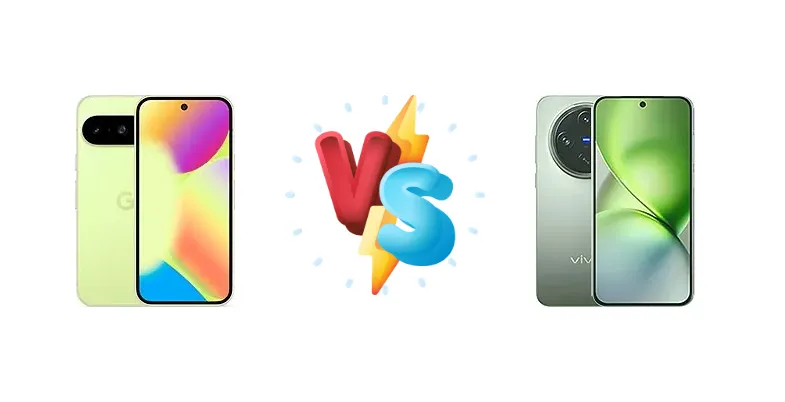
Pixel 10 vs. vivo X200 Pro mini: A Deep Dive into Two Android Flagships
| Phones Images | |||||
|---|---|---|---|---|---|
|
🏆 Quick Verdict
For the average user prioritizing software experience and long-term battery health, the Google Pixel 10 is the better choice. Its 49:23h endurance and 1000 cycle battery promise longevity. However, the vivo X200 Pro mini’s 90W charging is a game-changer for those who value speed and convenience.
| PHONES | ||
|---|---|---|
| Phone Names | Google Pixel 10 | vivo X200 Pro mini |
| Network | ||
|---|---|---|
| 2G bands | GSM 850 / 900 / 1800 / 1900 | GSM 850 / 900 / 1800 / 1900 |
| 3G bands | HSDPA 800 / 850 / 900 / 1700(AWS) / 1900 / 2100 | HSDPA 800 / 850 / 900 / 1700(AWS) / 1900 / 2100 |
| 4G bands | 1, 2, 3, 4, 5, 7, 8, 12, 13, 14, 17, 18, 19, 20, 21, 25, 26, 29, 30, 30, 32, 38, 39, 40 , 41, 42, 48, 66, 71, 75 - GK2MP | 1, 2, 3, 4, 5, 7, 8, 18, 19, 26, 28, 34, 38, 39, 40, 41, 66 |
| 5G bands | 1, 2, 3, 5, 7, 8, 12, 14, 20, 25, 26, 28, 38, 40, 46, 71, 75, 76, 77, 78, 79 SA/NSA/Sub6 - GK2MP | 1, 3, 5, 8, 28, 38, 40, 41, 77, 78 SA/NSA |
| Speed | HSPA, LTE (CA), 5G | HSPA, LTE, 5G |
| Technology | GSM / HSPA / LTE / 5G | GSM / HSPA / LTE / 5G |
| Launch | ||
|---|---|---|
| Announced | 2025, August 20 | 2024, October 14 |
| Status | Available. Released 2025, August 28 | Available. Released 2024, October 25 |
| Body | ||
|---|---|---|
| Build | Glass front (Gorilla Glass Victus 2), glass back (Gorilla Glass Victus 2), aluminum frame | Glass front, aluminum alloy frame |
| Dimensions | 152.8 x 72 x 8.6 mm (6.02 x 2.83 x 0.34 in) | 150.8 x 71.8 x 8.2 mm (5.94 x 2.83 x 0.32 in) |
| SIM | · Nano-SIM + eSIM· eSIM + eSIM (8 or more, max 2 at a time; USA) | Nano-SIM + Nano-SIM |
| Weight | 204 g (7.20 oz) | 187 g (6.60 oz) |
| Display | ||
|---|---|---|
| Protection | Corning Gorilla Glass Victus 2, Mohs level 4 | - |
| Resolution | 1080 x 2424 pixels, 20:9 ratio (~422 ppi density) | 1216 x 2640 pixels, 19.5:9 ratio (~460 ppi density) |
| Size | 6.3 inches, 94.7 cm2 (~86.1% screen-to-body ratio) | 6.31 inches, 98.0 cm2 (~90.5% screen-to-body ratio) |
| Type | OLED, 120Hz, HDR10+, 2000 nits (HBM), 3000 nits (peak) | LTPO AMOLED, 1B colors, 120Hz, 2160Hz PWM, HDR10+, 4500 nits (peak) |
| Platform | ||
|---|---|---|
| CPU | Octa-core (1x3.78 GHz Cortex-X4 & 5x3.05 GHz Cortex-A725 & 2x2.25 GHz Cortex-A520) | Octa-core (1x3.63 GHz Cortex-X925 & 3x3.3 GHz Cortex-X4 & 4x2.4 GHz Cortex-A720) |
| Chipset | Google Tensor G5 (3 nm) | Mediatek Dimensity 9400 (3 nm) |
| GPU | PowerVR DXT-48-1536 | Immortalis-G925 |
| OS | Android 16, up to 7 major Android upgrades | Android 15, OriginOS 5 (China) |
| Memory | ||
|---|---|---|
| Card slot | No | No |
| Internal | 128GB 12GB RAM, 256GB 12GB RAM | 256GB 12GB RAM, 512GB 12GB RAM, 512GB 16GB RAM, 1TB 16GB RAM |
| Main Camera | ||
|---|---|---|
| Features | Single-zone Laser AF, LED flash, Pixel Shift, Ultra-HDR, panorama, Best Take | Laser AF, Zeiss optics, Zeiss T* lens coating, LED flash, panorama, HDR |
| Triple | 48 MP, f/1.7, 25mm (wide), 1/2.0", 0.8µm, dual pixel PDAF, OIS 10.8 MP, f/3.1, 112mm (telephoto), 1/3.2", dual pixel PDAF, OIS, 5x optical zoom 13 MP, f/2.2, 120˚ (ultrawide), 1/3.1", PDAF | 50 MP, f/1.6, 23mm (wide), 1/1.28", 1.22µm, PDAF, OIS 50 MP, f/2.6, 70mm (periscope telephoto), 1/1.95", PDAF, OIS, 3x optical zoom 50 MP, f/2.0, 15mm, 119˚ (ultrawide), 1/2.76", 0.64µm, AF |
| Video | 4K@24/30/60fps, 1080p@24/30/60/120/240fps; gyro-EIS, OIS, 10-bit HDR | 4K@30/60fps, 1080p@30/60/120fps, gyro-EIS, HDR |
| Selfie camera | ||
|---|---|---|
| Features | HDR, panorama | HDR |
| Single | 10.5 MP, f/2.2, 95˚, 20mm (ultrawide), 1/3.1", 1.22µm, PDAF | 32 MP, f/2.0, 20mm (ultrawide) |
| Video | 4K@30/60fps, 1080p@30/60fps | 4K, 1080p |
| Sound | ||
|---|---|---|
| 35mm jack | No | No |
| Loudspeaker | Yes, with stereo speakers | Yes, with stereo speakers |
| Comms | ||
|---|---|---|
| Bluetooth | 6.0, A2DP, LE, aptX HD | 5.4, A2DP, LE, aptX HD, LHDC 5 |
| Infrared port | - | Yes |
| NFC | Yes | Yes |
| Positioning | GPS (L1+L5), GLONASS, GALILEO, BDS, QZSS, NavIC | GPS (L1+L5), GLONASS (L1), BDS (B1I+B1c+B2a+B2b), GALILEO (E1+E5a+E5b), QZSS (L1+L5), NavIC (L5) |
| Radio | No | No |
| USB | USB Type-C 3.2 | USB Type-C 2.0, OTG |
| WLAN | Wi-Fi 802.11 a/b/g/n/ac/6e, dual-band | Wi-Fi 802.11 a/b/g/n/ac/6/7, dual-band |
| Features | ||
|---|---|---|
| Sensors | Fingerprint (under display, ultrasonic), accelerometer, gyro, proximity, compass, barometer | Fingerprint (under display, optical), accelerometer, gyro, proximity, compass |
| Battery | ||
|---|---|---|
| Charging | 30W wired, PD3.0, PPS, 55% in 30 minutes 15W wireless (magnetic), Qi2 Reverse wired Bypass charging | 90W wired 30W wireless Reverse wired |
| Type | Li-Ion 4970 mAh | Si/C Li-Ion 5700 mAh |
| Misc | ||
|---|---|---|
| Colors | Indigo, Frost, Lemongrass, Obsidian | Black, White, Green, Pink |
| Models | GK2MP, GLBW0, GL066 | V2419A |
| Price | $ 583.50 / C$ 849.99 / £ 599.00 / € 637.10 / ₹ 68,918 | About 610 EUR |
| SAR | 1.18 W/kg (head) 0.99 W/kg (body) | - |
| SAR EU | 0.99 W/kg (head) 1.39 W/kg (body) | - |
| EU LABEL | ||
|---|---|---|
| Battery | 49:23h endurance, 1000 cycles | - |
| Energy | Class B | - |
| Free fall | Class A (270 falls) | - |
| Repairability | Class B | - |
Google Pixel 10
- Exceptional battery life (49:23h endurance)
- Long-term battery health (1000 cycles)
- Superior display brightness (2030 nits)
- Slower charging speed (30W wired)
- Potentially less raw CPU performance than the Dimensity 9400
vivo X200 Pro mini
- Blazing-fast 90W wired charging
- Potentially higher CPU performance with Dimensity 9400
- Compact form factor (implied by 'mini' designation)
- Likely shorter battery life compared to Pixel 10
- Software experience may not match Pixel's polish
Display Comparison
The Pixel 10 boasts a significantly brighter display, reaching a measured 2030 nits, which will be a boon for outdoor visibility. While the X200 Pro mini’s display specs are not provided, vivo typically employs high-quality AMOLED panels. The Pixel 10’s brightness advantage suggests superior HDR performance and readability in direct sunlight. The absence of refresh rate information for the vivo device makes a direct comparison difficult, but the Pixel 10 is likely to offer a smoother experience if it utilizes an adaptive LTPO panel.
Camera Comparison
Without detailed camera specifications for either device, a direct comparison is limited. However, Google’s Pixel line is renowned for its computational photography prowess, leveraging AI to deliver exceptional image quality. The Tensor G5 chip is specifically designed to accelerate these processes. The X200 Pro mini will likely rely on MediaTek’s image signal processor (ISP) and vivo’s image processing algorithms. The absence of sensor size information makes it difficult to assess low-light performance, but the Pixel’s software optimizations often compensate for smaller sensors. We expect both phones to offer excellent image quality, but with different aesthetic signatures.
Performance
Both the Google Tensor G5 and the MediaTek Dimensity 9400 are built on a 3nm process, promising efficiency gains. However, the Dimensity 9400’s CPU configuration – featuring a Cortex-X925 prime core alongside three Cortex-X4 cores – suggests a potential edge in raw processing power compared to the Pixel 10’s Cortex-X4 based setup. The X200 Pro mini’s CPU also has more X4 cores (3 vs 5 on the Pixel). This difference could translate to faster app loading and smoother multitasking, particularly in demanding applications. Thermal management will be crucial; the Dimensity 9400’s higher peak performance may require more aggressive cooling to prevent throttling.
Battery Life
The Pixel 10’s 49:23h endurance is a standout feature, indicating exceptional battery life. This is further reinforced by its 1000 charge cycle rating, suggesting a battery designed for longevity. The X200 Pro mini compensates with its 90W wired charging, capable of delivering a 55% charge in 30 minutes, significantly faster than the Pixel 10’s 30W charging. While the X200 Pro mini also offers 30W wireless charging, the Pixel 10’s 15W magnetic wireless charging (Qi2) is slower. The Pixel 10 prioritizes longevity, while the X200 Pro mini prioritizes speed.
Buying Guide
Buy the Google Pixel 10 if you need a consistently smooth software experience, prioritize AI-powered features like Magic Eraser, and value exceptional battery longevity with a focus on long-term reliability. Buy the vivo X200 Pro mini if you prefer blazing-fast charging, a more compact design, and are willing to trade some software polish for raw performance and charging convenience.