
Google Pixel 10 vs. Samsung Galaxy Z Fold6: A Deep Dive into Foldable Flagship Performance
| Phones Images | |||||
|---|---|---|---|---|---|
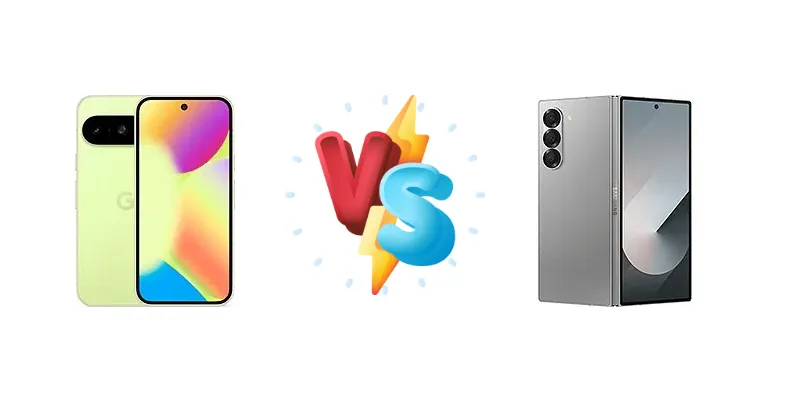
|
🏆 Quick Verdict
For the average user prioritizing longevity and display quality, the Google Pixel 10 emerges as the winner. Its significantly longer 49:23h battery endurance and 2030 nit peak brightness outweigh the Z Fold6’s raw processing power. However, power users demanding maximum performance and the unique foldable experience will find the Z Fold6 compelling.
| PHONES | ||
|---|---|---|
| Phone Names | Google Pixel 10 | Samsung Galaxy Z Fold6 |
| Network | ||
|---|---|---|
| 2G bands | GSM 850 / 900 / 1800 / 1900 | GSM 850 / 900 / 1800 / 1900 |
| 3G bands | HSDPA 800 / 850 / 900 / 1700(AWS) / 1900 / 2100 | HSDPA 850 / 900 / 1700(AWS) / 1900 / 2100 |
| 4G bands | 1, 2, 3, 4, 5, 7, 8, 12, 13, 14, 17, 18, 19, 20, 21, 25, 26, 29, 30, 30, 32, 38, 39, 40 , 41, 42, 48, 66, 71, 75 - GK2MP | 1, 2, 3, 4, 5, 7, 8, 12, 13, 17, 18, 19, 20, 25, 26, 28, 32, 38, 39, 40, 41, 66 - International |
| 5G bands | 1, 2, 3, 5, 7, 8, 12, 14, 20, 25, 26, 28, 38, 40, 46, 71, 75, 76, 77, 78, 79 SA/NSA/Sub6 - GK2MP | 1, 2, 3, 5, 7, 8, 12, 20, 25, 26, 28, 38, 40, 41, 66, 75, 77, 78 SA/NSA/Sub6 - International |
| Speed | HSPA, LTE (CA), 5G | HSPA, LTE, 5G |
| Technology | GSM / HSPA / LTE / 5G | GSM / CDMA / HSPA / EVDO / LTE / 5G |
| Launch | ||
|---|---|---|
| Announced | 2025, August 20 | 2024, July 10 |
| Status | Available. Released 2025, August 28 | Available. Released 2024, July 24 |
| Body | ||
|---|---|---|
| Build | Glass front (Gorilla Glass Victus 2), glass back (Gorilla Glass Victus 2), aluminum frame | Glass front (Gorilla Glass Victus 2) (folded), plastic front (unfolded), glass back (Gorilla Glass Victus 2), aluminum frame |
| Dimensions | 152.8 x 72 x 8.6 mm (6.02 x 2.83 x 0.34 in) | Unfolded: 153.5 x 132.6 x 5.6 mmFolded: 153.5 x 68.1 x 12.1 mm |
| SIM | · Nano-SIM + eSIM· eSIM + eSIM (8 or more, max 2 at a time; USA) | · Nano-SIM + eSIM· eSIM + eSIM· Nano-SIM + Nano-SIM (SM-F9560) |
| Weight | 204 g (7.20 oz) | 239 g (8.43 oz) |
| Display | ||
|---|---|---|
| Protection | Corning Gorilla Glass Victus 2, Mohs level 4 | - |
| Resolution | 1080 x 2424 pixels, 20:9 ratio (~422 ppi density) | 1856 x 2160 pixels (~374 ppi density) |
| Size | 6.3 inches, 94.7 cm2 (~86.1% screen-to-body ratio) | 7.6 inches, 185.2 cm2 (~91.0% screen-to-body ratio) |
| Type | OLED, 120Hz, HDR10+, 2000 nits (HBM), 3000 nits (peak) | Foldable Dynamic LTPO AMOLED 2X, 120Hz, HDR10+, 2600 nits (peak) |
| Platform | ||
|---|---|---|
| CPU | Octa-core (1x3.78 GHz Cortex-X4 & 5x3.05 GHz Cortex-A725 & 2x2.25 GHz Cortex-A520) | 8-core (1x3.39GHz Cortex-X4 & 3x3.1GHz Cortex-A720 & 2x2.9GHz Cortex-A720 & 2x2.2GHz Cortex-A520) |
| Chipset | Google Tensor G5 (3 nm) | Qualcomm SM8650-AC Snapdragon 8 Gen 3 (4 nm) |
| GPU | PowerVR DXT-48-1536 | Adreno 750 (1 GHz) |
| OS | Android 16, up to 7 major Android upgrades | Android 14, up to 7 major Android upgrades, One UI 6.1.1 |
| Memory | ||
|---|---|---|
| Card slot | No | No |
| Internal | 128GB 12GB RAM, 256GB 12GB RAM | 256GB 12GB RAM, 512GB 12GB RAM, 1TB 12GB RAM |
| Main Camera | ||
|---|---|---|
| Features | Single-zone Laser AF, LED flash, Pixel Shift, Ultra-HDR, panorama, Best Take | LED flash, HDR, panorama |
| Triple | 48 MP, f/1.7, 25mm (wide), 1/2.0", 0.8µm, dual pixel PDAF, OIS 10.8 MP, f/3.1, 112mm (telephoto), 1/3.2", dual pixel PDAF, OIS, 5x optical zoom 13 MP, f/2.2, 120˚ (ultrawide), 1/3.1", PDAF | 50 MP, f/1.8, 23mm (wide), 1/1.57", 1.0µm, dual pixel PDAF, OIS 10 MP, f/2.4, 66mm (telephoto), 1/3.94", 1.0µm, PDAF, OIS, 3x optical zoom 12 MP, f/2.2, 123˚, 12mm (ultrawide), 1/3.2", 1.12µm |
| Video | 4K@24/30/60fps, 1080p@24/30/60/120/240fps; gyro-EIS, OIS, 10-bit HDR | 8K@30fps, 4K@60fps, 1080p@60/120/240fps (gyro-EIS), HDR10+ |
| Selfie camera | ||
|---|---|---|
| Features | HDR, panorama | HDR |
| Single | 10.5 MP, f/2.2, 95˚, 20mm (ultrawide), 1/3.1", 1.22µm, PDAF | 4 MP, f/1.8, 26mm (wide), 1/3.0", 2.0µm, under display Cover camera: 10 MP, f/2.2, 24mm (wide), 1/3.0", 1.22µm |
| Video | 4K@30/60fps, 1080p@30/60fps | 4K@30/60fps, 1080p@30/60fps, gyro-EIS |
| Sound | ||
|---|---|---|
| 35mm jack | No | No |
| Loudspeaker | Yes, with stereo speakers | Yes, with stereo speakers |
| Comms | ||
|---|---|---|
| Bluetooth | 6.0, A2DP, LE, aptX HD | 5.3, A2DP, LE, aptX HD |
| NFC | Yes | Yes |
| Positioning | GPS (L1+L5), GLONASS, GALILEO, BDS, QZSS, NavIC | GPS, GALILEO, GLONASS, BDS, QZSS |
| Radio | No | No |
| USB | USB Type-C 3.2 | USB Type-C 3.2, OTG |
| WLAN | Wi-Fi 802.11 a/b/g/n/ac/6e, dual-band | Wi-Fi 802.11 a/b/g/n/ac/6e, tri-band, Wi-Fi Direct |
| Features | ||
|---|---|---|
| Sensors | Fingerprint (under display, ultrasonic), accelerometer, gyro, proximity, compass, barometer | Fingerprint (side-mounted), accelerometer, gyro, proximity, compass, barometer |
| Battery | ||
|---|---|---|
| Charging | 30W wired, PD3.0, PPS, 55% in 30 minutes 15W wireless (magnetic), Qi2 Reverse wired Bypass charging | 25W wired, QC2.0, 50% in 30 min 15W wireless 4.5W reverse wireless |
| Type | Li-Ion 4970 mAh | Li-Po 4400 mAh |
| Misc | ||
|---|---|---|
| Colors | Indigo, Frost, Lemongrass, Obsidian | Navy, Silver Shadow, Pink, Black, White |
| Models | GK2MP, GLBW0, GL066 | SM-F956B, SM-F956B/DS, SM-F956U, SM-F956U1, SM-F956N, SM-F956W, SM-F9560 |
| Price | $ 583.50 / C$ 849.99 / £ 599.00 / € 637.10 / ₹ 68,918 | € 670.13 / $ 799.95 / £ 789.99 / ₹ 109,999 |
| SAR | 1.18 W/kg (head) 0.99 W/kg (body) | - |
| SAR EU | 0.99 W/kg (head) 1.39 W/kg (body) | 1.24 W/kg (head) 1.39 W/kg (body) |
| EU LABEL | ||
|---|---|---|
| Battery | 49:23h endurance, 1000 cycles | - |
| Energy | Class B | - |
| Free fall | Class A (270 falls) | - |
| Repairability | Class B | - |
Google Pixel 10
- Exceptional battery life (49:23h endurance)
- Incredibly bright display (2030 nits)
- Google’s AI-powered software features
- Potentially less raw processing power than Snapdragon
- No foldable screen for multitasking
Samsung Galaxy Z Fold6
- Powerful Snapdragon 8 Gen 3 processor
- Innovative foldable display for multitasking
- Large screen real estate
- Significantly shorter battery life
- Crease in the foldable display
- Slower charging speeds
Display Comparison
The Pixel 10’s display dominates in brightness, achieving a measured peak of 2030 nits compared to the Z Fold6’s 1630 nits. This translates to superior visibility in direct sunlight. While both likely employ LTPO technology for variable refresh rates (based on market trends), the Pixel 10’s higher peak brightness is a clear advantage. The Z Fold6’s foldable nature introduces a crease, a trade-off for the larger screen real estate, which the Pixel 10 avoids entirely. Color accuracy is likely comparable, but the Pixel 10’s brightness will provide a more impactful viewing experience.
Camera Comparison
Without detailed camera specs, analysis focuses on processing. The Pixel 10 is renowned for its computational photography prowess, leveraging Google’s AI algorithms for exceptional image quality, particularly in challenging lighting conditions. The Z Fold6, while equipped with a capable camera system, typically leans towards more saturated and vibrant image processing. The Snapdragon 8 Gen 3’s ISP (Image Signal Processor) is powerful, but Google’s software optimization often compensates for hardware differences. The absence of detailed sensor information makes a direct comparison difficult, but the Pixel 10’s software advantage is a significant factor.
Performance
The Z Fold6 leverages the Qualcomm Snapdragon 8 Gen 3 (4nm) chipset, featuring an 8-core CPU configuration with a peak clock speed of 3.39GHz. The Pixel 10 counters with Google’s Tensor G5 (3nm) processor, boasting a 1x3.78 GHz Cortex-X4 prime core. While the Snapdragon 8 Gen 3 generally offers higher sustained performance in benchmarks, the Tensor G5’s 3nm process node promises improved power efficiency. The Pixel 10’s CPU configuration, with more cores at a slightly higher clock speed on the prime core, suggests strong multi-tasking capabilities. However, the Snapdragon’s Adreno GPU will likely provide a more substantial edge in graphically intensive tasks like gaming. Both devices will likely utilize LPDDR5x RAM, but the Z Fold6’s larger internal storage options could impact sustained performance under heavy load.
Battery Life
The Pixel 10’s battery endurance of 49:23h is a standout feature, significantly exceeding the Z Fold6’s active use score of 11:31h. This difference is likely due to the Tensor G5’s power efficiency and Google’s software optimizations. The Pixel 10 supports 30W wired charging with PD3.0 and PPS, reaching 55% in 30 minutes, alongside 15W magnetic wireless charging (Qi2) and reverse wired charging. The Z Fold6 offers 25W wired charging with QC2.0, achieving 50% in 30 minutes, and 15W wireless charging, but only 4.5W reverse wireless. The Pixel 10’s faster charging and superior battery life provide a more convenient and reliable user experience.
Buying Guide
Buy the Google Pixel 10 if you need a phone that lasts all day and beyond, prioritizes a vibrant and easily viewable display, and values Google’s clean software experience. Buy the Samsung Galaxy Z Fold6 if you prefer a larger, more immersive screen for multitasking, demand the latest Qualcomm Snapdragon performance, and are willing to trade some battery life for the innovative foldable form factor.