
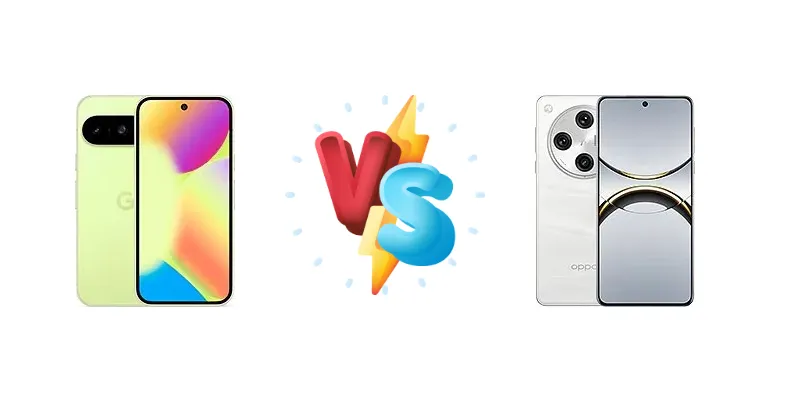
Google Pixel 10 vs Oppo Find X8 Pro: A Deep Dive into Flagship Android
| Phones Images | |||||
|---|---|---|---|---|---|
|
🏆 Quick Verdict
For the average user prioritizing long-term software support and AI features, the Google Pixel 10 is the better choice. Its 49:23h battery endurance and Tensor G5's optimized performance offer a smooth, reliable experience. However, the Oppo Find X8 Pro excels for power users demanding the fastest charging and peak performance.
| PHONES | ||
|---|---|---|
| Phone Names | Google Pixel 10 | Oppo Find X8 Pro |
| Network | ||
|---|---|---|
| 2G bands | GSM 850 / 900 / 1800 / 1900 | GSM 850 / 900 / 1800 / 1900 |
| 3G bands | HSDPA 800 / 850 / 900 / 1700(AWS) / 1900 / 2100 | HSDPA 800 / 850 / 900 / 1700(AWS) / 1900 / 2100 |
| 4G bands | 1, 2, 3, 4, 5, 7, 8, 12, 13, 14, 17, 18, 19, 20, 21, 25, 26, 29, 30, 30, 32, 38, 39, 40 , 41, 42, 48, 66, 71, 75 - GK2MP | 1, 2, 3, 4, 5, 7, 8, 12, 13, 17, 18, 19, 20, 25, 26, 28, 32, 38, 39, 40, 41, 66 - International |
| 5G bands | 1, 2, 3, 5, 7, 8, 12, 14, 20, 25, 26, 28, 38, 40, 46, 71, 75, 76, 77, 78, 79 SA/NSA/Sub6 - GK2MP | 1, 2, 3, 5, 7, 8, 12, 20, 25, 26, 28, 38, 40, 41, 66, 75, 77, 78 SA/NSA - International |
| Speed | HSPA, LTE (CA), 5G | HSPA, LTE, 5G |
| Technology | GSM / HSPA / LTE / 5G | GSM / HSPA / LTE / 5G |
| Launch | ||
|---|---|---|
| Announced | 2025, August 20 | 2024, October 24 |
| Status | Available. Released 2025, August 28 | Available. Released 2024, October 30 |
| Body | ||
|---|---|---|
| Build | Glass front (Gorilla Glass Victus 2), glass back (Gorilla Glass Victus 2), aluminum frame | Glass front (Gorilla Glass 7i), glass back (Gorilla Glass 7i), aluminum frame |
| Dimensions | 152.8 x 72 x 8.6 mm (6.02 x 2.83 x 0.34 in) | 162.3 x 76.7 x 8.2 mm (6.39 x 3.02 x 0.32 in) |
| SIM | · Nano-SIM + eSIM· eSIM + eSIM (8 or more, max 2 at a time; USA) | · Nano-SIM + eSIM· Nano-SIM + Nano-SIM |
| Weight | 204 g (7.20 oz) | 215 g (7.58 oz) |
| Display | ||
|---|---|---|
| Protection | Corning Gorilla Glass Victus 2, Mohs level 4 | Corning Gorilla Glass 7i |
| Resolution | 1080 x 2424 pixels, 20:9 ratio (~422 ppi density) | 1264 x 2780 pixels (~450 ppi density) |
| Size | 6.3 inches, 94.7 cm2 (~86.1% screen-to-body ratio) | 6.78 inches, 111.7 cm2 (~89.8% screen-to-body ratio) |
| Type | OLED, 120Hz, HDR10+, 2000 nits (HBM), 3000 nits (peak) | LTPO AMOLED, 1B colors, 120Hz, 2160Hz PWM, Dolby Vision, HDR10+, 800 nits (typ), 1600 nits (HBM), 4500 nits (peak) |
| Platform | ||
|---|---|---|
| CPU | Octa-core (1x3.78 GHz Cortex-X4 & 5x3.05 GHz Cortex-A725 & 2x2.25 GHz Cortex-A520) | Octa-core (1x3.63 GHz Cortex-X925 & 3x3.3 GHz Cortex-X4 & 4x2.4 GHz Cortex-A720) |
| Chipset | Google Tensor G5 (3 nm) | Mediatek Dimensity 9400 (3 nm) |
| GPU | PowerVR DXT-48-1536 | Immortalis-G925 |
| OS | Android 16, up to 7 major Android upgrades | Android 15, up to 5 major Android upgrades, ColorOS 15 |
| Memory | ||
|---|---|---|
| Card slot | No | No |
| Internal | 128GB 12GB RAM, 256GB 12GB RAM | 256GB 12GB RAM, 512GB 12GB RAM, 512GB 16GB RAM, 1TB 16GB RAM |
| Main Camera | ||
|---|---|---|
| Features | Single-zone Laser AF, LED flash, Pixel Shift, Ultra-HDR, panorama, Best Take | Laser AF, color spectrum sensor, Hasselblad Color Calibration, LED flash, HDR, panorama |
| Quad | - | 50 MP, f/1.6, 23mm (wide), 1/1.4", 1.12µm, multi-directional PDAF, OIS 50 MP, f/2.6, 73mm (periscope telephoto), 1/1.95", 0.61µm, 3x optical zoom, multi-directional PDAF, OIS 50 MP, f/4.3, 135mm (periscope telephoto), 1/2.51", 0.7µm, 6x optical zoom, dual pixel PDAF (35cm - ∞), OIS 50 MP, f/2.0, 15mm, 120˚ (ultrawide), 1/2.75", 0.64µm, multi-directional PDAF |
| Triple | 48 MP, f/1.7, 25mm (wide), 1/2.0", 0.8µm, dual pixel PDAF, OIS 10.8 MP, f/3.1, 112mm (telephoto), 1/3.2", dual pixel PDAF, OIS, 5x optical zoom 13 MP, f/2.2, 120˚ (ultrawide), 1/3.1", PDAF | - |
| Video | 4K@24/30/60fps, 1080p@24/30/60/120/240fps; gyro-EIS, OIS, 10-bit HDR | 4K@30/60fps, 1080p@30/60/240fps; gyro-EIS; HDR, 10‑bit video, Dolby Vision |
| Selfie camera | ||
|---|---|---|
| Features | HDR, panorama | Panorama |
| Single | 10.5 MP, f/2.2, 95˚, 20mm (ultrawide), 1/3.1", 1.22µm, PDAF | 32 MP, f/2.4, 21mm (wide), 1/2.74", 0.8µm |
| Video | 4K@30/60fps, 1080p@30/60fps | 4K@30/60fps, 1080p@30/60fps, gyro-EIS |
| Sound | ||
|---|---|---|
| 35mm jack | No | No |
| Loudspeaker | Yes, with stereo speakers | Yes, with stereo speakers |
| Comms | ||
|---|---|---|
| Bluetooth | 6.0, A2DP, LE, aptX HD | 5.4, A2DP, LE, aptX HD, LHDC 5 |
| Infrared port | - | Yes |
| NFC | Yes | Yes |
| Positioning | GPS (L1+L5), GLONASS, GALILEO, BDS, QZSS, NavIC | GPS (L1+L5), BDS (B1I+B1c+B2a+B2b), GALILEO (E1+E5a+E5b), QZSS (L1+L5), GLONASS, NavIC (L5) |
| Radio | No | No |
| USB | USB Type-C 3.2 | USB Type-C 3.2, OTG |
| WLAN | Wi-Fi 802.11 a/b/g/n/ac/6e, dual-band | Wi-Fi 802.11 a/b/g/n/ac/6/7, dual-band or tri-band, Wi-Fi Direct |
| Features | ||
|---|---|---|
| Sensors | Fingerprint (under display, ultrasonic), accelerometer, gyro, proximity, compass, barometer | Fingerprint (under display, optical), accelerometer, gyro, proximity, compass |
| Battery | ||
|---|---|---|
| Charging | 30W wired, PD3.0, PPS, 55% in 30 minutes 15W wireless (magnetic), Qi2 Reverse wired Bypass charging | 80W wired, PD 55W, PPS, UFCS 50W wireless 10W reverse wireless |
| Type | Li-Ion 4970 mAh | Si/C Li-Ion 5910 mAh |
| Misc | ||
|---|---|---|
| Colors | Indigo, Frost, Lemongrass, Obsidian | Space Black, Pearl White, Blue |
| Models | GK2MP, GLBW0, GL066 | CPH2659, PKC110, PKC130 |
| Price | $ 583.50 / C$ 849.99 / £ 599.00 / € 637.10 / ₹ 68,918 | € 1,014.99 / $ 1,349.00 / ₹ 92,990 |
| SAR | 1.18 W/kg (head) 0.99 W/kg (body) | - |
| SAR EU | 0.99 W/kg (head) 1.39 W/kg (body) | - |
| EU LABEL | ||
|---|---|---|
| Battery | 49:23h endurance, 1000 cycles | - |
| Energy | Class B | - |
| Free fall | Class A (270 falls) | - |
| Repairability | Class B | - |
Google Pixel 10
- Exceptional battery endurance (49:23h)
- Superior display brightness (2030 nits)
- Guaranteed software updates and AI features
- Slower charging speeds (30W wired)
- Potentially less raw gaming performance
Oppo Find X8 Pro
- Blazing-fast charging (80W wired, 50W wireless)
- Potentially higher peak performance with Dimensity 9400
- Bright display suitable for outdoor use
- Shorter battery endurance compared to Pixel 10
- Software update commitment may be shorter
Display Comparison
The Oppo Find X8 Pro and Google Pixel 10 diverge significantly in display technology. The Pixel 10 boasts a peak brightness of 2030 nits, making it exceptionally visible in direct sunlight, while the Find X8 Pro reaches 1333 nits. While the Find X8 Pro's brightness is still excellent, the Pixel 10 offers a substantial advantage for outdoor use. Both are likely to employ LTPO technology for variable refresh rates, but this isn't specified. The Pixel 10's higher brightness will benefit users who frequently consume content outdoors or in brightly lit environments.
Camera Comparison
Without detailed camera specs, analysis relies on brand tendencies. Google Pixels are renowned for their computational photography prowess, leveraging AI to enhance image quality. The Tensor G5 will undoubtedly play a key role in processing images. Oppo typically focuses on hardware, often employing large sensors and advanced optics. The Find X8 Pro is likely to excel in detail capture and low-light performance due to its hardware focus. The Pixel 10 will likely deliver more consistently pleasing images across a wider range of conditions thanks to its software optimization. The absence of information on sensor sizes and apertures makes a definitive comparison impossible.
Performance
Both devices utilize 3nm chipsets, but the architectures differ. The Oppo Find X8 Pro's Mediatek Dimensity 9400 features a Cortex-X925 prime core alongside three Cortex-X4 cores, suggesting a focus on sustained peak performance. The Pixel 10's Google Tensor G5 employs a Cortex-X4 prime core, five Cortex-A725 cores, and two Cortex-A520 cores, likely prioritizing AI tasks and efficiency. The Dimensity 9400's core configuration suggests a slight edge in multi-threaded workloads and gaming, while the Tensor G5's specialized cores will accelerate Google's AI features. Thermal management will be crucial; the Dimensity 9400's more aggressive core setup could lead to more throttling under sustained load.
Battery Life
The Oppo Find X8 Pro delivers a significantly faster charging experience with its 80W wired charging (PD 55W, UFCS) and 50W wireless charging, compared to the Pixel 10's 30W wired (PD3.0, PPS) and 15W wireless (magnetic, Qi2). The Find X8 Pro can reach 55% charge in 30 minutes, while the Pixel 10 takes the same time to reach the same level. However, the Pixel 10 boasts a superior battery endurance rating of 49:23h, while the Find X8 Pro achieves an active use score of 15:18h. This suggests Google has optimized the Tensor G5 for power efficiency, offsetting the lower charging speed. The Pixel 10 also offers reverse wired charging and bypass charging, features absent in the Oppo.
Buying Guide
Buy the Google Pixel 10 if you need a phone with guaranteed software updates, a seamless Google ecosystem integration, and a camera that excels in computational photography. Buy the Oppo Find X8 Pro if you prioritize blazing-fast charging, maximum performance for demanding tasks like gaming, and a brighter display for outdoor visibility.