
Google Pixel 10 vs OnePlus 13s: A Deep Dive into Performance, Battery, and Display
| Phones Images | |||||
|---|---|---|---|---|---|
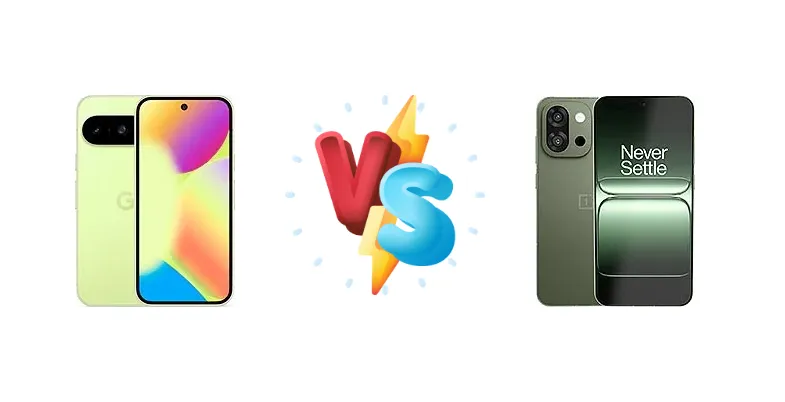
|
🏆 Quick Verdict
For the average user prioritizing all-day battery life and a seamless software experience, the Google Pixel 10 is the better choice. Its 49:23h endurance significantly outpaces the OnePlus 13s, and the Tensor G5 offers a smooth, if not always the fastest, experience. However, the OnePlus 13s wins for those demanding raw processing power and rapid charging.
| PHONES | ||
|---|---|---|
| Phone Names | Google Pixel 10 | OnePlus 13s |
| Network | ||
|---|---|---|
| 2G bands | GSM 850 / 900 / 1800 / 1900 | GSM 850 / 900 / 1800 / 1900 |
| 3G bands | HSDPA 800 / 850 / 900 / 1700(AWS) / 1900 / 2100 | HSDPA 850 / 900 / 1900 / 2100 |
| 4G bands | 1, 2, 3, 4, 5, 7, 8, 12, 13, 14, 17, 18, 19, 20, 21, 25, 26, 29, 30, 30, 32, 38, 39, 40 , 41, 42, 48, 66, 71, 75 - GK2MP | 1, 3, 4, 5, 8, 18, 19, 26, 28, 34, 38, 39, 40, 41, 42, 48, 66 |
| 5G bands | 1, 2, 3, 5, 7, 8, 12, 14, 20, 25, 26, 28, 38, 40, 46, 71, 75, 76, 77, 78, 79 SA/NSA/Sub6 - GK2MP | 1, 3, 5, 8, 26, 28, 38, 40, 41, 48, 66, 77, 78 SA/NSA |
| Speed | HSPA, LTE (CA), 5G | HSPA, LTE, 5G |
| Technology | GSM / HSPA / LTE / 5G | GSM / HSPA / LTE / 5G |
| Launch | ||
|---|---|---|
| Announced | 2025, August 20 | 2025, June 05 |
| Status | Available. Released 2025, August 28 | Available. Released 2025, June 12 |
| Body | ||
|---|---|---|
| Build | Glass front (Gorilla Glass Victus 2), glass back (Gorilla Glass Victus 2), aluminum frame | Glass front, aluminum alloy frame |
| Dimensions | 152.8 x 72 x 8.6 mm (6.02 x 2.83 x 0.34 in) | 150.8 x 71.7 x 8.2 mm (5.94 x 2.82 x 0.32 in) |
| SIM | · Nano-SIM + eSIM· eSIM + eSIM (8 or more, max 2 at a time; USA) | Nano-SIM + Nano-SIM + eSIM (max 2 at a time) |
| Weight | 204 g (7.20 oz) | 185 g (6.53 oz) |
| Display | ||
|---|---|---|
| Protection | Corning Gorilla Glass Victus 2, Mohs level 4 | Crystal Shield Glass |
| Resolution | 1080 x 2424 pixels, 20:9 ratio (~422 ppi density) | 1216 x 2640 pixels, 19.5:9 ratio (~460 ppi density) |
| Size | 6.3 inches, 94.7 cm2 (~86.1% screen-to-body ratio) | 6.32 inches, 97.9 cm2 (~90.6% screen-to-body ratio) |
| Type | OLED, 120Hz, HDR10+, 2000 nits (HBM), 3000 nits (peak) | LTPO AMOLED, 1B colors, 120Hz, 2160Hz PWM, Dolby Vision, HDR10+, HDR Vivid, 1600 nits (HBM) |
| Platform | ||
|---|---|---|
| CPU | Octa-core (1x3.78 GHz Cortex-X4 & 5x3.05 GHz Cortex-A725 & 2x2.25 GHz Cortex-A520) | Octa-core (2x4.32 GHz Oryon V2 Phoenix L + 6x3.53 GHz Oryon V2 Phoenix M) |
| Chipset | Google Tensor G5 (3 nm) | Qualcomm SM8750-AB Snapdragon 8 Elite (3 nm) |
| GPU | PowerVR DXT-48-1536 | Adreno 830 |
| OS | Android 16, up to 7 major Android upgrades | Android 15, OxygenOS 15 |
| Memory | ||
|---|---|---|
| Card slot | No | No |
| Internal | 128GB 12GB RAM, 256GB 12GB RAM | 256GB 12GB RAM, 512GB 12GB RAM |
| Main Camera | ||
|---|---|---|
| Dual | - | 50 MP, f/1.8, 24mm (wide), 1/1.56", 1.0µm, multi-directional PDAF, OIS 50 MP, f/2.0, (telephoto), 1/2.75", 0.64µm, 2x optical zoom, PDAF |
| Features | Single-zone Laser AF, LED flash, Pixel Shift, Ultra-HDR, panorama, Best Take | Color spectrum sensor, LED flash, HDR, panorama |
| Triple | 48 MP, f/1.7, 25mm (wide), 1/2.0", 0.8µm, dual pixel PDAF, OIS 10.8 MP, f/3.1, 112mm (telephoto), 1/3.2", dual pixel PDAF, OIS, 5x optical zoom 13 MP, f/2.2, 120˚ (ultrawide), 1/3.1", PDAF | - |
| Video | 4K@24/30/60fps, 1080p@24/30/60/120/240fps; gyro-EIS, OIS, 10-bit HDR | 4K@30/60fps, 1080p@30/60/240fps, gyro-EIS, OIS, Dolby Vision HDR |
| Selfie camera | ||
|---|---|---|
| Features | HDR, panorama | HDR, panorama |
| Single | 10.5 MP, f/2.2, 95˚, 20mm (ultrawide), 1/3.1", 1.22µm, PDAF | 32 MP, f/2.0, 21mm (wide), 1/3.1", 0.7µm, AF |
| Video | 4K@30/60fps, 1080p@30/60fps | 4K@30fps, 1080p@30fps, gyro-EIS |
| Sound | ||
|---|---|---|
| 35mm jack | No | No |
| Loudspeaker | Yes, with stereo speakers | Yes, with stereo speakers |
| Comms | ||
|---|---|---|
| Bluetooth | 6.0, A2DP, LE, aptX HD | 6.0, A2DP, LE, aptX HD, LHDC 5 |
| Infrared port | - | Yes |
| NFC | Yes | Yes |
| Positioning | GPS (L1+L5), GLONASS, GALILEO, BDS, QZSS, NavIC | GPS (L1+L5), BDS (B1I+B1C+B2a), GALILEO (E1+E5a), QZSS (L1+L5), NavIC (L5), GLONASS |
| Radio | No | No |
| USB | USB Type-C 3.2 | USB Type-C 2.0, OTG |
| WLAN | Wi-Fi 802.11 a/b/g/n/ac/6e, dual-band | Wi-Fi 802.11 a/b/g/n/ac/6/7, dual-band, Wi-Fi Direct |
| Features | ||
|---|---|---|
| Sensors | Fingerprint (under display, ultrasonic), accelerometer, gyro, proximity, compass, barometer | Fingerprint (under display, optical), accelerometer, gyro, proximity, compass |
| Battery | ||
|---|---|---|
| Charging | 30W wired, PD3.0, PPS, 55% in 30 minutes 15W wireless (magnetic), Qi2 Reverse wired Bypass charging | 80W wired, 33W PPS, 18W PD, 18W QC 5W reverse wired |
| Type | Li-Ion 4970 mAh | 5850 mAh |
| Misc | ||
|---|---|---|
| Colors | Indigo, Frost, Lemongrass, Obsidian | Green Silk, Black Velvet, Pink Satin |
| Models | GK2MP, GLBW0, GL066 | CPH2723 |
| Price | $ 583.50 / C$ 849.99 / £ 599.00 / € 637.10 / ₹ 68,918 | ₹ 52,999 |
| SAR | 1.18 W/kg (head) 0.99 W/kg (body) | - |
| SAR EU | 0.99 W/kg (head) 1.39 W/kg (body) | - |
| EU LABEL | ||
|---|---|---|
| Battery | 49:23h endurance, 1000 cycles | - |
| Energy | Class B | - |
| Free fall | Class A (270 falls) | - |
| Repairability | Class B | - |
Google Pixel 10
- Exceptional battery life (49:23h endurance)
- Google's AI-powered features and software support
- High peak display brightness (2030 nits)
- Potentially lower raw performance compared to Snapdragon 8 Elite
- Slower charging speed (30W)
OnePlus 13s
- Blazing-fast 80W wired charging
- Powerful Snapdragon 8 Elite processor
- Optimized for gaming and demanding applications
- Likely shorter battery life compared to Pixel 10
- Potentially less refined software experience
Display Comparison
The Pixel 10 boasts a peak brightness of 2030 nits, ensuring excellent visibility even in direct sunlight. While the OnePlus 13s’ display specs are not provided, OnePlus typically employs high-quality AMOLED panels. The Pixel 10’s brightness advantage is significant, and its likely use of LTPO technology (implied by its flagship status) will contribute to power efficiency. The lack of detailed display information for the OnePlus 13s makes a direct comparison difficult, but the Pixel 10 clearly leads in measured brightness.
Camera Comparison
Without detailed camera specifications for either device, a direct comparison is limited. However, Google’s Pixel line is renowned for its computational photography prowess, driven by the Tensor G5’s AI capabilities. The OnePlus 13s will likely rely on Qualcomm’s ISP for image processing, which has improved significantly, but may not match the Pixel’s software-driven enhancements. The absence of sensor details prevents a definitive judgment, but the Pixel 10’s software advantage is a strong point.
Performance
The OnePlus 13s leverages the Qualcomm SM8750-AB Snapdragon 8 Elite (3nm) with its Oryon V2 Phoenix cores, clocked up to 4.32 GHz. This architecture is designed for sustained performance, likely exceeding the Google Tensor G5’s 3.78 GHz Cortex-X4 core. The Tensor G5, while built on a 3nm process, focuses on AI and machine learning tasks, potentially sacrificing some raw CPU/GPU horsepower. The Snapdragon 8 Elite’s architecture suggests a clear advantage in demanding tasks like gaming and video editing, while the Tensor G5 excels in on-device AI processing.
Battery Life
The Pixel 10’s battery endurance of 49:23h is a standout feature, supported by 1000 charge cycles, indicating long-term battery health. The OnePlus 13s compensates with incredibly fast 80W wired charging (33W PPS, 18W PD, 18W QC), significantly faster than the Pixel 10’s 30W charging. While the OnePlus 13s’ battery capacity is unknown, its faster charging mitigates concerns about shorter runtimes. The Pixel 10 prioritizes longevity and minimizing charge cycles, while the OnePlus 13s focuses on quickly replenishing power.
Buying Guide
Buy the Google Pixel 10 if you need exceptional battery life, a clean Android experience with guaranteed updates, and prioritize AI-powered features like enhanced photo processing. Buy the OnePlus 13s if you prefer maximum performance for gaming and demanding applications, and value the fastest possible charging speeds – even if it means more frequent top-ups.