
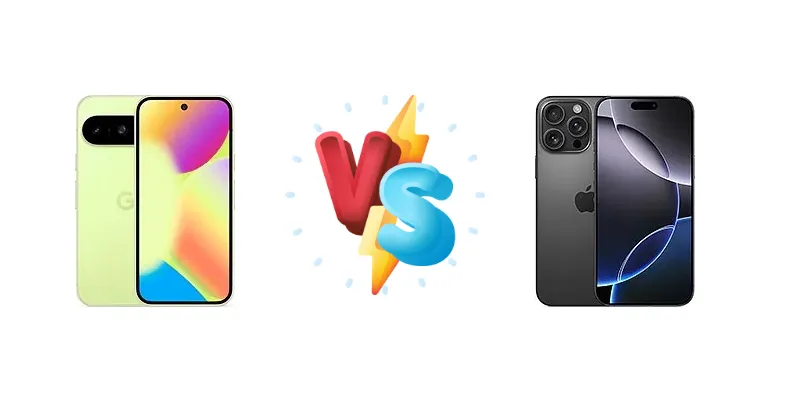
Pixel 10 vs iPhone 16 Pro Max: A Deep Dive into Flagship Performance and Endurance
| Phones Images | |||||
|---|---|---|---|---|---|
|
🏆 Quick Verdict
For the average user prioritizing sustained performance and active use, the Apple iPhone 16 Pro Max emerges as the winner. Its A18 Pro chipset delivers a significantly longer active use score (17:18h vs 12:08h) and while the Pixel 10 boasts impressive endurance, the iPhone’s overall responsiveness and efficiency are superior.
| PHONES | ||
|---|---|---|
| Phone Names | Google Pixel 10 | Apple iPhone 16 Pro Max |
| Network | ||
|---|---|---|
| 2G bands | GSM 850 / 900 / 1800 / 1900 | GSM 850 / 900 / 1800 / 1900 |
| 3G bands | HSDPA 800 / 850 / 900 / 1700(AWS) / 1900 / 2100 | HSDPA 850 / 900 / 1700(AWS) / 1900 / 2100 |
| 4G bands | 1, 2, 3, 4, 5, 7, 8, 12, 13, 14, 17, 18, 19, 20, 21, 25, 26, 29, 30, 30, 32, 38, 39, 40 , 41, 42, 48, 66, 71, 75 - GK2MP | 1, 2, 3, 4, 5, 7, 8, 12, 13, 17, 18, 19, 20, 25, 26, 28, 30, 32, 34, 38, 39, 40, 41, 42, 48, 53, 66 - A3296 |
| 5G bands | 1, 2, 3, 5, 7, 8, 12, 14, 20, 25, 26, 28, 38, 40, 46, 71, 75, 76, 77, 78, 79 SA/NSA/Sub6 - GK2MP | 1, 2, 3, 5, 7, 8, 12, 20, 25, 26, 28, 30, 38, 40, 41, 48, 53, 66, 70, 75, 76, 77, 78, 79 SA/NSA/Sub6 - A3296 |
| Speed | HSPA, LTE (CA), 5G | HSPA, LTE, 5G, EV-DO Rev.A 3.1 Mbps |
| Technology | GSM / HSPA / LTE / 5G | GSM / CDMA / HSPA / EVDO / LTE / 5G |
| Launch | ||
|---|---|---|
| Announced | 2025, August 20 | 2024, September 09 |
| Status | Available. Released 2025, August 28 | Available. Released 2024, September 20 |
| Body | ||
|---|---|---|
| Build | Glass front (Gorilla Glass Victus 2), glass back (Gorilla Glass Victus 2), aluminum frame | Glass front (Ceramic Shield), glass back, titanium frame (grade 5) |
| Dimensions | 152.8 x 72 x 8.6 mm (6.02 x 2.83 x 0.34 in) | 163 x 77.6 x 8.3 mm (6.42 x 3.06 x 0.33 in) |
| SIM | · Nano-SIM + eSIM· eSIM + eSIM (8 or more, max 2 at a time; USA) | · Nano-SIM + eSIM + eSIM (max 2 at a time; International)· eSIM + eSIM (8 or more, max 2 at a time; USA)· Nano-SIM + Nano-SIM (China) |
| Weight | 204 g (7.20 oz) | 227 g (8.01 oz) |
| Display | ||
|---|---|---|
| Protection | Corning Gorilla Glass Victus 2, Mohs level 4 | Ceramic Shield glass (2024 gen), Mohs level 4 |
| Resolution | 1080 x 2424 pixels, 20:9 ratio (~422 ppi density) | 1320 x 2868 pixels, 19.5:9 ratio (~460 ppi density) |
| Size | 6.3 inches, 94.7 cm2 (~86.1% screen-to-body ratio) | 6.9 inches, 115.6 cm2 (~91.4% screen-to-body ratio) |
| Type | OLED, 120Hz, HDR10+, 2000 nits (HBM), 3000 nits (peak) | LTPO Super Retina XDR OLED, 120Hz, HDR10, Dolby Vision, 1000 nits (typ), 2000 nits (HBM) |
| Platform | ||
|---|---|---|
| CPU | Octa-core (1x3.78 GHz Cortex-X4 & 5x3.05 GHz Cortex-A725 & 2x2.25 GHz Cortex-A520) | Hexa-core (2x4.05 GHz + 4x2.42 GHz) |
| Chipset | Google Tensor G5 (3 nm) | Apple A18 Pro (3 nm) |
| GPU | PowerVR DXT-48-1536 | Apple GPU (6-core graphics) |
| OS | Android 16, up to 7 major Android upgrades | iOS 18, upgradable to iOS 26.1 |
| Memory | ||
|---|---|---|
| Card slot | No | No |
| Internal | 128GB 12GB RAM, 256GB 12GB RAM | 256GB 8GB RAM, 512GB 8GB RAM, 1TB 8GB RAM |
| Main Camera | ||
|---|---|---|
| Features | Single-zone Laser AF, LED flash, Pixel Shift, Ultra-HDR, panorama, Best Take | Dual-LED dual-tone flash, HDR (photo/panorama) |
| Triple | 48 MP, f/1.7, 25mm (wide), 1/2.0", 0.8µm, dual pixel PDAF, OIS 10.8 MP, f/3.1, 112mm (telephoto), 1/3.2", dual pixel PDAF, OIS, 5x optical zoom 13 MP, f/2.2, 120˚ (ultrawide), 1/3.1", PDAF | 48 MP, f/1.8, 24mm (wide), 1/1.28", 1.22µm, dual pixel PDAF, sensor-shift OIS 12 MP, f/2.8, 120mm (periscope telephoto), 1/3.06", 1.12µm, dual pixel PDAF, 3D sensor‑shift OIS, 5x optical zoom 48 MP, f/2.2, 13mm (ultrawide), 1/2.55", 0.7µm, PDAF TOF 3D LiDAR scanner (depth) |
| Video | 4K@24/30/60fps, 1080p@24/30/60/120/240fps; gyro-EIS, OIS, 10-bit HDR | 4K@24/25/30/60/100/120fps, 1080p@25/30/60/120/240fps, 10-bit HDR, Dolby Vision HDR (up to 60fps), ProRes, 3D (spatial) video/audio, stereo sound rec. |
| Selfie camera | ||
|---|---|---|
| Features | HDR, panorama | HDR, Dolby Vision HDR, 3D (spatial) audio, stereo sound rec. |
| Single | 10.5 MP, f/2.2, 95˚, 20mm (ultrawide), 1/3.1", 1.22µm, PDAF | 12 MP, f/1.9, 23mm (wide), 1/3.6", 1.0µm, PDAF, OIS SL 3D, (depth/biometrics sensor) |
| Video | 4K@30/60fps, 1080p@30/60fps | 4K@24/25/30/60fps, 1080p@25/30/60/120fps, gyro-EIS |
| Sound | ||
|---|---|---|
| 35mm jack | No | No |
| Loudspeaker | Yes, with stereo speakers | Yes, with stereo speakers |
| Comms | ||
|---|---|---|
| Bluetooth | 6.0, A2DP, LE, aptX HD | 5.3, A2DP, LE |
| NFC | Yes | Yes |
| Positioning | GPS (L1+L5), GLONASS, GALILEO, BDS, QZSS, NavIC | GPS (L1+L5), GLONASS, GALILEO, BDS, QZSS, NavIC |
| Radio | No | No |
| USB | USB Type-C 3.2 | USB Type-C 3.2 Gen 2, DisplayPort |
| WLAN | Wi-Fi 802.11 a/b/g/n/ac/6e, dual-band | Wi-Fi 802.11 a/b/g/n/ac/6e/7, tri-band, hotspot |
| Features | ||
|---|---|---|
| Sensors | Fingerprint (under display, ultrasonic), accelerometer, gyro, proximity, compass, barometer | Face ID, accelerometer, gyro, proximity, compass, barometer |
| Battery | ||
|---|---|---|
| Charging | 30W wired, PD3.0, PPS, 55% in 30 minutes 15W wireless (magnetic), Qi2 Reverse wired Bypass charging | Wired, PD2.0, 50% in 30 min 25W wireless (MagSafe), 15W wireless (China only) 15W wireless (Qi2) 4.5W reverse wired |
| Type | Li-Ion 4970 mAh | Li-Ion 4685 mAh |
| Misc | ||
|---|---|---|
| Colors | Indigo, Frost, Lemongrass, Obsidian | Black Titanium, White Titanium, Natural Titanium, Desert Titanium |
| Models | GK2MP, GLBW0, GL066 | A3296, A3084, A3295, A3297, iPhone17,2 |
| Price | $ 583.50 / C$ 849.99 / £ 599.00 / € 637.10 / ₹ 68,918 | $ 724.88 / C$ 1,405.46 / £ 864.49 / € 955.00 |
| SAR | 1.18 W/kg (head) 0.99 W/kg (body) | 1.01 W/kg (head) 1.15 W/kg (body) |
| SAR EU | 0.99 W/kg (head) 1.39 W/kg (body) | 1.22 W/kg (head) 1.45 W/kg (body) |
| EU LABEL | ||
|---|---|---|
| Battery | 49:23h endurance, 1000 cycles | 48:00h endurance, 1000 cycles |
| Energy | Class B | Class B |
| Free fall | Class A (270 falls) | Class C (90 falls) |
| Repairability | Class B | Class C |
Google Pixel 10
- Exceptional battery endurance (49:23h)
- Faster wired charging (30W vs 20W)
- Reverse wired charging capability
- Lower active use score (12:08h)
- Potentially less peak performance compared to A18 Pro
Apple iPhone 16 Pro Max
- Superior active use performance (17:18h)
- More powerful A18 Pro chipset
- Optimized iOS ecosystem
- Slightly lower battery endurance (48:00h)
- Slower wired charging (50% in 30 min)
Display Comparison
The Pixel 10 boasts a significantly brighter display, reaching a measured 2030 nits compared to the iPhone 16 Pro Max’s 1796 nits. This translates to superior visibility in direct sunlight. While both support Qi2 wireless charging, the Pixel 10’s brightness advantage is particularly beneficial for outdoor photography and video consumption. However, the iPhone 16 Pro Max likely benefits from Apple’s industry-leading color accuracy and potentially a more refined LTPO panel for variable refresh rate efficiency, though this isn't specified in the provided data.
Camera Comparison
Without detailed camera specifications, it’s difficult to make a definitive judgment. However, the Pixel line is renowned for its computational photography prowess, and the Tensor G5 is specifically designed to accelerate these processes. The iPhone 16 Pro Max will likely leverage its A18 Pro’s image signal processor for enhanced detail and dynamic range. The absence of sensor size data makes a direct comparison impossible, but Apple’s history suggests a focus on larger sensors and advanced optical image stabilization (OIS).
Performance
Both devices utilize a 3nm process, but the architectural differences are stark. The iPhone 16 Pro Max’s hexa-core A18 Pro (2x4.05 GHz + 4x2.42 GHz) prioritizes peak performance with higher clock speeds, while the Pixel 10’s octa-core Tensor G5 (1x3.78 GHz Cortex-X4 & 5x3.05 GHz Cortex-A725 & 2x2.25 GHz Cortex-A520) employs a more diverse core configuration, likely focusing on AI and machine learning tasks. The iPhone’s active use score of 17:18h versus the Pixel’s 12:08h strongly suggests superior power efficiency despite the Pixel’s larger battery capacity, indicating the A18 Pro’s architectural advantages.
Battery Life
The Pixel 10’s 49:23h endurance is impressive, but the iPhone 16 Pro Max’s 48:00h endurance is remarkably close, especially considering its significantly better active use score. The Pixel 10 charges to 55% in 30 minutes with its 30W wired charging, while the iPhone 16 Pro Max reaches 50% in the same timeframe with its slower PD2.0 charging. The Pixel 10 also offers reverse wired charging and bypass charging, features absent in the iPhone 16 Pro Max, providing added versatility.
Buying Guide
Buy the Google Pixel 10 if you prioritize exceptional battery endurance (49:23h) and value Google’s AI-powered features and software experience. It’s ideal for users who frequently travel or rely heavily on their phone throughout the day without consistent access to charging. Buy the Apple iPhone 16 Pro Max if you demand peak performance for demanding tasks like video editing, gaming, and professional workflows, and prefer the seamless integration of the Apple ecosystem. Its superior active use score and optimized software make it the choice for power users.