
Google Pixel 10 Pro vs Nothing Phone (2): A Deep Dive into Performance, Battery, and Value
| Phones Images | |||||
|---|---|---|---|---|---|
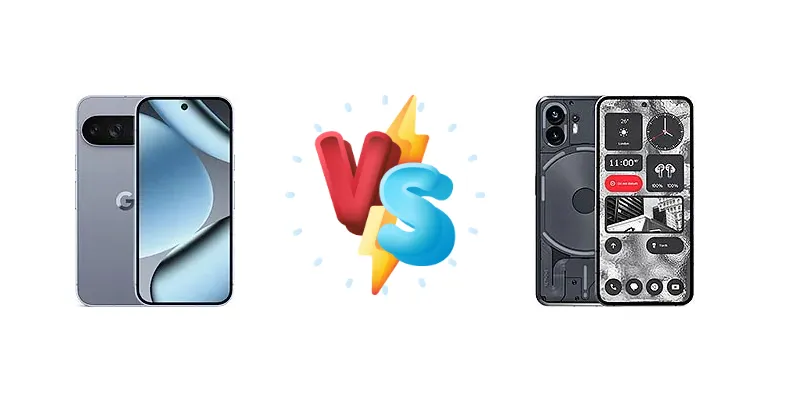
|
🏆 Quick Verdict
For the average user prioritizing all-around capability and AI-powered features, the Google Pixel 10 Pro emerges as the stronger choice. Its Tensor G5 chipset and 51:09h battery endurance offer a compelling package, despite the Nothing Phone (2)'s faster active use score and quicker charging.
| PHONES | ||
|---|---|---|
| Phone Names | Google Pixel 10 Pro | Nothing Phone (2) |
| Network | ||
|---|---|---|
| 2G bands | GSM 850 / 900 / 1800 / 1900 | GSM 850 / 900 / 1800 / 1900 |
| 3G bands | HSDPA 800 / 850 / 900 / 1700(AWS) / 1900 / 2100 | HSDPA 800 / 850 / 900 / 1700(AWS) / 1900 / 2100 |
| 4G bands | 1, 2, 3, 4, 5, 7, 8, 12, 13, 14, 17, 18, 19, 20, 21, 25, 26, 29, 30, 30, 32, 38, 39, 40, 41, 42, 48, 66, 71, 75 - GEHN3 | 1, 2, 3, 4, 5, 7, 8, 12, 17, 18, 19, 20, 25, 26, 28, 30, 32, 34, 38, 39, 40, 41, 42, 48, 66, 71 |
| 5G bands | 1, 2, 3, 5, 7, 8, 12, 14, 20, 25, 26, 30, 38, 40, 46, 71, 75, 76, 77, 78, 79 SA/NSA/Sub6 - GEHN3 | 1, 2, 3, 5, 7, 8, 12, 20, 25, 28, 30, 38, 40, 41, 66, 71, 75, 77, 78 SA/NSA |
| Speed | HSPA, LTE, 5G | HSPA, LTE, 5G |
| Technology | GSM / HSPA / LTE / 5G | GSM / HSPA / LTE / 5G |
| Launch | ||
|---|---|---|
| Announced | 2025, August 20 | 2023, July 11 |
| Status | Available. Released 2025, August 28 | Available. Released 2023, July 17 |
| Body | ||
|---|---|---|
| Build | Glass front (Gorilla Glass Victus 2), glass back (Gorilla Glass Victus 2), aluminum frame | Glass front (Gorilla Glass 5), glass back (Gorilla Glass 5), aluminum frame |
| Dimensions | 152.8 x 72 x 8.5 mm (6.02 x 2.83 x 0.33 in) | 162.1 x 76.4 x 8.6 mm (6.38 x 3.01 x 0.34 in) |
| SIM | · Nano-SIM + eSIM· eSIM + eSIM (8 or more, max 2 at a time; USA) | Nano-SIM + Nano-SIM |
| Weight | 207 g (7.30 oz) | 201.2 g (7.09 oz) |
| Display | ||
|---|---|---|
| Protection | Corning Gorilla Glass Victus 2, Mohs level 4 | Corning Gorilla Glass 5 |
| Resolution | 1280 x 2856 pixels, 20:9 ratio (~495 ppi density) | 1080 x 2412 pixels, 20:9 ratio (~394 ppi density) |
| Size | 6.3 inches, 96.3 cm2 (~87.6% screen-to-body ratio) | 6.7 inches, 108.0 cm2 (~87.2% screen-to-body ratio) |
| Type | LTPO OLED, 120Hz, HDR10+, 2200 nits (HBM), 3300 nits (peak) | LTPO OLED, 1B colors, 120Hz, 1920Hz PWM, HDR10+, 1600 nits (HBM), 1600 nits (peak) |
| Platform | ||
|---|---|---|
| CPU | Octa-core (1x3.78 GHz Cortex-X4 & 5x3.05 GHz Cortex-A725 & 2x2.25 GHz Cortex-A520) | Octa-core (1x3.0 GHz Cortex-X2 & 3x2.5 GHz Cortex-A710 & 4x1.80 GHz Cortex-A510) |
| Chipset | Google Tensor G5 (3 nm) | Qualcomm SM8475 Snapdragon 8+ Gen 1 (4 nm) |
| GPU | PowerVR DXT-48-1536 | Adreno 730 |
| OS | Android 16, up to 7 major Android upgrades | Android 13, upgradable to Android 15, up to 3 major Android upgrades, Nothing OS 3.0 |
| Memory | ||
|---|---|---|
| Card slot | No | No |
| Internal | 128GB 16GB RAM, 256GB 16GB RAM, 512GB 16GB RAM, 1TB 16GB RAM | 128GB 8GB RAM, 256GB 12GB RAM, 512GB 12GB RAM |
| Main Camera | ||
|---|---|---|
| Dual | - | 50 MP, f/1.9, 24mm (wide), 1/1.56", 1.0µm, PDAF, OIS 50 MP, f/2.2, 114˚ (ultrawide), 1/2.76", 0.64µm, AF |
| Features | Multi-zone Laser AF, LED flash, Pixel Shift, Ultra-HDR, panorama, Best Take, Zoom Enhance | LED flash, panorama, HDR |
| Triple | 50 MP, f/1.7, 25mm (wide), 1/1.31", 1.2µm, dual pixel PDAF, OIS 48 MP, f/2.8, 113mm (periscope telephoto), 1/2.55", dual pixel PDAF, OIS, 5x optical zoom 48 MP, f/1.7, 123˚ (ultrawide), 1/2.55", dual pixel PDAF | - |
| Video | 8K@30fps (via cloud-based upscaling), 4K@24/30/60fps, 1080p@24/30/60/120/240fps; gyro-EIS, OIS, 10-bit HDR | 4K@30/60fps, 1080p@30/60fps, gyro-EIS, live HDR, OIS |
| Selfie camera | ||
|---|---|---|
| Features | HDR, panorama | HDR |
| Single | 42 MP, f/2.2, 17mm (ultrawide), PDAF | 32 MP, f/2.5, (wide), 1/2.74", 0.8µm |
| Video | 4K@30/60fps, 1080p@30/60fps | 1080p@30fps |
| Sound | ||
|---|---|---|
| 35mm jack | No | No |
| Loudspeaker | Yes, with stereo speakers | Yes, with stereo speakers |
| Comms | ||
|---|---|---|
| Bluetooth | 6.0, A2DP, LE, aptX HD | 5.3, A2DP, LE, aptX HD, aptX Adaptive |
| NFC | Yes | Yes |
| Positioning | GPS (L1+L5), GLONASS, GALILEO, BDS, QZSS, NavIC | GPS (L1+L5), GLONASS (L1), BDS (B1I+B1c), GALILEO (E1), QZSS (L1), NavIC |
| Radio | No | No |
| USB | USB Type-C 3.2 | USB Type-C 2.0, OTG |
| WLAN | Wi-Fi 802.11 a/b/g/n/ac/6e/7, tri-band | Wi-Fi 802.11 a/b/g/n/ac/6, dual-band, Wi-Fi Direct |
| Features | ||
|---|---|---|
| Sensors | Fingerprint (under display, ultrasonic), accelerometer, gyro, proximity, compass, barometer, thermometer (skin temperature) | Fingerprint (under display, optical), accelerometer, proximity, gyro, compass |
| Battery | ||
|---|---|---|
| Charging | 30W wired, PD3.0, PPS, 55% in 30 min 15W wireless (magnetic), Qi2 Reverse wired Bypass charging | 45W wired, PD3.0, PPS, QC4, 100% in 55 min 15W wireless, 100% in 130 min 5W reverse wireless |
| Type | Li-Ion 4870 mAh | Li-Ion 4700 mAh |
| Misc | ||
|---|---|---|
| Colors | Moonstone, Jade, Porcelain, Obsidian | White, Dark Gray |
| Models | GEHN3, G4QUR, GN4F5 | A065 |
| Price | $ 659.95 / C$ 1,099.99 / £ 899.00 / € 880.00 / ₹ 100,950 | $ 379.99 / £ 370.00 |
| SAR | 0.99 W/kg (head) 0.99 W/kg (body) | - |
| SAR EU | 0.99 W/kg (head) 1.39 W/kg (body) | - |
| EU LABEL | ||
|---|---|---|
| Battery | 51:09h endurance, 1000 cycles | - |
| Energy | Class A | - |
| Free fall | Class A (270 falls) | - |
| Repairability | Class B | - |
Google Pixel 10 Pro
- Potentially superior AI processing with Tensor G5
- Longer battery endurance (51:09h)
- Google ecosystem integration
- Slower wired charging (30W)
- Active use score lower than Nothing Phone (2)
Nothing Phone (2)
- Faster wired charging (45W, 100% in 55 min)
- Higher active use score (14:21h)
- Unique design and Glyph Interface
- Less advanced chipset (Snapdragon 8+ Gen 1)
- Shorter battery endurance (103h)
Display Comparison
The Nothing Phone (2) boasts a measured peak brightness of 998 nits, a respectable figure, but the Pixel 10 Pro’s display specifications are currently unavailable. However, given Google’s history with flagship displays, we anticipate comparable or superior brightness. The Nothing Phone (2)'s focus on visual clarity is evident, but the Pixel 10 Pro likely benefits from Google’s advanced color calibration and potentially LTPO technology for adaptive refresh rates, optimizing battery life. Without Pixel 10 Pro display specs, a direct comparison is limited, but Google typically prioritizes color accuracy and viewing angles.
Camera Comparison
Detailed camera specs for the Pixel 10 Pro are currently unavailable, but Google’s Pixel line is renowned for its computational photography prowess. The Nothing Phone (2) features a capable camera system, but the Pixel’s strength lies in its image processing algorithms, leveraging the Tensor G5’s dedicated image signal processor (ISP). The Pixel 10 Pro will likely excel in low-light photography and dynamic range, while the Nothing Phone (2) offers a solid, reliable camera experience. Without specific sensor details for the Pixel 10 Pro, it’s difficult to make a definitive judgment, but Google’s software advantage is a significant factor.
Performance
The core difference lies in the chipsets: Google’s Tensor G5 (3nm) versus Qualcomm’s Snapdragon 8+ Gen 1 (4nm). The Tensor G5, built on a more advanced 3nm process, theoretically offers superior power efficiency and transistor density compared to the 4nm Snapdragon 8+ Gen 1. While the Snapdragon 8+ Gen 1’s CPU configuration (1x3.0 GHz Cortex-X2, 3x2.5 GHz Cortex-A710, 4x1.80 GHz Cortex-A510) is potent, the Pixel 10 Pro’s octa-core setup (1x3.78 GHz Cortex-X4, 5x3.05 GHz Cortex-A725, 2x2.25 GHz Cortex-A520) features a newer Cortex-X4 prime core, suggesting a performance advantage in demanding tasks. The Pixel 10 Pro’s Tensor G5 is also heavily optimized for machine learning, impacting features like voice recognition and image processing. The Snapdragon 8+ Gen 1 in the Nothing Phone (2) provides excellent performance, but the Tensor G5 aims for a more holistic, AI-driven experience.
Battery Life
The Nothing Phone (2) achieves an impressive active use score of 14:21h, while the Pixel 10 Pro delivers 12:06h. However, the Pixel 10 Pro boasts a significantly higher endurance rating of 51:09h compared to the Nothing Phone (2)'s 103h (older rating). This suggests the Pixel 10 Pro’s power efficiency, despite the potentially more demanding Tensor G5, allows for longer standby times. Charging speeds differ considerably: the Nothing Phone (2) reaches 100% in 55 minutes with its 45W wired charging, while the Pixel 10 Pro hits 55% in 30 minutes with 30W charging. The Nothing Phone (2) is demonstrably faster for a full charge, but the Pixel 10 Pro supports 15W magnetic wireless charging (Qi2) and reverse wired charging, offering greater versatility.
Buying Guide
Buy the Google Pixel 10 Pro if you need the most advanced camera system, seamless Google ecosystem integration, and cutting-edge AI features like enhanced photo editing and real-time translation. Buy the Nothing Phone (2) if you prefer a cleaner, more minimalist Android experience, a unique design aesthetic, and prioritize faster charging speeds alongside solid performance.