
Google Pixel 10 Pro XL vs Sony Xperia 1 VII: A Deep Dive into Flagship Android
| Phones Images | |||||
|---|---|---|---|---|---|
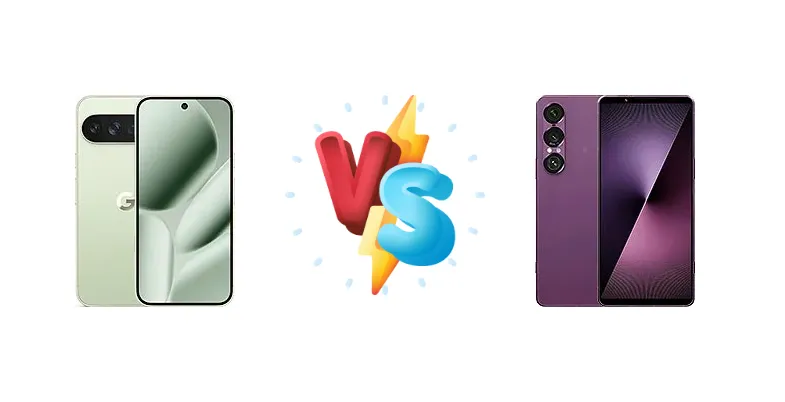
|
🏆 Quick Verdict
For the average user prioritizing all-day battery life and seamless AI integration, the Google Pixel 10 Pro XL emerges as the winner. Its 48:39h endurance and Tensor G5’s AI capabilities offer a compelling package. However, power users and content creators will find the Xperia 1 VII’s Snapdragon 8 Elite and superior active use score more appealing.
| PHONES | ||
|---|---|---|
| Phone Names | Google Pixel 10 Pro XL | Sony Xperia 1 VII |
| Network | ||
|---|---|---|
| 2G bands | GSM 850 / 900 / 1800 / 1900 | GSM 850 / 900 / 1800 / 1900 |
| 3G bands | HSDPA 800 / 850 / 900 / 1700(AWS) / 1900 / 2100 | HSDPA 800 / 850 / 900 / 1700(AWS) / 1900 / 2100 |
| 4G bands | 1, 2, 3, 4, 5, 7, 8, 12, 13, 14, 17, 18, 19, 20, 21, 25, 26, 29, 30, 30, 32, 38, 39, 40, 41, 42, 48, 66, 71, 75 - G45RY | 1, 2, 3, 4, 5, 7, 8, 12, 13, 17, 19, 20, 25, 26, 28, 32, 34, 38, 39, 40, 41, 66 - Europe |
| 5G bands | 1, 2, 3, 5, 7, 8, 12, 14, 20, 25, 26, 30, 38, 40, 46, 71, 75, 76, 77, 78, 79 SA/NSA/Sub6 - G45RY | 1, 3, 5, 7, 8, 20, 28, 38, 40, 41, 75, 77, 78 SA/NSA/Sub6 - Europe |
| Speed | HSPA, LTE, 5G | HSPA, LTE, 5G |
| Technology | GSM / HSPA / LTE / 5G | GSM / HSPA / LTE / 5G |
| Launch | ||
|---|---|---|
| Announced | 2025, August 20 | 2025, May 13 |
| Status | Available. Released 2025, August 28 | Available. Released 2025, June 04 |
| Body | ||
|---|---|---|
| Build | Glass front (Gorilla Glass Victus 2), glass back (Gorilla Glass Victus 2), aluminum frame | Glass front (Gorilla Glass Victus 2), glass back (Gorilla Glass Victus), aluminum frame |
| Dimensions | 162.8 x 76.6 x 8.5 mm (6.41 x 3.02 x 0.33 in) | 162 x 74 x 8.2 mm (6.38 x 2.91 x 0.32 in) |
| SIM | · Nano-SIM + eSIM· eSIM + eSIM (8 or more, max 2 at a time; USA) | · Nano-SIM + eSIM· Nano-SIM + Nano-SIM |
| Weight | 232 g (8.18 oz) | 197 g (6.95 oz) |
| Display | ||
|---|---|---|
| Protection | Corning Gorilla Glass Victus 2, Mohs level 4 | Corning Gorilla Glass Victus 2, Mohs level 5 |
| Resolution | 1344 x 2992 pixels, 20:9 ratio (~486 ppi density) | 1080 x 2340 pixels, 19.5:9 ratio (~396 ppi density) |
| Size | 6.8 inches, 109.7 cm2 (~88.0% screen-to-body ratio) | 6.5 inches, 103.7 cm2 (~86.5% screen-to-body ratio) |
| Type | LTPO OLED, 120Hz, HDR10+, 2200 nits (HBM), 3300 nits (peak) | LTPO OLED, 1B colors, 120Hz, HDR BT.2020 |
| Platform | ||
|---|---|---|
| CPU | Octa-core (1x3.78 GHz Cortex-X4 & 5x3.05 GHz Cortex-A725 & 2x2.25 GHz Cortex-A520) | Octa-core (2x4.32 GHz Oryon V2 Phoenix L + 6x3.53 GHz Oryon V2 Phoenix M) |
| Chipset | Google Tensor G5 (3 nm) | Qualcomm SM8750-AB Snapdragon 8 Elite (3 nm) |
| GPU | PowerVR DXT-48-1536 | Adreno 830 |
| OS | Android 16, up to 7 major Android upgrades | Android 15, up to 4 major Android upgrades |
| Memory | ||
|---|---|---|
| Card slot | No | microSDXC (uses shared SIM slot) |
| Internal | 256GB 16GB RAM, 512GB 16GB RAM, 1TB 16GB RAM | 256GB 12GB RAM, 512GB 12GB RAM |
| Main Camera | ||
|---|---|---|
| Features | Multi-zone Laser AF, LED flash, Pixel Shift, Ultra-HDR, panorama, Best Take, Zoom Enhance | Zeiss optics, Zeiss T* lens coating, color spectrum sensor, LED flash, panorama, HDR, eye tracking |
| Triple | 50 MP, f/1.7, 25mm (wide), 1/1.31", 1.2µm, dual pixel PDAF, OIS 48 MP, f/2.8, 113mm (periscope telephoto), 1/2.55", dual pixel PDAF, OIS, 5x optical zoom 48 MP, f/1.7, 123˚ (ultrawide), 1/2.55", dual pixel PDAF, | 48 MP, f/1.9, 24mm (wide), 1/1.35", 1.12µm, dual pixel PDAF, OIS 12 MP, f/2.3, 85mm (telephoto), f/3.5, 170mm (telephoto), 1/3.5", 1.0µm, dual pixel PDAF, 3.5x-7.1x continuous optical zoom, OIS, 4cm macro @ 120mm, no AF 48 MP, f/2.0, 16mm (ultrawide), 1/1.56", 1.0µm, PDAF |
| Video | 8K@30fps (via cloud-based upscaling), 4K@24/30/60fps, 1080p@24/30/60/120/240fps; gyro-EIS, OIS, 10-bit HDR | 4K@24/30/60/120fps HDR, 1080p@30/60/120fps; 5-axis gyro-EIS, OIS |
| Selfie camera | ||
|---|---|---|
| Features | HDR, panorama | HDR |
| Single | 42 MP, f/2.2, 17mm (ultrawide), PDAF | 12 MP, f/2.0, 24mm (wide), 1/2.9", 1.22µm |
| Video | 4K@30/60fps, 1080p@30/60fps | 4K@30/60fps, 1080p@30/60fps, 5-axis gyro-EIS |
| Sound | ||
|---|---|---|
| 35mm jack | No | Yes |
| Loudspeaker | Yes, with stereo speakers | Yes, with stereo speakers |
| Comms | ||
|---|---|---|
| Bluetooth | 6.0, A2DP, LE, aptX HD | 6.0, A2DP, LE Audio, aptX HD, aptX Adaptive, aptX Lossless |
| NFC | Yes | Yes |
| Positioning | GPS (L1+L5), GLONASS, GALILEO, BDS, QZSS, NavIC | GPS, GLONASS, BDS, GALILEO, QZSS |
| Radio | No | No |
| USB | USB Type-C 3.2 | USB Type-C 3.2, OTG, video output |
| WLAN | Wi-Fi 802.11 a/b/g/n/ac/6e/7, tri-band | Wi-Fi 802.11 a/b/g/n/ac/6e/7, tri-band, Wi-Fi Direct, DLNA |
| Features | ||
|---|---|---|
| Sensors | Fingerprint (under display, ultrasonic), accelerometer, gyro, proximity, compass, barometer, thermometer (skin temperature) | Fingerprint (side-mounted), accelerometer, gyro, proximity, barometer, compass |
| Battery | ||
|---|---|---|
| Charging | 45W wired, PD3.0, PPS, 70% in 30 min 25W wireless (magnetic), Qi2 Reverse wired Bypass charging | 30W wired, PD3.0, PPS, 50% in 30 min 15W wireless Reverse wireless |
| Type | Li-Ion 5200 mAh | 5000 mAh |
| Misc | ||
|---|---|---|
| Colors | Moonstone, Jade, Porcelain, Obsidian | Moss Green, Orchid Purple, Slate Black |
| Models | G45RY, GUL82, GYPW4 | XQ-FS54, XQFS54EUKCG.GC, XQFS54EUKCV.GC, XQFS54EUKCB.GC, PDX256 |
| Price | $ 749.90 / C$ 1,329.99 / £ 999.00 / € 1,059.99 / ₹ 118,299 | € 1,338.99 / $ 1,394.99 / £ 1,149.94 |
| SAR | 0.99 W/kg (head) 0.99 W/kg (body) | - |
| SAR EU | 0.99 W/kg (head) 1.39 W/kg (body) | - |
| EU LABEL | ||
|---|---|---|
| Battery | 48:39h endurance, 1000 cycles | 43:30h endurance, 1400 cycles |
| Energy | Class B | Class B |
| Free fall | Class A (270 falls) | Class B (181 falls) |
| Repairability | Class B | Class D |
Google Pixel 10 Pro XL
- Exceptional battery endurance (48:39h)
- Faster wired charging (45W)
- Advanced AI features powered by Tensor G5
- Potentially lower raw CPU performance
- Fewer charge cycles (1000)
Sony Xperia 1 VII
- Superior CPU performance with Snapdragon 8 Elite
- Longer battery cycle count (1400)
- Higher active use score (15:32h)
- Lower peak display brightness
- Slower wired charging (30W)
Display Comparison
The Pixel 10 Pro XL boasts a significantly brighter display, reaching a measured 2340 nits, compared to the Xperia 1 VII’s 1475 nits. This translates to superior visibility in direct sunlight. While both likely utilize LTPO technology for variable refresh rates (based on flagship standards), the Pixel’s brightness advantage is undeniable. Sony’s displays are traditionally color accurate, but the Pixel’s higher peak brightness provides a more impactful viewing experience for HDR content. The lack of specific bezel information prevents a direct comparison in that area.
Camera Comparison
Without detailed camera specs, analysis focuses on brand strengths. Google’s Pixel line is renowned for its computational photography, leveraging AI to produce stunning images even in challenging conditions. Sony, conversely, emphasizes hardware and manual control. The Xperia 1 VII likely features a larger sensor and more advanced optics, appealing to photography enthusiasts who prefer a hands-on approach. The Pixel’s AI processing will likely excel in dynamic range and low-light performance, while the Xperia 1 VII may offer greater detail and flexibility for post-processing. Ignoring the likely inclusion of low-resolution auxiliary cameras on both devices, the core imaging experience will be defined by software versus hardware.
Performance
Both devices leverage 3nm chipsets, but their architectures differ significantly. The Pixel 10 Pro XL’s Google Tensor G5 features a tri-cluster configuration with a Cortex-X4 prime core clocked at 3.78 GHz, designed for AI tasks. The Xperia 1 VII’s Snapdragon 8 Elite utilizes Qualcomm’s Oryon V2 Phoenix cores, with two performance cores reaching 4.32 GHz. This suggests the Xperia 1 VII will deliver superior raw CPU performance, particularly in tasks that aren’t AI-accelerated. The Xperia 1 VII’s active use score of 15:32h also indicates better thermal management and sustained performance under load. The Pixel’s Tensor G5 excels in machine learning, impacting camera processing and on-device AI features.
Battery Life
The Xperia 1 VII’s 43:30h endurance surpasses the Pixel 10 Pro XL’s 48:39h, despite a smaller battery. This is likely due to the Snapdragon 8 Elite’s superior power efficiency. However, the Pixel 10 Pro XL offers faster wired charging at 45W, achieving 70% charge in 30 minutes, compared to the Xperia 1 VII’s 50% in the same timeframe. The Pixel also supports 25W wireless charging with magnetic attachment and Qi2, while the Xperia 1 VII is limited to 15W wireless. The Xperia 1 VII’s 1400 charge cycles significantly exceed the Pixel’s 1000, indicating greater long-term battery health.
Buying Guide
Buy the Google Pixel 10 Pro XL if you need exceptional battery life, a constantly evolving software experience powered by AI, and a camera that excels in computational photography. Buy the Sony Xperia 1 VII if you prefer a more raw, creator-focused experience, demand peak performance for gaming and multimedia editing, and value a longer cycle count for long-term battery health.