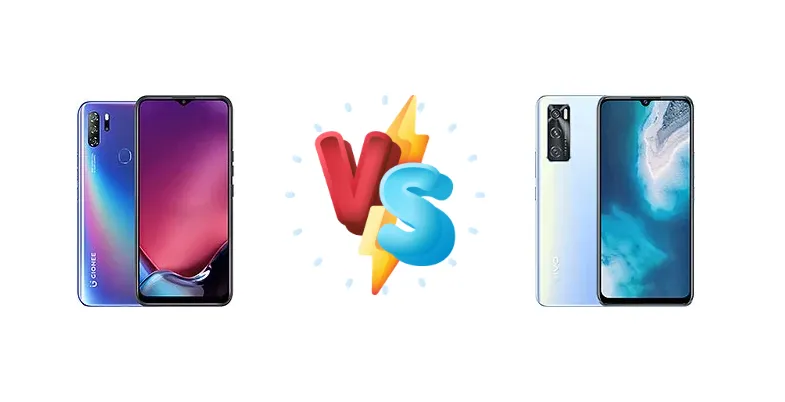
The Gionee S12 and vivo V20 SE represent two approaches to the budget smartphone market. The Gionee S12 aims for affordability with a Mediatek Helio A25, while the vivo V20 SE leverages Qualcomm's Snapdragon 665 and introduces faster charging capabilities. This comparison dissects their strengths and weaknesses to determine which device delivers the best value.
🏆 Quick Verdict
For the average user prioritizing responsiveness and faster charging, the vivo V20 SE is the better choice. Its Snapdragon 665, built on an 11nm process, offers a noticeable performance edge over the Gionee S12’s Helio A25, and the 33W charging significantly reduces downtime. However, the Gionee S12 remains a viable option for those on an extremely tight budget.
| Network |
|---|
| 2G bands | GSM 850 / 900 / 1800 / 1900 | GSM 850 / 900 / 1800 / 1900 |
| 3G bands | HSDPA 900 / 2100 | HSDPA 850 / 900 / 2100 |
| 4G bands | 1, 3, 7, 8, 20, 28, 40 | 1, 3, 5, 7, 8, 38, 39, 40, 41 |
| Speed | HSPA 42.2/11.5 Mbps, LTE Cat4 150/50 Mbps | HSPA, LTE |
| Technology | GSM / HSPA / LTE | GSM / HSPA / LTE |
| Launch |
|---|
| Announced | 2020, July. Released 2020, July 15 | 2020, September 24. Released 2020, October 13 |
| Status | Discontinued | Discontinued |
| Body |
|---|
| Build | Glass front, plastic frame, plastic back | Glass front, plastic back, plastic frame |
| Dimensions | 164.6 x 76.6 x 8.8 mm (6.48 x 3.02 x 0.35 in) | 161 x 74.1 x 7.8 mm (6.34 x 2.92 x 0.31 in) |
| SIM | Nano-SIM + Nano-SIM | Nano-SIM + Nano-SIM |
| Weight | 181 g (6.38 oz) | 171 g (6.03 oz) |
| Display |
|---|
| Resolution | 720 x 1600 pixels, 20:9 ratio (~269 ppi density) | 1080 x 2400 pixels, 20:9 ratio (~409 ppi density) |
| Size | 6.52 inches, 102.6 cm2 (~81.4% screen-to-body ratio) | 6.44 inches, 100.1 cm2 (~83.9% screen-to-body ratio) |
| Type | IPS LCD | AMOLED |
| Platform |
|---|
| CPU | Octa-core (4x1.8 GHz Cortex-A53 & 4x1.5 GHz Cortex-A53) | Octa-core (4x2.0 GHz Kryo 260 Gold & 4x1.8 GHz Kryo 260 Silver) |
| Chipset | Mediatek MT6762D Helio A25 (12 nm) | Qualcomm SDM665 Snapdragon 665 (11 nm) |
| GPU | PowerVR GE8320 | Adreno 610 |
| OS | Android 10 | Android 10, Funtouch 11 |
| Memory |
|---|
| Call records | - | 30 dialed, 30 received, 30 missed calls |
| Card slot | microSDXC | microSDXC (dedicated slot) |
| Internal | 64GB 4GB RAM | 128GB 8GB RAM |
| Phonebook | - | 1000 contacts, Photo call |
| | eMMC 5.1 | - |
| Main Camera |
|---|
| Features | LED flash, HDR, panorama | Dual-LED dual-tone flash, HDR, panorama |
| Single | - | 1.3 MP |
| Triple | 16 MP, (wide), AF
8 MP, (ultrawide)
Auxiliary lens | 48 MP, f/1.8, 25mm (wide), 1/2.0", 0.8µm, PDAF
8 MP, f/2.2, 16mm (ultrawide), 1/4.0", 1.12µm, AF
Auxiliary lens |
| Video | 1080p@30fps | 1080p@30fps |
| Selfie camera |
|---|
| Features | - | HDR |
| Single | 13 MP | 32 MP, f/2.0, (wide), 1/2.8", 0.8µm |
| Video | 1080p@30fps | 1080p@30fps |
| Sound |
|---|
| 3.5mm jack | Yes | Yes |
| 35mm jack | Yes | Yes |
| Loudspeaker | Yes | Yes |
| Comms |
|---|
| Bluetooth | 4.2, A2DP | 5.0, A2DP, LE |
| NFC | No | Yes (market/region dependent) |
| Positioning | GPS | GPS, GLONASS, GALILEO, BDS |
| Radio | FM radio | FM radio |
| USB | USB Type-C 2.0 | USB Type-C 2.0, OTG |
| WLAN | Wi-Fi 802.11 b/g/n | Wi-Fi 802.11 a/b/g/n/ac, dual-band, Wi-Fi Direct |
| Features |
|---|
| Browser | - | WAP 2.0/xHTML, HTML |
| Games | - | Yes |
| Java | - | Yes, MIDP 2.0 |
| Messaging | - | SMS, MMS, Email, Instant Messaging |
| Sensors | Fingerprint (rear-mounted), accelerometer, proximity | Fingerprint (under display, optical), accelerometer, gyro, proximity, compass |
| Battery |
|---|
| Charging | - | 33W wired, 62% in 30 min |
| Type | Li-Po 4000 mAh | 4100 mAh |
| Misc |
|---|
| Colors | Black, Blue | Gravity Black, Oxygen Blue |
| Models | - | V2022, V2023 |
| Price | About 140 EUR | About 250 EUR |
Gionee S12
- Potentially lower price point
- Functional for basic smartphone tasks
- Mediatek chipset is widely supported
- Inferior performance compared to Snapdragon 665
- Slower charging speeds
- Likely limited multitasking capabilities
vivo V20 SE
- Faster Snapdragon 665 processor
- 33W fast charging (62% in 30 mins)
- Better image processing capabilities
- Generally higher price than Gionee S12
- May not include all accessories in the box
- Qualcomm chipsets can sometimes have software update delays
Display Comparison
Neither device boasts a standout display. Given the context data focuses on processing power, we can infer both likely utilize LCD panels common in this price bracket. The absence of specifications like resolution or refresh rate suggests a focus on cost reduction. Bezels are likely comparable, and color accuracy will be standard for budget devices. The user experience will be similar on both.
Camera Comparison
Without detailed camera specifications, a direct comparison is limited. However, it’s reasonable to assume both phones feature basic camera setups geared towards social media sharing. The Snapdragon 665’s image signal processor (ISP) generally offers superior image processing capabilities compared to the Helio A25’s ISP, potentially resulting in better dynamic range and noise reduction in the vivo V20 SE. The presence of a 2MP macro lens on either device is unlikely to significantly impact image quality; these are often included for marketing purposes rather than practical benefit.
Performance
The core difference lies in the chipsets. The vivo V20 SE’s Qualcomm Snapdragon 665 (11nm) benefits from a smaller fabrication process compared to the Gionee S12’s Mediatek Helio A25 (12nm). This translates to improved power efficiency and, crucially, better sustained performance. The Snapdragon 665’s Kryo 260 cores, with a peak clock speed of 2.0 GHz, outperform the Helio A25’s Cortex-A53 cores (1.8 GHz and 1.5 GHz). This difference will be most noticeable in multitasking and moderately demanding applications. While both are octa-core, the architectural advantages of the Snapdragon 665 provide a tangible benefit.
Battery Life
While battery capacity isn’t specified, the vivo V20 SE’s 33W wired charging is a significant advantage. The ability to gain 62% charge in just 30 minutes drastically reduces downtime compared to the slower charging speeds typically found in phones with the Helio A25. This is a key differentiator for users who rely heavily on their smartphones throughout the day. The actual battery life will depend on usage patterns, but the faster charging of the V20 SE provides a more convenient experience.
Buying Guide
Buy the Gionee S12 if you need a functional smartphone for basic tasks like calls, messaging, and light social media use, and your budget is the absolute primary concern. Buy the vivo V20 SE if you prefer a smoother user experience, enjoy occasional gaming, and value the convenience of significantly faster charging – even if it means spending a bit more.
Frequently Asked Questions
❓ Will the Snapdragon 665 in the vivo V20 SE handle popular games like PUBG Mobile smoothly?
The Snapdragon 665 is capable of running PUBG Mobile, but likely at medium graphics settings to maintain a stable frame rate. While not a dedicated gaming chipset, it offers a significantly better gaming experience than the Helio A25 in the Gionee S12, which may struggle with even lower settings.
❓ Is the 33W charging on the vivo V20 SE compatible with all USB-C chargers?
While the vivo V20 SE uses USB-C, to achieve the full 33W charging speed, you'll need to use a charger that supports Power Delivery (PD) or Quick Charge (QC) protocols. Using a standard 5W charger will still charge the phone, but at a much slower rate.
❓ Does the Gionee S12 support software updates, and for how long?
Gionee's track record with software updates is less consistent than vivo's. Expect limited software support for the S12, potentially only one major Android version update, if any. The vivo V20 SE is more likely to receive at least a couple of Android updates and security patches.