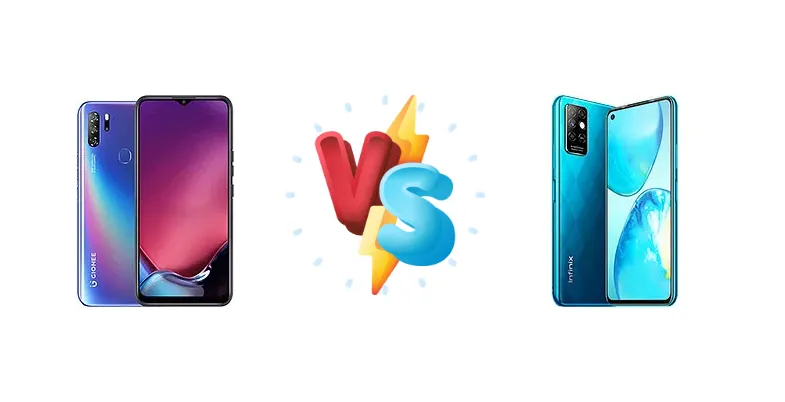
Both the Gionee S12 and Infinix Note 8i target the ultra-budget smartphone market, but they approach it with different hardware philosophies. The Gionee S12 prioritizes a basic, functional experience, while the Infinix Note 8i aims for a more compelling feature set, particularly in performance. This comparison dissects the key differences to help you choose the right device.
🏆 Quick Verdict
For the average user, the Infinix Note 8i is the clear winner. Its MediaTek Helio G80 chipset delivers substantially better performance than the Gionee S12’s Helio A25, making it more suitable for gaming and multitasking. While the Gionee S12 may offer slightly better battery life due to its less powerful processor, the performance gains of the Note 8i outweigh this advantage.
| Network |
|---|
| 2G bands | GSM 850 / 900 / 1800 / 1900 | GSM 850 / 900 / 1800 / 1900 |
| 3G bands | HSDPA 900 / 2100 | HSDPA 850 / 900 / 2100 |
| 4G bands | 1, 3, 7, 8, 20, 28, 40 | 1, 3, 5, 7, 8, 20, 38, 40, 41 |
| Speed | HSPA 42.2/11.5 Mbps, LTE Cat4 150/50 Mbps | HSPA 42.2/5.76 Mbps, LTE Cat4 150/50 Mbps |
| Technology | GSM / HSPA / LTE | GSM / HSPA / LTE |
| | - | 1, 3, 7, 8, 20, 28 |
| Launch |
|---|
| Announced | 2020, July. Released 2020, July 15 | 2020, October 15. Released 2020, November 15 |
| Status | Discontinued | Discontinued |
| Body |
|---|
| Build | Glass front, plastic frame, plastic back | - |
| Dimensions | 164.6 x 76.6 x 8.8 mm (6.48 x 3.02 x 0.35 in) | 171.4 x 77.7 x 8.9 mm (6.75 x 3.06 x 0.35 in) |
| SIM | Nano-SIM + Nano-SIM | Nano-SIM + Nano-SIM |
| Weight | 181 g (6.38 oz) | - |
| Display |
|---|
| Protection | - | Corning Gorilla Glass |
| Resolution | 720 x 1600 pixels, 20:9 ratio (~269 ppi density) | 720 x 1640 pixels (~264 ppi density) |
| Size | 6.52 inches, 102.6 cm2 (~81.4% screen-to-body ratio) | 6.78 inches, 109.2 cm2 (~82.0% screen-to-body ratio) |
| Type | IPS LCD | IPS LCD, 480 nits (peak) |
| Platform |
|---|
| CPU | Octa-core (4x1.8 GHz Cortex-A53 & 4x1.5 GHz Cortex-A53) | Octa-core (2x2.0 GHz Cortex-A75 & 6x1.8 GHz Cortex-A55) |
| Chipset | Mediatek MT6762D Helio A25 (12 nm) | Mediatek MT6769V/CU Helio G80 (12 nm) |
| GPU | PowerVR GE8320 | Mali-G52 MC2 |
| OS | Android 10 | Android 10, XOS 7.1 |
| Memory |
|---|
| Card slot | microSDXC | microSDXC (dedicated slot) |
| Internal | 64GB 4GB RAM | 64GB 4GB RAM, 128GB 4GB RAM, 128GB 6GB RAM |
| | eMMC 5.1 | - |
| Main Camera |
|---|
| Features | LED flash, HDR, panorama | Quad-LED flash, HDR, panorama |
| Quad | - | 48 MP, (wide), 1/2.0", 0.8µm, PDAF
2 MP (macro)
Auxiliary lenses |
| Triple | 16 MP, (wide), AF
8 MP, (ultrawide)
Auxiliary lens | - |
| Video | 1080p@30fps | 1440p@30fps |
| Selfie camera |
|---|
| Features | - | Dual-LED flash |
| Single | 13 MP | 8 MP |
| Video | 1080p@30fps | 1080p@30fps |
| Sound |
|---|
| 3.5mm jack | Yes | Yes |
| 35mm jack | Yes | Yes |
| Loudspeaker | Yes | Yes |
| Comms |
|---|
| Bluetooth | 4.2, A2DP | 5.0, A2DP, LE |
| NFC | No | No |
| Positioning | GPS | GPS |
| Radio | FM radio | FM radio |
| USB | USB Type-C 2.0 | USB Type-C 2.0, OTG |
| WLAN | Wi-Fi 802.11 b/g/n | Wi-Fi 802.11 a/b/g/n/ac, dual-band, Wi-Fi Direct |
| Features |
|---|
| Sensors | Fingerprint (rear-mounted), accelerometer, proximity | Fingerprint (side-mounted), accelerometer, proximity, compass |
| Battery |
|---|
| Charging | - | 18W wired |
| Type | Li-Po 4000 mAh | 5200 mAh |
| Misc |
|---|
| Colors | Black, Blue | Gray, Blue, Green |
| Models | - | X683, X683B |
| Price | About 140 EUR | About 150 EUR |
Gionee S12
- Potentially longer battery life during basic use.
- Likely lower price point.
- Simple and straightforward user experience.
- Significantly slower performance.
- Poor gaming capabilities.
- Likely slower charging speeds.
Infinix Note 8i
- Much faster performance thanks to the Helio G80.
- 18W fast charging.
- Better gaming experience.
- Potentially shorter battery life during heavy use.
- May be slightly more expensive.
- More complex software experience.
Display Comparison
Neither device boasts a standout display. Both utilize 12nm chipsets, suggesting similar power constraints impacting display capabilities. Without specific display specs for the Gionee S12, it's reasonable to assume a standard LCD panel. The Infinix Note 8i, while also likely LCD, benefits from the more powerful chipset potentially allowing for better image processing. Bezels are expected to be substantial on both, typical of this price segment. Color accuracy is unlikely to be a strong point on either device.
Camera Comparison
Without detailed camera specifications for either device, a direct comparison is difficult. However, it’s safe to assume both will feature basic camera setups. The presence of a Helio G80 in the Infinix Note 8i suggests a more capable image signal processor (ISP), potentially leading to better image quality and faster processing times. The Gionee S12’s A25 chipset will likely struggle with complex image processing tasks. Expect both to include multiple rear cameras, but image quality will be heavily dependent on sensor size and lens quality, data not provided.
Performance
The core difference lies in the chipsets. The Infinix Note 8i’s MediaTek Helio G80 (MT6769V/CU) is a significant upgrade over the Gionee S12’s Helio A25 (MT6762D). The G80 features a dual-cluster configuration with 2x2.0 GHz Cortex-A75 cores and 6x1.8 GHz Cortex-A55 cores, compared to the A25’s 4x1.8 GHz Cortex-A53 and 4x1.5 GHz Cortex-A53. The A75 cores in the G80 provide a substantial performance boost in single-threaded tasks and gaming. The G80’s GPU is also considerably more capable, making it the better choice for mobile gaming. While both are 12nm, the architectural improvements in the G80 translate to a smoother user experience.
Battery Life
Battery capacity isn't specified for the Gionee S12, but given its focus on basic functionality, it likely prioritizes longevity. The Infinix Note 8i’s 18W wired charging is a key advantage. While the battery capacity isn't stated, 18W charging will significantly reduce charging times compared to a standard 5W or 10W charger likely bundled with the Gionee S12. The Helio A25’s lower power consumption in the Gionee S12 may result in slightly longer battery life during light use, but the faster charging of the Note 8i is a more practical benefit for most users.
Buying Guide
Buy the Gionee S12 if you need a supremely basic smartphone for essential tasks like calls, texts, and light web browsing, and prioritize absolute minimum cost. Buy the Infinix Note 8i if you prefer a more responsive experience, enjoy occasional gaming, or value faster charging capabilities. The Note 8i is the better choice for anyone who doesn't want to constantly fight with a sluggish interface.
Frequently Asked Questions
❓ Will the Infinix Note 8i be able to run PUBG Mobile smoothly?
The Helio G80 in the Infinix Note 8i is capable of running PUBG Mobile at medium settings with reasonable frame rates. While it won't deliver a flagship-level experience, it's significantly better than the Gionee S12, which would likely struggle even at the lowest settings.
❓ Is the 18W charging on the Infinix Note 8i a significant improvement over standard charging?
Yes, 18W charging is a substantial improvement. It will significantly reduce charging times compared to the 5W or 10W chargers typically included with phones in this price range. Expect a much faster top-up, allowing you to quickly get back to using your phone.
❓ Does the Gionee S12 have enough processing power for social media apps like Facebook and WhatsApp?
The Gionee S12 can handle basic social media apps like Facebook and WhatsApp, but expect some lag and slowdowns, especially when multitasking. The Helio A25 is a very basic processor and will struggle with more demanding apps.
❓ What type of storage does the Infinix Note 8i use, and is it expandable?
While not specified in the provided data, Infinix phones in this segment typically use eMMC storage. Expandability via microSD card is highly likely, offering users the option to increase storage capacity.