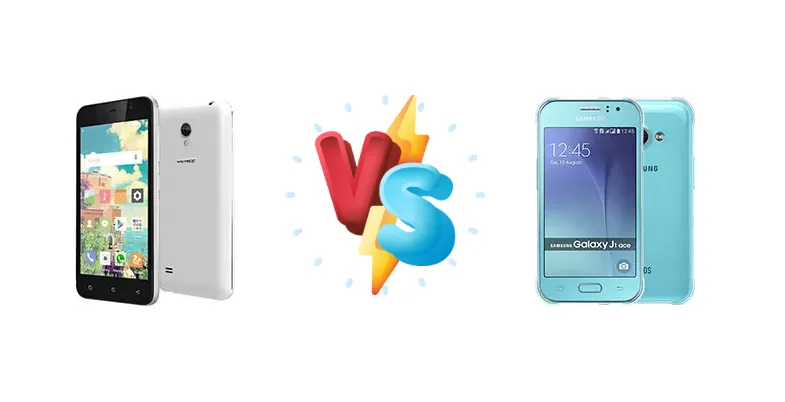
The Gionee Pioneer P3S and Samsung Galaxy J1 Ace represent the extreme end of the smartphone spectrum – devices designed for first-time smartphone owners or those seeking a reliable, ultra-affordable secondary device. Both phones aim to deliver basic functionality at a minimal cost, but significant differences in their underlying hardware dictate which one offers a smoother, more capable experience.
🏆 Quick Verdict
For the average user prioritizing consistent performance, the Samsung Galaxy J1 Ace emerges as the slightly better choice. While the Gionee Pioneer P3S offers a newer chipset generation, the J1 Ace’s potentially faster Cortex-A7 core configuration and wider availability of software optimizations give it an edge in everyday tasks.
| Network |
|---|
| 2G bands | GSM 850 / 900 / 1800 / 1900 | GSM 850 / 900 / 1800 / 1900 - SIM 1 & SIM 2 (dual-SIM model only) |
| 3G bands | HSDPA 900 / 1900 / 2100 | HSDPA 850 / 900 / 2100 - J111F |
| 4G bands | - | 1, 3, 5, 7, 8, 20 - J110F |
| Speed | HSPA | HSPA 21.1/5.76 Mbps, LTE Cat4 150/50 Mbps |
| Technology | GSM / HSPA | GSM / HSPA / LTE |
| | - | 1, 3, 5, 7, 8, 20, 40 - J110G, J111F |
| Launch |
|---|
| Announced | 2015, September. Released 2015, September | 2015, August 31. Released 2015, October |
| Status | Discontinued | Discontinued |
| Body |
|---|
| Build | - | Glass front, plastic back, plastic frame |
| Dimensions | 133 x 67.4 x 11.2 mm (5.24 x 2.65 x 0.44 in) | 130.1 x 67.6 x 9.5 mm (5.12 x 2.66 x 0.37 in) |
| SIM | Dual SIM | Single SIM (Micro-SIM) or Dual SIM (Micro-SIM, dual stand-by) |
| Weight | 161 g (5.68 oz) | 131 g (4.62 oz) |
| Display |
|---|
| Resolution | 480 x 800 pixels, 5:3 ratio (~207 ppi density) | 480 x 800 pixels, 5:3 ratio (~217 ppi density) |
| Size | 4.5 inches, 57.6 cm2 (~64.3% screen-to-body ratio) | 4.3 inches, 52.6 cm2 (~59.8% screen-to-body ratio) |
| Type | IPS LCD | Super AMOLED |
| Platform |
|---|
| CPU | Quad-core 1.3 GHz Cortex-A7 | Quad-core 1.5 GHz Cortex-A7 - J111FQuad-core 1.2 GHz Cortex-A7Dual-core 1.3 GHz Cortex-A53- J110L |
| Chipset | Mediatek MT6580 (28 nm) | Spreadtrum SC9830Marvell PXA1908 - J110L |
| GPU | Mali-400MP2 | Mali-400MP2Vivante GC7000 UL - J110L |
| OS | Android 5.1 (Lollipop), Amigo 3.1 | Android 4.4.4 (KitKat), upgradable to 5.1.1 (Lollipop) |
| Memory |
|---|
| Card slot | microSDHC (dedicated slot) | microSDXC (dedicated slot) |
| Internal | 16GB 1GB RAM | 4GB 512MB RAM (J110L), 4GB 768MB RAM (J110F, J110G), 8GB 1GB RAM (J110M, J111F) |
| Main Camera |
|---|
| Features | LED flash, panorama, HDR | LED flash, panorama |
| Single | 5 MP, AF | 5 MP, f/2.2, 31mm (standard), AF |
| Video | 720p@30fps | 720p@30fps |
| Selfie camera |
|---|
| Single | VGA | 2 MP |
| Sound |
|---|
| 3.5mm jack | Yes | Yes |
| 35mm jack | Yes | Yes |
| Loudspeaker | Yes | Yes |
| Comms |
|---|
| Bluetooth | 4.0, A2DP | 4.0, A2DP |
| NFC | No | No |
| Positioning | GPS | GPS, GLONASS |
| Radio | FM radio | FM radio, RDS, recording |
| USB | microUSB 2.0 | microUSB 2.0 |
| WLAN | Wi-Fi 802.11 b/g/n, Wi-Fi Direct, hotspot | Wi-Fi 802.11 b/g/n, Wi-Fi Direct, hotspot |
| Features |
|---|
| Sensors | Accelerometer, proximity, compass | Accelerometer, proximity |
| Battery |
|---|
| Music play | - | Up to 68 h |
| Stand-by | Up to 240 h (2G) / Up to 200 h (3G) | - |
| Talk time | Up to 22 h 30 min (2G) / Up to 9 h (3G) | Up to 10 h (3G) |
| Type | Li-Ion 2000 mAh, removable | Li-Ion 1900 mAh, removable |
| Misc |
|---|
| Colors | White, Gray, Red, Gold | White, Black, Blue |
| Models | - | SM-J111F, SM-J110G, SM-J110F, SM-J110H, SM-J110M, SM-J110L, SM-J111M |
| Price | - | About 140 EUR |
| SAR | 0.51 W/kg (head) 1.01 W/kg (body) | 1.57 W/kg (head) 1.22 W/kg (body) |
| SAR EU | - | 0.69 W/kg (head) 0.53 W/kg (body) |
Gionee Pioneer P3S
- Slightly newer chipset architecture (MT6580)
- Potentially better power efficiency
- May be more readily available in certain markets
- Limited brand recognition
- Potentially less software support
- Uncertain camera performance
Samsung Galaxy J1 Ace
- Established brand (Samsung)
- Potentially better software optimization
- Wider community support
- Older chipset (SC9830/PXA1908)
- Performance variability between J1 Ace models
- Limited camera capabilities
Display Comparison
Neither device boasts a standout display. Both are expected to feature low-resolution panels, likely around 480x854 pixels, given their target market. The lack of detailed display specifications necessitates a focus on real-world usability. Expect limited viewing angles and color accuracy on both. The J1 Ace’s potential for slightly better software calibration, stemming from Samsung’s display expertise, might offer a marginally improved viewing experience, but this is speculative.
Camera Comparison
Camera performance on both devices will be basic. Expect 5MP or 8MP main sensors with limited low-light capabilities. The presence of a 2MP front-facing camera on both is primarily for video calls rather than high-quality selfies. Detailed sensor information is unavailable, making a direct comparison difficult. Image processing will likely be minimal, relying heavily on software algorithms to enhance photos. The J1 Ace’s potential for Samsung’s image processing optimizations might yield slightly more pleasing results, but don’t expect flagship-level quality from either.
Performance
The performance disparity hinges on the chipset architecture. The Gionee Pioneer P3S utilizes the Mediatek MT6580, featuring a quad-core 1.3 GHz Cortex-A7 CPU built on a 28nm process. The Samsung Galaxy J1 Ace, however, presents a more complex picture. The SC9830 variant has a quad-core 1.5 GHz Cortex-A7, while the J111F model features a quad-core 1.2 GHz Cortex-A7 and the J110L a dual-core 1.3 GHz Cortex-A53. The 1.5 GHz Cortex-A7 in some J1 Ace variants offers a clock speed advantage, potentially leading to snappier app launches and smoother multitasking. The MT6580’s 28nm process, while older, isn’t necessarily a disadvantage in this segment, as thermal constraints are minimal. The Cortex-A53 in the J110L variant is a more efficient core, but its dual-core configuration will likely result in lower overall performance.
Battery Life
Battery capacity is a critical factor in this segment. While specific mAh ratings are unavailable, both devices likely feature batteries in the 1500-2000 mAh range. The Mediatek MT6580’s power efficiency could give the Gionee Pioneer P3S a slight edge in battery life, but the J1 Ace’s potentially optimized software and lower clock speeds in some variants could offset this. Charging speeds will be slow, likely utilizing Micro-USB with 5W charging. Expect several hours to fully charge either device.
Buying Guide
Buy the Gionee Pioneer P3S if you need a phone with a slightly newer chipset architecture and are comfortable with potentially limited software support. It’s a good option for users who primarily need a device for calls and basic messaging. Buy the Samsung Galaxy J1 Ace if you prefer a phone from a more established brand with a potentially more refined user experience and wider access to community support, even if the chipset is older.
Frequently Asked Questions
❓ Will the Samsung Galaxy J1 Ace receive Android updates?
Given its age and position in Samsung’s lineup, the J1 Ace is unlikely to receive major Android version updates. It likely shipped with Android 5.1 Lollipop and may have received a minor update to 6.0 Marshmallow. Security patches are also unlikely to be consistently provided.
❓ Is the Mediatek MT6580 in the Gionee Pioneer P3S powerful enough for WhatsApp and Facebook?
Yes, the MT6580 is sufficient for running basic social media applications like WhatsApp and Facebook. However, expect some lag when switching between apps or loading media-heavy content. It’s designed for light usage, not demanding multitasking.
❓ Which phone is better for playing simple games like Candy Crush?
The Samsung Galaxy J1 Ace, particularly the variants with the 1.5 GHz Cortex-A7, will likely offer a slightly smoother gaming experience for simple games like Candy Crush due to its higher clock speed. However, neither phone is designed for graphically intensive gaming.
❓ Does either phone support 4G LTE?
Both the Gionee Pioneer P3S and Samsung Galaxy J1 Ace are expected to support 4G LTE connectivity, allowing for faster data speeds where available. However, the specific LTE bands supported may vary depending on the region.