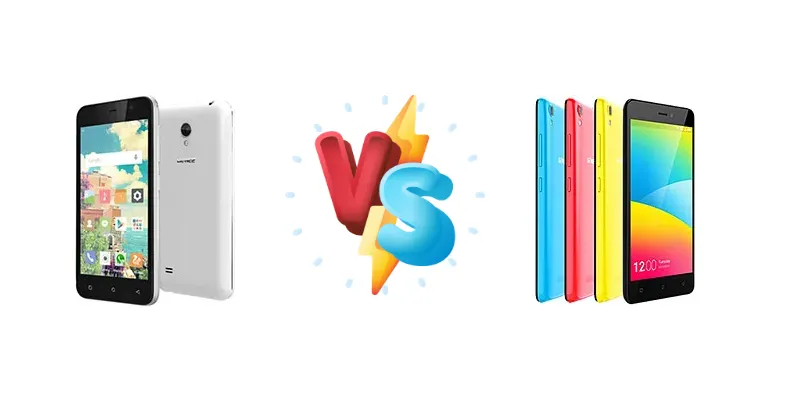
The Gionee Pioneer P3S and P5W represent Gionee's continued focus on the ultra-budget smartphone market. While both devices share a similar aesthetic and price point, a key difference lies under the hood: their chipsets. This comparison dissects the Mediatek MT6580 in the P3S versus the MT6735 in the P5W, revealing which device delivers a more responsive and future-proof experience.
🏆 Quick Verdict
For most users, the Gionee Pioneer P5W is the better choice. Its Mediatek MT6735 chipset, featuring Cortex-A53 cores, provides a noticeable performance uplift over the P3S’s MT6580 and Cortex-A7, translating to smoother multitasking and app loading. While both are entry-level, the P5W offers a more modern and capable platform.
| Network |
|---|
| 2G bands | GSM 850 / 900 / 1800 / 1900 | GSM 850 / 900 / 1800 / 1900 - SIM 1 & SIM 2 |
| 3G bands | HSDPA 900 / 1900 / 2100 | HSDPA 900 / 1900 / 2100 |
| Speed | HSPA | HSPA |
| Technology | GSM / HSPA | GSM / HSPA |
| Launch |
|---|
| Announced | 2015, September. Released 2015, September | 2015, December. Released 2016, January |
| Status | Discontinued | Discontinued |
| Body |
|---|
| Dimensions | 133 x 67.4 x 11.2 mm (5.24 x 2.65 x 0.44 in) | 143.3 x 72 x 8.9 mm (5.64 x 2.83 x 0.35 in) |
| SIM | Dual SIM | Dual SIM |
| Weight | 161 g (5.68 oz) | 153 g (5.40 oz) |
| Display |
|---|
| Resolution | 480 x 800 pixels, 5:3 ratio (~207 ppi density) | 720 x 1280 pixels, 16:9 ratio (~294 ppi density) |
| Size | 4.5 inches, 57.6 cm2 (~64.3% screen-to-body ratio) | 5.0 inches, 68.9 cm2 (~66.8% screen-to-body ratio) |
| Type | IPS LCD | IPS LCD |
| Platform |
|---|
| CPU | Quad-core 1.3 GHz Cortex-A7 | Quad-core 1.3 GHz Cortex-A53 |
| Chipset | Mediatek MT6580 (28 nm) | Mediatek MT6735 (28 nm) |
| GPU | Mali-400MP2 | Mali-T720MP2 |
| OS | Android 5.1 (Lollipop), Amigo 3.1 | Android 5.1 (Lollipop) |
| Memory |
|---|
| Card slot | microSDHC (dedicated slot) | microSDHC (dedicated slot) |
| Internal | 16GB 1GB RAM | 16GB 1GB RAM |
| Main Camera |
|---|
| Features | LED flash, panorama, HDR | LED flash |
| Single | 5 MP, AF | 5 MP, AF |
| Video | 720p@30fps | 1080p@30fps |
| Selfie camera |
|---|
| Single | VGA | 2 MP |
| Sound |
|---|
| 3.5mm jack | Yes | Yes |
| 35mm jack | Yes | Yes |
| Loudspeaker | Yes | Yes |
| Comms |
|---|
| Bluetooth | 4.0, A2DP | 4.0, A2DP |
| NFC | No | No |
| Positioning | GPS | GPS |
| Radio | FM radio | FM radio |
| USB | microUSB 2.0 | microUSB 2.0 |
| WLAN | Wi-Fi 802.11 b/g/n, Wi-Fi Direct, hotspot | Wi-Fi 802.11 b/g/n, Wi-Fi Direct, hotspot |
| Features |
|---|
| Sensors | Accelerometer, proximity, compass | Accelerometer, proximity |
| Battery |
|---|
| Stand-by | Up to 240 h (2G) / Up to 200 h (3G) | Up to 192 h (2G) / Up to 192 h (3G) |
| Talk time | Up to 22 h 30 min (2G) / Up to 9 h (3G) | Up to 5 h (2G) / Up to 3 h (3G) |
| Type | Li-Ion 2000 mAh, removable | Li-Ion 2000 mAh, removable |
| Misc |
|---|
| Colors | White, Gray, Red, Gold | White, Blue, Red, Yellow, Black |
| Models | - | P5W |
| Price | - | About 90 EUR |
| SAR | 0.51 W/kg (head) 1.01 W/kg (body) | - |
Gionee Pioneer P3S
- Potentially lower price point (depending on retailer)
- Simpler user experience for basic tasks
- Sufficient for calls, texts, and minimal app usage
- Outdated Mediatek MT6580 chipset
- Slower performance and less responsive UI
- Limited multitasking capabilities
Gionee Pioneer P5W
- More powerful Mediatek MT6735 chipset
- Smoother multitasking and app loading
- More efficient Cortex-A53 cores
- Better ISP for potentially improved image processing
- May be slightly more expensive than the P3S
- Still an entry-level device with limitations
Display Comparison
Neither Gionee specifies display details beyond size. However, given the price bracket, both likely utilize IPS LCD panels. The core difference isn't display quality, but the chipset's ability to drive the UI smoothly on the display. The P5W’s MT6735 will likely result in fewer dropped frames during scrolling and animations, even with a similar panel.
Camera Comparison
Without detailed camera specifications, a direct comparison is difficult. Both phones likely feature basic camera setups geared towards casual photography. The chipset’s ISP (Image Signal Processor) plays a role, and the MT6735 in the P5W generally offers a more capable ISP, potentially resulting in slightly better image processing and noise reduction. However, the quality will largely depend on the sensor and lens used, which are currently unknown.
Performance
The core distinction lies in the chipsets. The Gionee P3S utilizes the Mediatek MT6580, featuring a quad-core Cortex-A7 processor. The P5W steps up to the Mediatek MT6735, employing a quad-core Cortex-A53. Architecturally, Cortex-A53 cores are significantly more efficient and offer higher IPC (Instructions Per Clock) than the older Cortex-A7. This means the P5W will handle multitasking, app launches, and web browsing with greater ease. Both chipsets are built on a 28nm process, so thermal efficiency will be comparable, but the A53’s efficiency gains will still be noticeable.
Battery Life
Battery capacity is not specified for either device. Given the similar chipsets (both 28nm) and target market, battery life will likely be comparable. The MT6735’s improved efficiency *could* translate to slightly longer runtimes, but this will be minimal. Charging wattage is also unknown; both will likely ship with basic 5W chargers, resulting in several hours for a full charge.
Buying Guide
Buy the Gionee Pioneer P3S if you prioritize absolute simplicity and are only using the phone for basic tasks like calls, texts, and light web browsing. Its older chipset is sufficient for these minimal demands. Buy the Gionee Pioneer P5W if you anticipate using more demanding apps, enjoy occasional gaming, or want a device that feels more responsive and capable in everyday use. The MT6735 provides a tangible improvement in performance.
Frequently Asked Questions
❓ Will the Gionee P5W handle popular social media apps like Facebook and WhatsApp smoothly?
Yes, the Mediatek MT6735 chipset with Cortex-A53 cores in the P5W is capable of running these apps without significant lag. While it won't offer a flagship-level experience, it will provide a usable and responsive experience for everyday social media use, unlike the P3S which may struggle with multiple apps open.
❓ Is the difference in performance between the MT6580 and MT6735 noticeable for basic web browsing?
Yes, the difference is noticeable. The MT6735’s Cortex-A53 cores offer a significant improvement in single-core performance, which directly impacts web browsing speed. Pages will load faster, and scrolling will be smoother on the P5W compared to the P3S. The P3S may exhibit noticeable lag when loading complex websites.
❓ Can the Gionee P5W run any modern mobile games?
The P5W can run some less demanding mobile games, but don't expect high frame rates or graphics settings. Games like Candy Crush or simple puzzle games will run fine. More graphically intensive titles like PUBG Mobile will likely be playable only on the lowest settings, and even then, performance may be inconsistent. The P3S will struggle even more with these games.