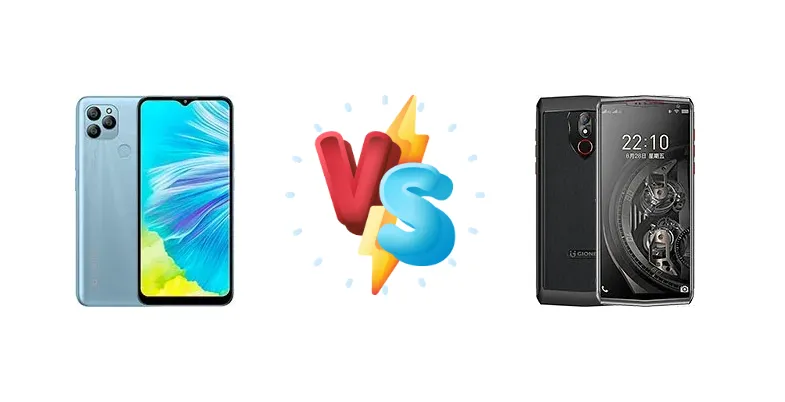
Gionee's P15 and M30 represent two distinct approaches to the ultra-budget smartphone market. The P15 prioritizes efficiency with its Unisoc chipset, while the M30 aims for a performance boost with MediaTek's Helio P60. This comparison dissects the core differences to determine which device delivers the best value for users seeking affordability.
🏆 Quick Verdict
For the average user prioritizing responsiveness and faster charging, the Gionee M30 is the better choice. Its Helio P60 chipset, built on a smaller 12nm process, offers a noticeable performance advantage over the P15’s Unisoc SC9863A, and the 25W charging is a significant convenience.
| Network |
|---|
| 2G bands | GSM 850 / 900 / 1800 / 1900 | GSM 850 / 900 / 1800 / 1900 |
| 3G bands | HSDPA 850 / 900 / 1900 / 2100 | HSDPA 850 / 900 / 2100 |
| 4G bands | 1, 2, 3, 5, 7, 8, 20, 28, 40 | LTE |
| Speed | HSPA, LTE | HSPA, LTE |
| Technology | GSM / HSPA / LTE | GSM / HSPA / LTE |
| Launch |
|---|
| Announced | 2021, July 26. Released 2021, July 30 | 2020, August 25. Released 2020, August 31 |
| Status | Discontinued | Discontinued |
| Body |
|---|
| Build | - | Glass front, aluminum frame, aluminum back |
| Dimensions | 164.7 x 76.3 x 9 mm (6.48 x 3.00 x 0.35 in) | - |
| SIM | Nano-SIM + Nano-SIM | Nano-SIM + Nano-SIM |
| Weight | - | 305 g (10.76 oz) |
| Display |
|---|
| Resolution | 720 x 1600 pixels, 20:9 ratio (~269 ppi density) | 720 x 1440 pixels, 18:9 ratio (~268 ppi density) |
| Size | 6.52 inches, 102.6 cm2 (~81.7% screen-to-body ratio) | 6.0 inches, 92.9 cm2 |
| Type | IPS LCD | IPS LCD |
| Platform |
|---|
| CPU | Octa-core (4x1.6 GHz Cortex-A55 & 4x1.2 GHz Cortex-A55) | Octa-core (4x2.0 GHz Cortex-A73 & 4x2.0 GHz Cortex-A53) |
| Chipset | Unisoc SC9863A (28 nm) | Mediatek MT6771 Helio P60 (12 nm) |
| GPU | IMG8322 | Mali-G72 MP3 |
| OS | Android 11 (Go edition) | Android |
| Memory |
|---|
| Card slot | microSDXC (dedicated slot) | microSDXC |
| Internal | 32GB 2GB RAM | 128GB 8GB RAM |
| | eMMC 5.1 | - |
| Main Camera |
|---|
| Features | LED flash | LED flash |
| Single | 13 MP, (wide), PDAF
Auxiliary lenses | 16 MP, (wide), AF |
| Triple | 13 MP, (wide), PDAF
0.08 MP
0.08 MP | - |
| Video | Unspecified | 1080p@30fps |
| Selfie camera |
|---|
| Single | 8 MP | 8 MP |
| Video | Unspecified | 1080p@30fps |
| Sound |
|---|
| 3.5mm jack | Yes | Yes |
| 35mm jack | Yes | Yes |
| Loudspeaker | Yes | Yes, with stereo speakers |
| Comms |
|---|
| Bluetooth | Yes | 4.2, A2DP |
| NFC | No | No |
| Positioning | GPS | GPS |
| Radio | Unspecified | FM radio |
| USB | microUSB, OTG | USB Type-C 2.0, OTG |
| WLAN | Yes | Wi-Fi 802.11 b/g/n, hotspot |
| Features |
|---|
| Sensors | Fingerprint (rear-mounted), accelerometer, proximity, compass | Fingerprint (rear-mounted), accelerometer, proximity |
| Battery |
|---|
| Charging | - | 25W wired |
| Type | Li-Po 5000 mAh | Li-Po 10000 mAh |
| Misc |
|---|
| Colors | Black, Blue, Light Blue | Black |
| Price | About 100 EUR | About 170 EUR |
Gionee P15
- Potentially better battery life during light use due to efficient chipset.
- Lower price point is likely.
- Simpler software experience may appeal to some users.
- Significantly slower performance compared to the M30.
- Slow charging speeds.
- Limited multitasking capabilities.
Gionee M30
- Faster and more responsive performance thanks to the Helio P60.
- 25W fast charging significantly reduces charging time.
- Better suited for gaming and demanding applications.
- Potentially shorter battery life during heavy use.
- May be slightly more expensive than the P15.
- Helio P60 is an older chipset.
Display Comparison
Neither Gionee provides detailed display specifications. Assuming typical budget panels, both likely utilize IPS LCD technology. The absence of information regarding peak brightness, color gamut coverage, or refresh rates suggests a focus on cost reduction. Bezels are likely substantial on both devices, typical for this price bracket. Color accuracy is expected to be moderate at best, suitable for everyday viewing but not ideal for color-critical work.
Camera Comparison
Without detailed camera specs, a direct comparison is difficult. However, it’s safe to assume both phones feature basic camera setups geared towards casual photography. The absence of information regarding sensor size or optical image stabilization (OIS) suggests neither phone excels in low-light conditions. Any macro camera included (likely 2MP) will offer limited utility due to the small sensor size and lack of detail. Image processing will likely be basic on both devices, prioritizing speed over quality.
Performance
The core difference lies in the chipsets. The Gionee M30’s MediaTek Helio P60 (12nm) utilizes a more advanced fabrication process than the Unisoc SC9863A (28nm) in the P15. This translates to better power efficiency and higher sustained performance. The Helio P60’s CPU configuration – 4x2.0 GHz Cortex-A73 & 4x2.0 GHz Cortex-A53 – is significantly more powerful than the P15’s 4x1.6 GHz Cortex-A55 & 4x1.2 GHz Cortex-A55. The Cortex-A73 cores in the M30 offer a substantial architectural advantage, resulting in faster app loading times and smoother multitasking. While both are octa-core, the architectural differences are key. The P15 will likely struggle with demanding applications, while the M30 will handle them with greater ease.
Battery Life
While battery capacity isn't specified, the M30’s 25W wired charging is a major advantage. This allows for significantly faster charging times compared to the P15, which likely supports standard 5W or 10W charging. Even with a similar battery capacity, the M30’s faster charging will minimize downtime. The P15’s Unisoc chipset, being more power-efficient, may offer slightly longer battery life during light usage, but the M30’s faster charging compensates for any potential difference.
Buying Guide
Buy the Gionee P15 if you need a phone primarily for basic tasks like calls, messaging, and light social media use, and long battery life is paramount. Its Unisoc chipset is designed for efficiency. Buy the Gionee M30 if you prefer a smoother multitasking experience, enjoy occasional gaming, and value faster charging speeds – the Helio P60 provides a tangible performance uplift.
Frequently Asked Questions
❓ Will the Helio P60 in the Gionee M30 struggle with modern games like PUBG Mobile?
While the Helio P60 isn't a flagship chipset, it's capable of running PUBG Mobile at medium settings with reasonable frame rates. Expect some occasional stuttering during intense scenes, but it's a playable experience. The P15's Unisoc SC9863A would likely struggle to maintain a stable frame rate even at the lowest settings.
❓ Is the power efficiency of the Unisoc SC9863A in the Gionee P15 enough to make a significant difference in real-world battery life?
The Unisoc SC9863A is more power-efficient, but the difference in real-world battery life will be most noticeable during light usage – primarily calls, texts, and basic browsing. If you're a heavy user, the M30’s faster charging will likely be more beneficial than the P15’s slightly longer standby time.
❓ Does the Gionee M30's 25W charging require a special charger, or does it come with one in the box?
It's highly recommended to use the charger included in the box with the Gionee M30 to achieve the full 25W charging speed. Using a lower-wattage charger will significantly increase charging times. Check the packaging to confirm the charger's output specifications.