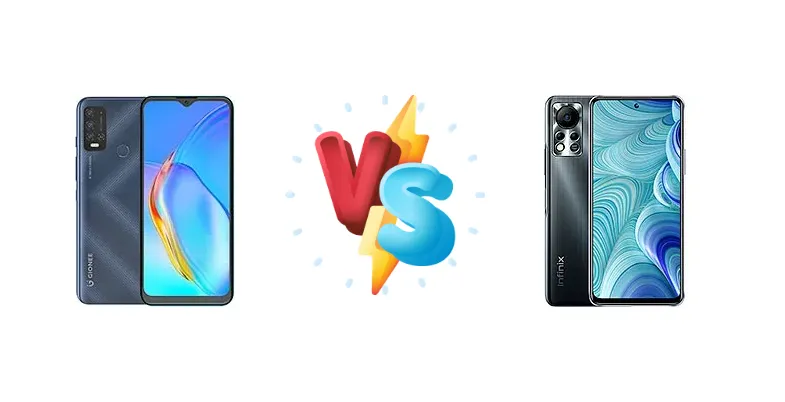
The Gionee P15 Pro and Infinix Hot 11s NFC represent compelling options in the ultra-budget smartphone segment. Both aim to deliver essential features at a low price point, but they diverge significantly in their core processing power. This comparison dissects these differences, focusing on how they impact real-world performance and user experience.
🏆 Quick Verdict
For the average user prioritizing smoother multitasking and occasional gaming, the Infinix Hot 11s NFC is the better choice. Its Helio G88 chipset offers a noticeable performance uplift over the Gionee P15 Pro’s Helio G35, justifying the slight price difference. However, the Gionee remains a viable option for extremely basic use cases.
| Network |
|---|
| 2G bands | GSM 850 / 900 / 1800 / 1900 | GSM 850 / 900 / 1800 / 1900 |
| 3G bands | HSDPA 900 / 2100 | HSDPA 850 / 900 / 2100 |
| 4G bands | 1, 3, 7, 8, 20, 28, 40 | 1, 3, 5, 8, 38, 40, 41 |
| Speed | HSPA 42.2/11.5 Mbps, LTE Cat4 150/50 Mbps | HSPA 42.2/5.76 Mbps, LTE Cat4 150/50 Mbps |
| Technology | GSM / HSPA / LTE | GSM / HSPA / LTE |
| | - | 1, 3, 7, 8, 20 |
| Launch |
|---|
| Announced | 2021, March 26. Released 2021, March 29 | 2022, February 18 |
| Status | Discontinued | Available. Released 2022, February 18 |
| Body |
|---|
| Build | Glass front, plastic frame, plastic back | Glass front, plastic back, plastic frame |
| Dimensions | 173.8 x 78.5 x 9.5 mm (6.84 x 3.09 x 0.37 in) | 168.9 x 77 x 8.8 mm (6.65 x 3.03 x 0.35 in) |
| SIM | Nano-SIM + Nano-SIM | Nano-SIM + Nano-SIM |
| Weight | 208 g (7.34 oz) | - |
| Display |
|---|
| Resolution | 720 x 1640 pixels (~263 ppi density) | 1080 x 2460 pixels (~396 ppi density) |
| Size | 6.82 inches, 110.5 cm2 (~81.0% screen-to-body ratio) | 6.78 inches, 109.2 cm2 (~83.9% screen-to-body ratio) |
| Type | IPS LCD | IPS LCD, 90Hz, 500 nits (peak) |
| Platform |
|---|
| CPU | Octa-core (4x2.3 GHz Cortex-A53 & 4x1.8 GHz Cortex-A53) | Octa-core (2x2.0 GHz Cortex-A75 & 6x1.8 GHz Cortex-A55) |
| Chipset | Mediatek MT6765G Helio G35 (12 nm) | Mediatek MT6769H Helio G88 (12 nm) |
| GPU | PowerVR GE8320 | Mali-G52 MC2 |
| OS | Android 11 | Android 11, XOS 7.6 |
| Memory |
|---|
| Card slot | microSDXC | microSDXC (dedicated slot) |
| Internal | 64GB 3GB RAM | 64GB 4GB RAM, 128GB 4GB RAM, 128GB 6GB RAM |
| | eMMC 5.1 | eMMC 5.1 |
| Main Camera |
|---|
| Dual | 13 MP, (wide), AF
2 MP, (ultrawide)
Auxiliary lens | - |
| Features | LED flash | Quad-LED flash, HDR, panorama |
| Single | 8 MP | - |
| Triple | - | 50 MP, f/1.6, (wide), PDAF
Auxiliary lenses |
| Video | 1080p@30fps | 1440p@30fps |
| Selfie camera |
|---|
| Features | - | Dual-LED flash |
| Single | 8 MP | 8 MP, f/2.0, (wide) |
| Video | 1080p@30fps | 1440p@30fps |
| Sound |
|---|
| 3.5mm jack | Yes | Yes |
| 35mm jack | Yes | Yes |
| Loudspeaker | Yes | Yes, with dual speakers |
| Comms |
|---|
| Bluetooth | 5.0, A2DP, LE | 5.0, A2DP, LE |
| NFC | No | Yes |
| Positioning | GPS | GPS |
| Radio | FM radio | FM radio |
| USB | USB Type-C 2.0, OTG | USB Type-C 2.0, OTG |
| WLAN | Wi-Fi 802.11 b/g/n | Wi-Fi 802.11 a/b/g/n |
| Features |
|---|
| Sensors | Fingerprint (rear-mounted), accelerometer, proximity, compass | Fingerprint (rear-mounted), accelerometer, gyro, proximity, compass |
| Battery |
|---|
| Charging | - | 18W wired |
| Type | Li-Po 6000 mAh | 5000 mAh |
| Misc |
|---|
| Colors | Fjord, Petrol Blue | Polar Black, Green Wave, Purple |
| Price | About 120 EUR | About 230 EUR |
Gionee P15 Pro
- Potentially longer battery life due to less powerful chipset.
- Lower price point (likely).
- Simple and straightforward user experience.
- Significantly weaker performance compared to the Infinix.
- Likely slower charging speeds.
- Limited multitasking capabilities.
Infinix Hot 11s NFC
- Faster and more responsive performance with the Helio G88.
- 18W fast charging for quicker top-ups.
- NFC support for contactless payments and pairing.
- Potentially shorter battery life compared to the Gionee (though mitigated by efficiency).
- Slightly higher price point.
- May still struggle with graphically intensive games at high settings.
Display Comparison
Neither device boasts a standout display. Both utilize 12nm chipsets, suggesting similar power constraints impacting display capabilities. While specific display specs (resolution, brightness) are missing for the Gionee P15 Pro, we can infer it's a basic LCD panel. The Infinix Hot 11s NFC doesn't specify advanced features like high refresh rates or HDR support, indicating a focus on cost-effectiveness over visual fidelity. Bezels are likely to be substantial on both, typical for this price bracket.
Camera Comparison
Camera performance is likely to be similar in real-world results, given the focus on budget components. Both phones likely feature a primary camera paired with auxiliary lenses of limited utility. Without specific sensor details for the Gionee P15 Pro, it’s safe to assume it won’t outperform the Infinix. The Infinix Hot 11s NFC’s camera setup, while not detailed in the provided data, benefits from the more powerful ISP (Image Signal Processor) within the Helio G88, potentially leading to better image processing and low-light performance. Expect both to struggle in challenging lighting conditions.
Performance
The core difference lies in the chipsets. The Infinix Hot 11s NFC’s MediaTek Helio G88 is a significant upgrade over the Gionee P15 Pro’s Helio G35. The G88 features two Cortex-A75 cores clocked at 2.0 GHz alongside six A55 cores, providing a substantial boost in single-core and multi-core performance compared to the G35’s four A53 cores at 2.3 GHz and four at 1.8 GHz. The A75 architecture is more efficient and powerful than the older A53. This translates to snappier app launches, smoother scrolling, and a more enjoyable gaming experience on the Infinix. The Gionee will struggle with demanding tasks and multitasking. The 18W charging on the Infinix is also a plus, offering faster top-ups than what the Gionee likely provides (spec not available).
Battery Life
Battery life is a potential strength for both devices, given their lower-powered chipsets and likely large battery capacities (specs missing for Gionee). The Infinix Hot 11s NFC’s 18W charging is a clear advantage, allowing for quicker replenishment. While the Gionee P15 Pro may have a larger battery, the slower charging speed (if any) will offset this advantage for users who frequently need to top up their device. The more efficient Helio G88 in the Infinix will also contribute to better overall battery endurance during active use.
Buying Guide
Buy the Gionee P15 Pro if you need a phone for absolutely essential tasks – calls, texts, and light social media – and prioritize maximum battery life over performance. Buy the Infinix Hot 11s NFC if you prefer a more responsive experience for everyday apps, enjoy mobile gaming (even at lower settings), and value the convenience of NFC for mobile payments and quick pairing.
Frequently Asked Questions
❓ Will the Infinix Hot 11s NFC handle popular games like PUBG Mobile or Call of Duty?
The Helio G88 in the Infinix Hot 11s NFC can run PUBG Mobile and Call of Duty, but you’ll likely need to play at medium or low graphics settings to maintain a stable frame rate. The Gionee P15 Pro’s Helio G35 will struggle significantly with these titles, offering a less enjoyable gaming experience.
❓ Does the Infinix Hot 11s NFC support Google Pay or other NFC-based payment services?
Yes, the 'NFC' in the Infinix Hot 11s NFC’s name confirms its support for NFC functionality. This allows you to use Google Pay or other compatible mobile payment services for contactless transactions. The Gionee P15 Pro does not have NFC.
❓ How much storage does each phone offer, and can it be expanded?
While the provided data doesn't specify storage, both phones in this price range typically offer 32GB or 64GB of internal storage. Both are also likely to include a microSD card slot for expandable storage, allowing you to add more space for photos, videos, and apps.
❓ Is the difference in CPU architecture (Cortex-A53 vs A75) really that noticeable in everyday use?
Yes, the difference is significant. The Cortex-A75 cores in the Infinix Hot 11s NFC are considerably more powerful and efficient than the Cortex-A53 cores in the Gionee P15 Pro. This translates to faster app loading times, smoother multitasking, and a more responsive overall experience, even with everyday tasks like browsing the web or checking email.