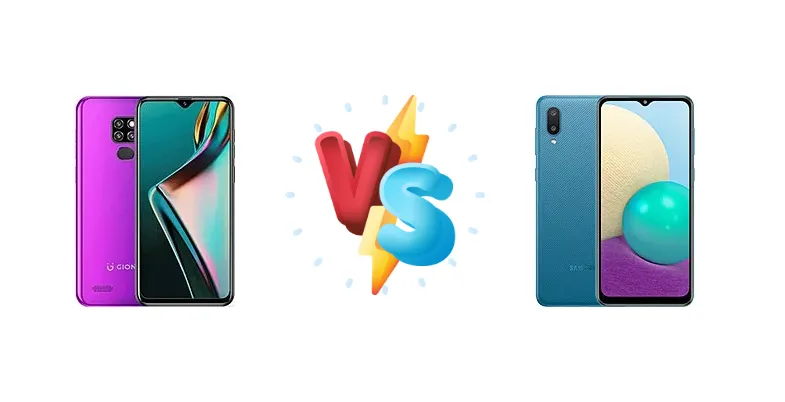
The Gionee P12 and Samsung Galaxy A02 represent the extreme end of the budget smartphone market. While both aim to deliver basic smartphone functionality at an accessible price, they take different approaches to achieving this. The Gionee P12 leverages a newer, albeit still entry-level, Mediatek Helio A20 chipset, while the Samsung Galaxy A02 relies on the older, more power-hungry MT6739W. This comparison will dissect the implications of these choices for everyday users.
🏆 Quick Verdict
For the average user prioritizing responsiveness and future-proofing, the Gionee P12 emerges as the better choice. Its newer Mediatek Helio A20 chipset, fabricated on a 12nm process, offers a noticeable efficiency advantage over the Samsung Galaxy A02’s 28nm MT6739W, translating to smoother multitasking and potentially longer battery life.
| Network |
|---|
| 2G bands | GSM 850 / 900 / 1800 / 1900 | GSM 850 / 900 / 1800 / 1900 |
| 3G bands | HSDPA 900 / 1900 | HSDPA 850 / 900 / 2100 |
| 4G bands | 1, 3, 7, 8, 20, 28, 40 | 1, 3, 5, 7, 8, 20, 28, 38, 40, 41 |
| Speed | HSPA 42.2/11.5 Mbps, LTE Cat4 150/50 Mbps | HSPA 42.2/5.76 Mbps, LTE Cat4 150/50 Mbps |
| Technology | GSM / HSPA / LTE | GSM / HSPA / LTE |
| Launch |
|---|
| Announced | 2020, November 09. Released 2020, November 09 | 2021, January 27 |
| Status | Discontinued | Available. Released 2021, January 27 |
| Body |
|---|
| Build | Glass front, plastic frame, glass back | Glass front, plastic back, plastic frame |
| Dimensions | 156.1 x 73.7 x 9.7 mm (6.15 x 2.90 x 0.38 in) | 164 x 75.9 x 9.1 mm (6.46 x 2.99 x 0.36 in) |
| SIM | Nano-SIM + Nano-SIM | · Nano-SIM· Nano-SIM + Nano-SIM |
| Weight | 178 g (6.28 oz) | 206 g (7.27 oz) |
| Display |
|---|
| Resolution | 720 x 1600 pixels, 20:9 ratio (~288 ppi density) | 720 x 1600 pixels, 20:9 ratio (~270 ppi density) |
| Size | 6.1 inches, 89.8 cm2 (~78.1% screen-to-body ratio) | 6.5 inches, 102.0 cm2 (~81.9% screen-to-body ratio) |
| Type | IPS LCD | PLS LCD |
| Platform |
|---|
| CPU | Quad-core 1.8 GHz Cortex-A53 | Quad-core 1.5 GHz Cortex-A53 |
| Chipset | Mediatek MT6761 Helio A20 (12 nm) | Mediatek MT6739W (28 nm) |
| GPU | PowerVR GE8320 | PowerVR GE8100 |
| OS | Android 10 | Android 10, upgradable to Android 11, One UI Core 3.1 |
| Memory |
|---|
| Card slot | microSDXC | microSDXC (dedicated slot) |
| Internal | 16GB 2GB RAM | 32GB 2GB RAM, 32GB 3GB RAM, 32GB 4GB RAM, 64GB 3GB RAM |
| | eMMC 5.1 | eMMC 5.1 |
| Main Camera |
|---|
| Dual | - | 13 MP, f/1.9, (wide), AF
2 MP (macro) |
| Features | LED flash, HDR, panorama | LED flash |
| Single | 5 MP, f/2.8, AF | - |
| Triple | 13 MP, (wide), AF
0.3 MP, (ultrawide)
Auxiliary lens | - |
| Video | 1080p@30fps | 1080p@30fps |
| Selfie camera |
|---|
| Single | 5 MP | 5 MP, f/2.0 |
| Video | 1080p@30fps | - |
| Sound |
|---|
| 3.5mm jack | Yes | Yes |
| 35mm jack | Yes | Yes |
| Loudspeaker | Yes | Yes |
| Comms |
|---|
| Bluetooth | 5.0, A2DP, LE | 5.1, A2DP, LE |
| NFC | No | No |
| Positioning | GPS | GPS, GLONASS |
| Radio | FM radio | FM radio |
| USB | microUSB 2.0, OTG | microUSB 2.0 |
| WLAN | Wi-Fi 802.11 a/b/g/n/ac, dual-band | Wi-Fi 802.11 b/g/n, Wi-Fi Direct |
| Features |
|---|
| Sensors | Fingerprint (rear-mounted), accelerometer, proximity | Accelerometer |
| | - | Virtual proximity sensing |
| Battery |
|---|
| Stand-by | Up to 510 h (2G) / Up to 500 h (3G) | - |
| Talk time | Up to 20 h (2G) / Up to 9 h (3G) | - |
| Type | Li-Ion 3200 mAh | Li-Po 5000 mAh |
| Misc |
|---|
| Colors | Black, Purple | Black, Blue |
| Models | K130, K120, K121 | SM-A022F, SM-A022F/DS, SM-A022M, SM-A022M/DS, SM-A022G, SM-A022G/DS |
| Price | About 80 EUR | € 97.46 |
| SAR EU | - | 0.65 W/kg (head) 1.71 W/kg (body) |
| Pricing |
|---|
| 32GB 2GB RAM | - | $ 149.99 |
| 32GB 3GB RAM | - | $ 129.99 |
| 64GB 3GB RAM | - | $ 199.99 |
| RENEWED | - | £ 113.00 |
Gionee P12
- More efficient chipset (Helio A20)
- Potentially better sustained performance
- Likely better battery life due to chipset efficiency
- Brand recognition is lower than Samsung
- Specific display details are unknown
Samsung Galaxy A02
- Stronger brand recognition (Samsung)
- Multiple RAM/storage configurations available
- Potentially lower price point depending on configuration
- Less efficient chipset (MT6739W)
- Likely more throttling under load
- Potentially shorter battery life
Display Comparison
Neither device is expected to deliver a stellar display experience. Specifics regarding panel type (IPS vs. TFT) and resolution are missing, but both will likely feature low-resolution displays. The key difference lies in the underlying processing power needed to drive them. The more efficient Helio A20 in the Gionee P12 will put less strain on the battery when displaying content compared to the older MT6739W in the A02. Bezels are likely to be substantial on both devices, typical of this price segment.
Camera Comparison
Camera performance on both devices will be limited. Details regarding sensor size and image processing are unavailable, but given the price point, expectations should be tempered. The Samsung Galaxy A02 offers various configurations (32GB/2GB, 32GB/3GB, 64GB/3GB), but the camera hardware is unlikely to differ significantly across these variants. Any 2MP macro or depth sensors present on either device should be considered marketing features rather than substantial photographic tools. Image quality will heavily rely on software processing, and the more efficient chipset in the Gionee P12 *could* allow for slightly more sophisticated processing without significant battery drain.
Performance
The core of the difference lies in the chipsets. The Gionee P12’s Mediatek MT6761 Helio A20 (12nm) boasts a more modern fabrication process than the Samsung Galaxy A02’s MT6739W (28nm). While both utilize a quad-core Cortex-A53 CPU, the 12nm process allows the Helio A20 to operate more efficiently at a slightly higher clock speed (1.8 GHz vs 1.5 GHz). This translates to better thermal management and sustained performance under load. The A02’s older chipset will likely exhibit more noticeable throttling during prolonged use. The RAM options on the A02 (2GB/3GB) are also a factor, but the chipset itself is the primary bottleneck.
Battery Life
Battery capacity is not specified for either device. However, the Gionee P12’s more efficient chipset will undoubtedly translate to better battery life, even with a potentially smaller battery capacity. The 28nm MT6739W in the A02 is a known power hog. While the A02 may offer a larger battery on paper, the Helio A20’s efficiency will likely result in comparable or superior real-world usage time. Charging wattage is also unknown for both devices, suggesting slow charging speeds are likely.
Buying Guide
Buy the Gionee P12 if you need a phone that feels slightly more responsive for basic tasks like browsing and social media, and if you value a more modern chipset architecture for potential software updates. Buy the Samsung Galaxy A02 if you prioritize brand recognition and are willing to accept a performance trade-off for a potentially lower price point, especially considering the various RAM/storage configurations available.
Frequently Asked Questions
❓ Will the Samsung Galaxy A02 overheat during extended use of apps like Facebook or WhatsApp?
The MT6739W chipset is known to generate more heat than the Helio A20. While it won't likely become dangerously hot, prolonged use of social media apps or even basic web browsing on the Galaxy A02 could lead to noticeable throttling, resulting in slower performance and a warmer device.
❓ Is the 2GB of RAM in some Galaxy A02 configurations sufficient for multitasking?
2GB of RAM is extremely limited in 2024. While the A02 can handle a few apps simultaneously, you'll likely experience significant slowdowns and app reloading when switching between applications. Opting for the 3GB RAM variant is highly recommended if multitasking is a priority.
❓ Does the Gionee P12 support software updates, and for how long?
Gionee's track record for software updates is inconsistent. While the Helio A20 chipset is relatively modern, the P12 is a budget device, so expect limited software support. Don't anticipate major Android version updates, but security patches may be provided for a limited time.
❓ What kind of gaming performance can I expect from either phone?
Neither phone is designed for gaming. Basic 2D games will be playable at low settings, but demanding 3D titles will struggle. The Helio A20 in the Gionee P12 will offer slightly better performance, but don't expect a smooth gaming experience on either device.