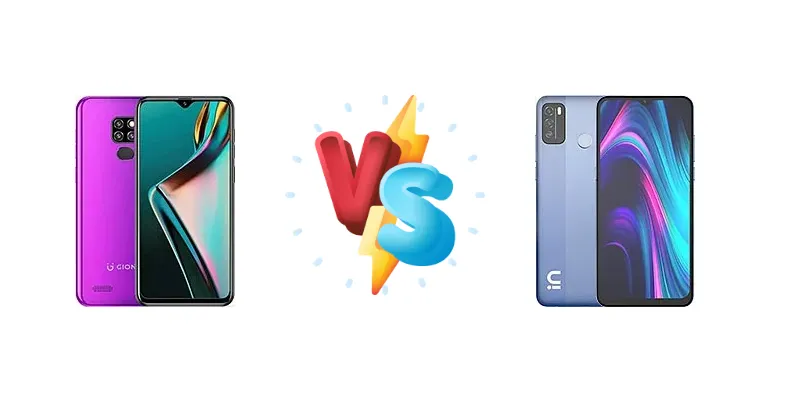
The sub-$150 smartphone market is fiercely competitive. Both the Gionee P12 and the Micromax In 1b aim to deliver essential smartphone functionality at an accessible price point. However, they take different approaches to achieving this, primarily through their chipset choices. This comparison will dissect the key differences between the MediaTek Helio A20 powering the Gionee P12 and the Helio G35 in the Micromax In 1b, revealing which device offers the better user experience.
🏆 Quick Verdict
For the average user prioritizing responsiveness and multitasking, the Micromax In 1b is the clear winner. Its octa-core Helio G35 chipset provides a significant performance uplift over the Gionee P12’s quad-core Helio A20, making it noticeably smoother for everyday tasks and light gaming. While both phones are budget-focused, the In 1b offers a better return on investment.
| Network |
|---|
| 2G bands | GSM 850 / 900 / 1800 / 1900 | GSM 850 / 900 / 1800 / 1900 |
| 3G bands | HSDPA 900 / 1900 | HSDPA 850 / 2100 |
| 4G bands | 1, 3, 7, 8, 20, 28, 40 | 1, 3, 5, 8, 40, 41 |
| Speed | HSPA 42.2/11.5 Mbps, LTE Cat4 150/50 Mbps | HSPA, LTE |
| Technology | GSM / HSPA / LTE | GSM / HSPA / LTE |
| Launch |
|---|
| Announced | 2020, November 09. Released 2020, November 09 | 2020, November 03. Released 2020, November 26 |
| Status | Discontinued | Discontinued |
| Body |
|---|
| Build | Glass front, plastic frame, glass back | - |
| Dimensions | 156.1 x 73.7 x 9.7 mm (6.15 x 2.90 x 0.38 in) | 164.5 x 75.8 x 8.9 mm (6.48 x 2.98 x 0.35 in) |
| SIM | Nano-SIM + Nano-SIM | Nano-SIM + Nano-SIM |
| Weight | 178 g (6.28 oz) | 188 g (6.63 oz) |
| Display |
|---|
| Resolution | 720 x 1600 pixels, 20:9 ratio (~288 ppi density) | 720 x 1600 pixels, 20:9 ratio (~269 ppi density) |
| Size | 6.1 inches, 89.8 cm2 (~78.1% screen-to-body ratio) | 6.52 inches, 102.6 cm2 (~82.3% screen-to-body ratio) |
| Type | IPS LCD | IPS LCD, 400 nits (typ) |
| Platform |
|---|
| CPU | Quad-core 1.8 GHz Cortex-A53 | Octa-core (4x2.3 GHz Cortex-A53 & 4x1.8 GHz Cortex-A53) |
| Chipset | Mediatek MT6761 Helio A20 (12 nm) | Mediatek MT6765G Helio G35 (12 nm) |
| GPU | PowerVR GE8320 | PowerVR GE8320 |
| OS | Android 10 | Android 10 (Go edition) |
| Memory |
|---|
| Card slot | microSDXC | microSDXC (dedicated slot) |
| Internal | 16GB 2GB RAM | 32GB 2GB RAM, 64GB 4GB RAM |
| | eMMC 5.1 | eMMC 5.1 |
| Main Camera |
|---|
| Dual | - | 13 MP, f/1.9, 26mm (wide), PDAF
Auxiliary lens |
| Features | LED flash, HDR, panorama | LED flash, panorama |
| Single | 5 MP, f/2.8, AF | - |
| Triple | 13 MP, (wide), AF
0.3 MP, (ultrawide)
Auxiliary lens | - |
| Video | 1080p@30fps | 1080p@30fps |
| Selfie camera |
|---|
| Single | 5 MP | 8 MP, f/2.0 |
| Video | 1080p@30fps | 1080p@30fps |
| Sound |
|---|
| 3.5mm jack | Yes | Yes |
| 35mm jack | Yes | Yes |
| Loudspeaker | Yes | Yes |
| Comms |
|---|
| Bluetooth | 5.0, A2DP, LE | 5.0, A2DP, LE |
| NFC | No | No |
| Positioning | GPS | GPS, GLONASS, GALILEO |
| Radio | FM radio | Unspecified |
| USB | microUSB 2.0, OTG | USB Type-C 2.0, OTG |
| WLAN | Wi-Fi 802.11 a/b/g/n/ac, dual-band | Wi-Fi 802.11 a/b/g/n/ac, Wi-Fi Direct |
| Features |
|---|
| Sensors | Fingerprint (rear-mounted), accelerometer, proximity | Fingerprint (rear-mounted), accelerometer, gyro, proximity |
| Battery |
|---|
| Charging | - | 10W wired
Reverse wired |
| Stand-by | Up to 510 h (2G) / Up to 500 h (3G) | - |
| Talk time | Up to 20 h (2G) / Up to 9 h (3G) | - |
| Type | Li-Ion 3200 mAh | Li-Po 5000 mAh |
| Misc |
|---|
| Colors | Black, Purple | Blue, Purple, Green |
| Models | K130, K120, K121 | E6523, E7533 |
| Price | About 80 EUR | About 80 EUR |
| SAR | - | 0.57 W/kg (head) 0.90 W/kg (body) |
Gionee P12
- Extremely affordable price point
- Simple and easy-to-use interface
- Potentially longer battery life due to less powerful processor (depending on usage)
- Significantly slower performance
- Limited multitasking capabilities
- Poor gaming performance
Micromax In 1b
- Faster and more responsive performance
- Octa-core processor for smoother multitasking
- Reverse wired charging capability
- Better gaming performance (for casual games)
- Slightly higher price
- Potentially shorter battery life (depending on usage)
- Charging speed is relatively slow
Display Comparison
Neither Gionee nor Micromax provide detailed display specifications for these models. Given their price points, we can assume both utilize LCD panels with 720p+ resolutions. The lack of information regarding peak brightness, color gamut coverage, or PWM dimming rates suggests neither phone will excel in display quality. Users prioritizing outdoor visibility or color accuracy should consider alternatives. Bezels are likely to be substantial on both devices, reflecting their budget nature.
Camera Comparison
Detailed camera specifications are scarce for both devices. It’s safe to assume both feature a primary camera and potentially a secondary depth sensor. However, without knowing sensor sizes, apertures, or image processing capabilities, a meaningful comparison is difficult. The presence of a 2MP macro camera on either device is unlikely to deliver significant photographic value. Image quality will likely be acceptable in good lighting conditions but will struggle in low-light scenarios. The Micromax In 1b *may* have a slight edge due to the G35’s integrated image signal processor (ISP), potentially offering better noise reduction and dynamic range.
Performance
The core difference lies in the chipsets. The Gionee P12’s MediaTek Helio A20 is a quad-core processor clocked at 1.8 GHz, utilizing Cortex-A53 cores. This is a basic processor designed for minimal tasks. Conversely, the Micromax In 1b boasts the Helio G35, an octa-core chip featuring four Cortex-A53 cores at 2.3 GHz and four at 1.8 GHz. This configuration provides a substantial performance advantage, particularly in multi-threaded applications and gaming. The higher clock speeds and additional cores translate to faster app loading times, smoother scrolling, and a more responsive user interface. While both are built on a 12nm process, the architectural advantage of the G35 is significant. The In 1b also benefits from potentially better GPU performance, enabling playable frame rates in less demanding mobile games.
Battery Life
Again, specific battery capacities are not provided. However, given the hardware, both phones likely house batteries in the 4000-5000 mAh range. The Micromax In 1b includes 10W wired charging and, crucially, reverse wired charging. This allows the In 1b to act as a power bank for other devices, a feature absent on the Gionee P12. While 10W charging isn’t fast, it’s sufficient for overnight charging. The more powerful processor in the In 1b will likely consume more power, but the efficiency gains from completing tasks faster could offset this difference.
Buying Guide
Buy the Gionee P12 if you need a basic, extremely affordable smartphone for essential communication – calls, texts, and very light app usage. It’s a suitable option for first-time smartphone users or those needing a simple backup device. Buy the Micromax In 1b if you prefer a more responsive experience, enjoy occasional gaming, or frequently multitask between apps. The In 1b’s more powerful processor and reverse charging capability offer greater versatility.
Frequently Asked Questions
❓ Will the Micromax In 1b be able to run popular games like PUBG Mobile?
While the Helio G35 isn't a gaming powerhouse, the Micromax In 1b can run PUBG Mobile at low to medium settings with acceptable frame rates. Expect some occasional stuttering, especially in intense scenes. The Gionee P12’s Helio A20 would struggle significantly with this title.
❓ Does the Gionee P12 have any notable software features?
The Gionee P12 likely runs a basic version of Android with minimal customization. It’s unlikely to receive frequent software updates. The Micromax In 1b, while also running a relatively stock Android experience, may benefit from slightly more frequent updates from Micromax.
❓ Is the reverse charging feature on the Micromax In 1b useful in practice?
Yes, the reverse charging feature is surprisingly practical. While 10W charging is slow, it can provide a significant boost to devices like wireless earbuds, smartwatches, or even another smartphone in an emergency. It’s a feature the Gionee P12 lacks entirely.