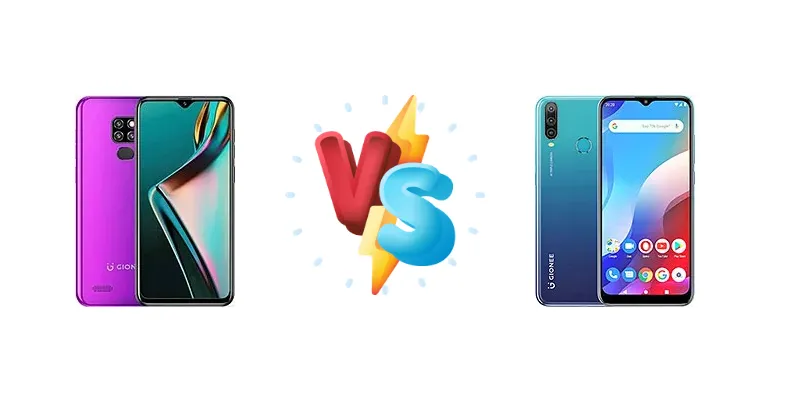
Gionee's P12 and S12 Lite represent attempts to deliver affordable Android experiences. While visually similar, the core difference lies beneath the surface: their chipsets. This comparison dissects the Mediatek Helio A20 in the P12 versus the Helio A25 in the S12 Lite, revealing which device offers a smoother, more responsive experience for the price-conscious user.
🏆 Quick Verdict
For most users, the Gionee S12 Lite is the better choice. Its Helio A25 chipset, with its octa-core configuration, provides a noticeable performance uplift over the P12’s quad-core Helio A20, translating to faster app loading and smoother multitasking. The price difference is likely minimal, making the S12 Lite the clear winner.
| Network |
|---|
| 2G bands | GSM 850 / 900 / 1800 / 1900 | GSM 850 / 900 / 1800 / 1900 |
| 3G bands | HSDPA 900 / 1900 | HSDPA 900 / 2100 |
| 4G bands | 1, 3, 7, 8, 20, 28, 40 | 1, 3, 7, 8, 20, 28, 40 |
| Speed | HSPA 42.2/11.5 Mbps, LTE Cat4 150/50 Mbps | HSPA 42.2/11.5 Mbps, LTE Cat4 150/50 Mbps |
| Technology | GSM / HSPA / LTE | GSM / HSPA / LTE |
| Launch |
|---|
| Announced | 2020, November 09. Released 2020, November 09 | 2020, September 29. Released 2020, October 05 |
| Status | Discontinued | Discontinued |
| Body |
|---|
| Build | Glass front, plastic frame, glass back | Glass front, plastic frame, plastic back |
| Dimensions | 156.1 x 73.7 x 9.7 mm (6.15 x 2.90 x 0.38 in) | 166.2 x 76.3 x 8.4 mm (6.54 x 3.00 x 0.33 in) |
| SIM | Nano-SIM + Nano-SIM | Nano-SIM + Nano-SIM |
| Weight | 178 g (6.28 oz) | 174 g (6.14 oz) |
| Display |
|---|
| Resolution | 720 x 1600 pixels, 20:9 ratio (~288 ppi density) | 720 x 1600 pixels, 20:9 ratio (~269 ppi density) |
| Size | 6.1 inches, 89.8 cm2 (~78.1% screen-to-body ratio) | 6.52 inches, 102.6 cm2 (~80.9% screen-to-body ratio) |
| Type | IPS LCD | IPS LCD |
| Platform |
|---|
| CPU | Quad-core 1.8 GHz Cortex-A53 | Octa-core (4x1.8 GHz Cortex-A53 & 4x1.5 GHz Cortex-A53) |
| Chipset | Mediatek MT6761 Helio A20 (12 nm) | Mediatek MT6762D Helio A25 (12 nm) |
| GPU | PowerVR GE8320 | PowerVR GE8320 |
| OS | Android 10 | Android 10 |
| Memory |
|---|
| Card slot | microSDXC | microSDXC |
| Internal | 16GB 2GB RAM | 32GB 3GB RAM |
| | eMMC 5.1 | eMMC 5.1 |
| Main Camera |
|---|
| Features | LED flash, HDR, panorama | LED flash, HDR |
| Single | 5 MP, f/2.8, AF | - |
| Triple | 13 MP, (wide), AF
0.3 MP, (ultrawide)
Auxiliary lens | 13 MP, (wide), AF
5 MP, (ultrawide)
Auxiliary lens |
| Video | 1080p@30fps | 1080p@30fps |
| Selfie camera |
|---|
| Single | 5 MP | 8 MP |
| Video | 1080p@30fps | 1080p@30fps |
| Sound |
|---|
| 3.5mm jack | Yes | Yes |
| 35mm jack | Yes | Yes |
| Loudspeaker | Yes | Yes |
| Comms |
|---|
| Bluetooth | 5.0, A2DP, LE | 4.2, A2DP |
| NFC | No | No |
| Positioning | GPS | GPS |
| Radio | FM radio | FM radio |
| USB | microUSB 2.0, OTG | microUSB 2.0, OTG |
| WLAN | Wi-Fi 802.11 a/b/g/n/ac, dual-band | Wi-Fi 802.11 b/g/n |
| Features |
|---|
| Sensors | Fingerprint (rear-mounted), accelerometer, proximity | Fingerprint (rear-mounted), accelerometer, proximity |
| Battery |
|---|
| Stand-by | Up to 510 h (2G) / Up to 500 h (3G) | - |
| Talk time | Up to 20 h (2G) / Up to 9 h (3G) | - |
| Type | Li-Ion 3200 mAh | Li-Po 4000 mAh |
| Misc |
|---|
| Colors | Black, Purple | Blue, Green, Gray |
| Models | K130, K120, K121 | H602 |
| Price | About 80 EUR | - |
Gionee P12
- Potentially slightly longer battery life due to less powerful processor.
- May be marginally cheaper than the S12 Lite.
- Simple and straightforward user experience for basic tasks.
- Significantly slower performance compared to the S12 Lite.
- Struggles with multitasking and demanding apps.
- Less future-proof due to limited processing power.
Gionee S12 Lite
- Noticeably faster performance thanks to the octa-core Helio A25.
- Smoother multitasking and app switching.
- Better suited for light gaming and everyday use.
- May have slightly shorter battery life than the P12.
- Potentially a slightly higher price point.
- Camera performance likely similar to the P12.
Display Comparison
Neither Gionee specifies display details beyond size and resolution, suggesting both likely utilize standard IPS LCD panels. Without knowing peak brightness or color gamut coverage, it’s safe to assume display quality is comparable and not a differentiating factor. Bezels are likely similar given the similar overall phone dimensions. Color accuracy will likely be standard for this price point, leaning towards warmer tones.
Camera Comparison
Given the price bracket, detailed camera analysis is limited by the available specifications. Both phones likely feature a primary camera and a depth sensor. Without knowing sensor sizes or apertures, it’s difficult to assess image quality. The inclusion of a 2MP macro camera on either device is largely a marketing tactic, offering minimal practical benefit due to the low resolution and lack of optical image stabilization. Image processing will likely be similar, prioritizing contrast and saturation over natural color reproduction.
Performance
The core distinction is the chipset. The Gionee P12’s Mediatek Helio A20 (MT6761) features a quad-core Cortex-A53 CPU clocked at 1.8 GHz. The S12 Lite steps up to the Helio A25 (MT6762D), boasting an octa-core configuration: four Cortex-A53 cores at 1.8 GHz and four at 1.5 GHz. This architectural shift is crucial. While both use the same Cortex-A53 core, the S12 Lite’s eight cores allow for better parallel processing, resulting in faster app launches and smoother multitasking. The A25 also benefits from slight architectural improvements over the A20. Users who frequently switch between apps or engage in light gaming will experience a tangible benefit with the S12 Lite.
Battery Life
Battery capacity isn't specified, but given the similar form factors and target market, they are likely in the 3000-4000 mAh range. The Helio A25 in the S12 Lite, while more powerful, is also fabricated on a 12nm process, similar to the A20. This means the power efficiency difference isn't dramatic. Charging wattage is also unknown, but both likely support standard 5W or 10W charging. Real-world battery life will depend heavily on usage patterns, but the S12 Lite’s more efficient multitasking could slightly offset the increased power draw of the octa-core processor.
Buying Guide
Buy the Gionee P12 if your primary needs are basic communication – calls, texts, and light social media – and you prioritize maximizing battery life over performance. It's a suitable option for first-time smartphone users or those on an extremely tight budget. Buy the Gionee S12 Lite if you want a more responsive experience for everyday tasks like browsing, using multiple apps simultaneously, and occasional light gaming. The extra processing power offers a significant improvement in usability.
Frequently Asked Questions
❓ Will the Gionee S12 Lite handle popular social media apps like Facebook and Instagram smoothly?
Yes, the Helio A25 chipset in the S12 Lite provides sufficient processing power for smooth operation of popular social media apps. The octa-core configuration ensures that scrolling through feeds and loading images will be a more responsive experience compared to the quad-core P12.
❓ Is the Gionee P12 suitable for playing mobile games like PUBG Mobile or Call of Duty?
The Gionee P12 is not well-suited for demanding games like PUBG Mobile or Call of Duty. The Helio A20 chipset lacks the processing power and graphics capabilities to deliver a playable experience, even on low settings. Expect significant lag and frame rate drops. The S12 Lite will perform better, but still isn't ideal for serious gaming.
❓ How much storage do these phones have, and can it be expanded?
Storage capacity isn't specified in the provided data. However, given the target market, both phones likely offer 32GB of internal storage. It's highly probable that both devices include a microSD card slot for storage expansion, allowing users to add more space for photos, videos, and apps.
❓ What version of Android do these phones run?
The Android version isn't specified. However, given the hardware specifications, it's likely both phones run Android Go Edition, a lightweight version of Android designed for devices with limited processing power and RAM. This ensures a smoother experience on these budget smartphones.