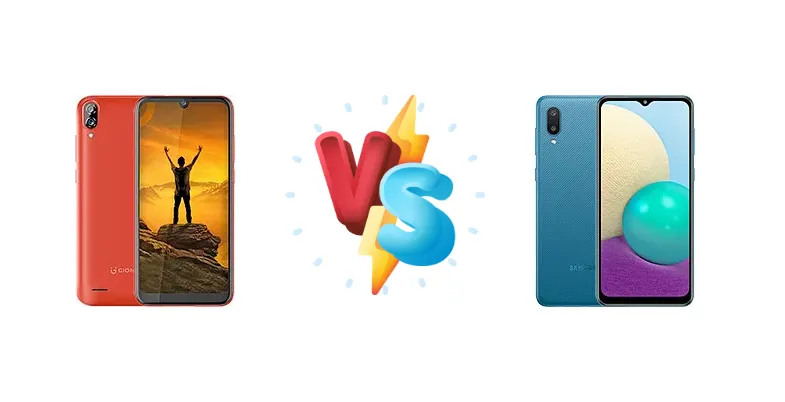
The ultra-budget smartphone segment is fiercely competitive. Both the Gionee Max and Samsung Galaxy A02 aim to deliver essential smartphone functionality at the lowest possible price point. However, they take different approaches to achieving this, with the Gionee Max leveraging an octa-core Unisoc processor while the Samsung A02 relies on a quad-core Mediatek chip. This comparison will dissect their key differences to determine which device offers the best value.
🏆 Quick Verdict
For most users, the Gionee Max emerges as the better choice. Its octa-core Unisoc SC9863A processor provides a noticeable performance advantage over the Samsung Galaxy A02’s quad-core Mediatek MT6739W, translating to smoother multitasking and app loading. While both phones are limited in features, the Gionee Max offers more processing power for a similar price.
| Network |
|---|
| 2G bands | GSM 850 / 900 / 1800 / 1900 | GSM 850 / 900 / 1800 / 1900 |
| 3G bands | HSDPA 900 / 2100 | HSDPA 850 / 900 / 2100 |
| 4G bands | 1, 3, 5, 8, 38, 40, 41 | 1, 3, 5, 7, 8, 20, 28, 38, 40, 41 |
| Speed | HSPA, LTE | HSPA 42.2/5.76 Mbps, LTE Cat4 150/50 Mbps |
| Technology | GSM / HSPA / LTE | GSM / HSPA / LTE |
| Launch |
|---|
| Announced | 2020, August 25. Released 2020, August 31 | 2021, January 27 |
| Status | Discontinued | Available. Released 2021, January 27 |
| Body |
|---|
| Build | - | Glass front, plastic back, plastic frame |
| Dimensions | 148 x 70.9 x 10.8 mm (5.83 x 2.79 x 0.43 in) | 164 x 75.9 x 9.1 mm (6.46 x 2.99 x 0.36 in) |
| SIM | Nano-SIM + Nano-SIM | · Nano-SIM· Nano-SIM + Nano-SIM |
| Weight | 185 g (6.53 oz) | 206 g (7.27 oz) |
| Display |
|---|
| Resolution | 720 x 1560 pixels, 19.5:9 ratio (~282 ppi density) | 720 x 1600 pixels, 20:9 ratio (~270 ppi density) |
| Size | 6.1 inches, 91.3 cm2 (~87.0% screen-to-body ratio) | 6.5 inches, 102.0 cm2 (~81.9% screen-to-body ratio) |
| Type | IPS LCD | PLS LCD |
| Platform |
|---|
| CPU | Octa-core (4x1.6 GHz Cortex-A55 & 4x1.2 GHz Cortex-A55) | Quad-core 1.5 GHz Cortex-A53 |
| Chipset | Unisoc SC9863A (28 nm) | Mediatek MT6739W (28 nm) |
| GPU | IMG8322 | PowerVR GE8100 |
| OS | Android 10 | Android 10, upgradable to Android 11, One UI Core 3.1 |
| Memory |
|---|
| Card slot | microSDXC (dedicated slot) | microSDXC (dedicated slot) |
| Internal | 32GB 2GB RAM | 32GB 2GB RAM, 32GB 3GB RAM, 32GB 4GB RAM, 64GB 3GB RAM |
| | eMMC 5.1 | eMMC 5.1 |
| Main Camera |
|---|
| Dual | 13 MP, (wide), AF
Auxiliary lens | 13 MP, f/1.9, (wide), AF
2 MP (macro) |
| Features | LED flash | LED flash |
| Video | 1080p@24fps | 1080p@30fps |
| Selfie camera |
|---|
| Single | 5 MP | 5 MP, f/2.0 |
| Sound |
|---|
| 3.5mm jack | Yes | Yes |
| 35mm jack | Yes | Yes |
| Loudspeaker | Yes | Yes |
| Comms |
|---|
| Bluetooth | 4.2, A2DP | 5.1, A2DP, LE |
| NFC | No | No |
| Positioning | GPS | GPS, GLONASS |
| Radio | FM radio | FM radio |
| USB | microUSB 2.0, OTG | microUSB 2.0 |
| WLAN | Wi-Fi 802.11 a/b/g/n/ac | Wi-Fi 802.11 b/g/n, Wi-Fi Direct |
| Features |
|---|
| Sensors | Accelerometer, proximity | Accelerometer |
| | - | Virtual proximity sensing |
| Battery |
|---|
| Type | Li-Po 5000 mAh | Li-Po 5000 mAh |
| Misc |
|---|
| Colors | Black, Red, Royal Blue | Black, Blue |
| Models | - | SM-A022F, SM-A022F/DS, SM-A022M, SM-A022M/DS, SM-A022G, SM-A022G/DS |
| Price | About 70 EUR | € 97.46 |
| SAR | 0.41 W/kg (head) 0.90 W/kg (body) | - |
| SAR EU | - | 0.65 W/kg (head) 1.71 W/kg (body) |
| Pricing |
|---|
| 32GB 2GB RAM | - | $ 149.99 |
| 32GB 3GB RAM | - | $ 129.99 |
| 64GB 3GB RAM | - | $ 199.99 |
| RENEWED | - | £ 113.00 |
Gionee Max
- Octa-core processor offers better performance
- Likely more responsive multitasking
- Potentially better value for money
- Brand recognition is lower than Samsung
- Camera specifications are unknown
Samsung Galaxy A02
- Established brand with Samsung ecosystem
- Multiple RAM/storage configurations
- Larger battery capacity (5000 mAh)
- Quad-core processor is significantly slower
- Limited performance for demanding tasks
- 2MP macro camera is largely ineffective
Display Comparison
Neither device boasts a standout display. Both utilize 28nm chipsets, suggesting similar power constraints impacting display capabilities. Specific display specs (resolution, brightness) are missing for the Gionee Max, but given the price point, it’s likely comparable to the Galaxy A02’s 6.5-inch PLS LCD. The A02’s PLS LCD offers decent viewing angles, but lacks the vibrancy of AMOLED panels found in higher-end devices. Bezels are substantial on both, reflecting their budget nature. Color accuracy is likely to be basic on both, prioritizing power efficiency over fidelity.
Camera Comparison
Camera performance is expected to be basic on both devices. The Samsung Galaxy A02 features a 13MP main camera and a 2MP macro lens. The Gionee Max’s camera specifications are not provided, but it’s reasonable to assume a similar configuration with a primary sensor around 8-13MP. The 2MP macro lens on the A02 is largely a marketing gimmick, offering limited practical benefit due to its low resolution and lack of autofocus. Image processing will be minimal on both, resulting in images that are acceptable in good lighting conditions but struggle in low light. OIS (Optical Image Stabilization) is absent on both devices.
Performance
The core difference lies in the processors. The Gionee Max’s Unisoc SC9863A is an octa-core chip featuring four Cortex-A55 cores clocked at 1.6 GHz and four at 1.2 GHz. This contrasts sharply with the Samsung Galaxy A02’s Mediatek MT6739W, a quad-core processor with Cortex-A53 cores clocked at 1.5 GHz. While both are based on a 28nm process, the higher core count and newer Cortex-A55 architecture of the Unisoc chip provide a significant advantage in multi-threaded tasks. The A02’s 2GB or 3GB of RAM (depending on the configuration) is paired with 32GB or 64GB of storage, while the Gionee Max’s RAM is unspecified, but likely 2GB or 3GB. The A02’s RAM options offer some flexibility, but the processor bottleneck will limit overall performance gains. Thermal management is unlikely to be a concern on either device due to the low-power chipsets.
Battery Life
Battery capacity is not specified for the Gionee Max, but given its target market, it’s likely around 4000-5000 mAh, similar to the Samsung Galaxy A02’s 5000 mAh battery. The 28nm process node of both chipsets suggests reasonable power efficiency. Charging wattage is also unspecified for both, but likely limited to 10W or 15W. Expect a full charge to take around 2-3 hours. The A02’s larger battery capacity *may* translate to slightly longer screen-on time, but the more efficient processor in the Gionee Max could offset this difference.
Buying Guide
Buy the Gionee Max if you prioritize responsiveness and multitasking, even within the constraints of an entry-level device. It’s ideal for users who need to run multiple apps simultaneously or occasionally engage in light gaming. Buy the Samsung Galaxy A02 if brand recognition and access to Samsung’s ecosystem are paramount, and your usage is limited to basic tasks like calls, texts, and light social media browsing. The A02’s varying RAM/storage configurations offer some flexibility, but the core performance remains a limitation.
Frequently Asked Questions
❓ Is the Mediatek MT6739W chip in the Samsung Galaxy A02 sufficient for running WhatsApp and Facebook?
Yes, the MT6739W is capable of running basic social media apps like WhatsApp and Facebook. However, expect some lag when switching between apps or loading media-heavy content. It's not ideal for heavy social media users or those who frequently use multiple apps simultaneously.
❓ Does the Gionee Max support popular games like PUBG Mobile or Call of Duty Mobile?
While the Gionee Max’s octa-core processor is more capable than the A02’s, it’s still an entry-level chip. PUBG Mobile and Call of Duty Mobile are likely playable at the lowest graphics settings and frame rates, but expect significant lag and stuttering. It’s not designed for serious gaming.
❓ What version of Android does the Samsung Galaxy A02 run?
The Samsung Galaxy A02 launched with Android 10 and Samsung’s One UI Core 2.5. It may have received an update to Android 11 or 12, but future updates are unlikely given its budget status. The Gionee Max likely runs Android Go Edition, a lightweight version of Android designed for devices with limited resources.
❓ Is the 2MP macro camera on the Samsung Galaxy A02 worth using?
Not really. The 2MP macro camera on the A02 suffers from low resolution and a lack of autofocus, resulting in blurry and often unusable macro shots. It’s primarily a marketing feature and doesn’t significantly enhance the camera experience.