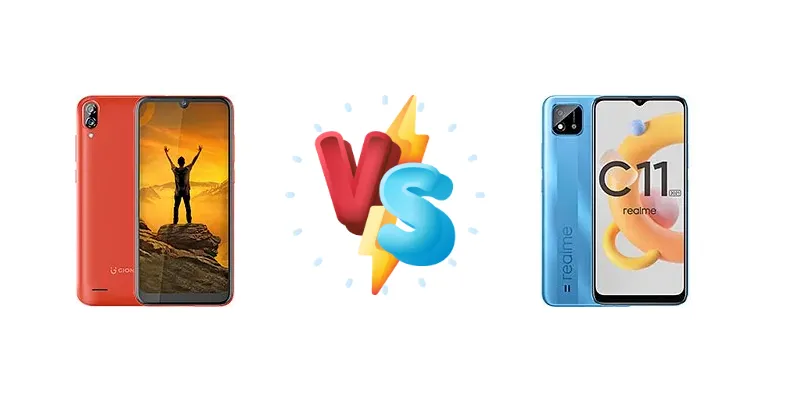
The Gionee Max and the Realme C11 (2021) occupy the ultra-budget smartphone segment, a space where incremental differences can be decisive. Surprisingly, both devices are powered by the exact same Unisoc SC9863A chipset, making a direct performance comparison less about raw power and more about software optimization, features, and brand ecosystem.
🏆 Quick Verdict
For the average user, the Realme C11 (2021) is the better choice. While performance is identical to the Gionee Max due to the shared Unisoc SC9863A chipset, Realme’s inclusion of 10W charging and established brand reputation offer a more complete package, even if the difference is minimal.
| Network |
|---|
| 2G bands | GSM 850 / 900 / 1800 / 1900 | GSM 850 / 900 / 1800 / 1900 |
| 3G bands | HSDPA 900 / 2100 | HSDPA 850 / 900 / 1900 / 2100 |
| 4G bands | 1, 3, 5, 8, 38, 40, 41 | 1, 3, 5, 8, 38, 40, 41 |
| Speed | HSPA, LTE | HSPA, LTE |
| Technology | GSM / HSPA / LTE | GSM / HSPA / LTE |
| Launch |
|---|
| Announced | 2020, August 25. Released 2020, August 31 | 2021, June 28 |
| Status | Discontinued | Available. Released 2021, June 28 |
| Body |
|---|
| Build | - | Glass front, plastic frame, plastic back |
| Dimensions | 148 x 70.9 x 10.8 mm (5.83 x 2.79 x 0.43 in) | 165.2 x 76.4 x 8.9 mm (6.50 x 3.01 x 0.35 in) |
| SIM | Nano-SIM + Nano-SIM | Nano-SIM + Nano-SIM |
| Weight | 185 g (6.53 oz) | 190 g (6.70 oz) |
| | - | Splash resistant design |
| Display |
|---|
| Resolution | 720 x 1560 pixels, 19.5:9 ratio (~282 ppi density) | 720 x 1600 pixels, 20:9 ratio (~269 ppi density) |
| Size | 6.1 inches, 91.3 cm2 (~87.0% screen-to-body ratio) | 6.52 inches, 102.6 cm2 (~81.3% screen-to-body ratio) |
| Type | IPS LCD | IPS LCD, 400 nits (typ) |
| Platform |
|---|
| CPU | Octa-core (4x1.6 GHz Cortex-A55 & 4x1.2 GHz Cortex-A55) | Octa-core (4x1.6 GHz Cortex-A55 & 4x1.2 GHz Cortex-A55) |
| Chipset | Unisoc SC9863A (28 nm) | Unisoc SC9863A (28 nm) |
| GPU | IMG8322 | IMG8322 |
| OS | Android 10 | Android 11, Realme Go UI |
| Memory |
|---|
| Card slot | microSDXC (dedicated slot) | microSDXC (dedicated slot) |
| Internal | 32GB 2GB RAM | 32GB 2GB RAM, 64GB 4GB RAM |
| | eMMC 5.1 | eMMC 5.1 |
| Main Camera |
|---|
| Dual | 13 MP, (wide), AF
Auxiliary lens | - |
| Features | LED flash | LED flash, HDR, panorama |
| Single | - | 8 MP, f/2.0, (wide), AF |
| Video | 1080p@24fps | 1080p@30fps |
| Selfie camera |
|---|
| Features | - | HDR, panorama |
| Single | 5 MP | 5 MP, f/2.2, (wide) |
| Video | - | 1080p@30fps |
| Sound |
|---|
| 3.5mm jack | Yes | Yes |
| 35mm jack | Yes | Yes |
| Loudspeaker | Yes | Yes |
| Comms |
|---|
| Bluetooth | 4.2, A2DP | 4.2, A2DP |
| NFC | No | No |
| Positioning | GPS | GPS, GLONASS, GALILEO, BDS |
| Radio | FM radio | Unspecified |
| USB | microUSB 2.0, OTG | microUSB 2.0, OTG |
| WLAN | Wi-Fi 802.11 a/b/g/n/ac | Wi-Fi 802.11 b/g/n |
| Features |
|---|
| Sensors | Accelerometer, proximity | Accelerometer, gyro, proximity, compass |
| Battery |
|---|
| Charging | - | 10W wired
Reverse wired |
| Type | Li-Po 5000 mAh | 5000 mAh |
| Misc |
|---|
| Colors | Black, Red, Royal Blue | Cool Blue, Cool Grey |
| Models | - | RMX3231 |
| Price | About 70 EUR | About 80 EUR |
| SAR | 0.41 W/kg (head) 0.90 W/kg (body) | - |
Gionee Max
- Potentially lower price point
- Functional for basic tasks
- Simple, uncluttered interface (potentially)
- No charging support specified
- Less established brand reputation
- Likely slower software updates
Realme C11 (2021)
- 10W wired charging
- Reverse wired charging
- Established brand with wider support
- Identical performance to Gionee Max
- Still limited by Unisoc SC9863A chipset
- Basic camera system
Display Comparison
Neither Gionee nor Realme provide detailed display specifications beyond resolution. Given the price point, both likely utilize LCD panels with standard 60Hz refresh rates. The absence of information regarding peak brightness or color gamut suggests both displays are geared towards basic visibility rather than media consumption. Bezels are expected to be substantial on both devices, maximizing screen real estate within a compact form factor.
Camera Comparison
Camera specifications are likely similar, focusing on basic image capture. Expect a primary sensor around 8-13MP, accompanied by a depth sensor and potentially a 2MP macro lens on both devices. The 2MP macro lens offers limited practical utility due to its low resolution and fixed focus. Image processing will be basic, prioritizing speed over detail. Neither device is expected to offer optical image stabilization (OIS).
Performance
The core of both the Gionee Max and Realme C11 (2021) is the Unisoc SC9863A, a 28nm octa-core processor featuring four Cortex-A55 cores clocked at 1.6GHz and another four at 1.2GHz. This configuration is designed for efficient handling of everyday tasks like calling, texting, and light social media browsing. The identical chipset means performance will be virtually indistinguishable between the two. RAM capacity is a critical factor not specified, but likely limited to 2GB or 3GB in both cases, impacting multitasking capabilities. Thermal management will likely be passive, relying on the chassis to dissipate heat, which isn't a concern given the low-power chipset.
Battery Life
Battery capacity is not specified for the Gionee Max, but the Realme C11 (2021) features a 5000mAh battery. The Realme C11 (2021) also supports 10W wired charging and reverse wired charging, a feature absent on the Gionee Max. While 10W charging isn't fast by modern standards, it's a significant advantage over no charging support at all. The larger battery capacity in the Realme C11 (2021) translates to longer screen-on time, making it more suitable for users who rely heavily on their phone throughout the day.
Buying Guide
Buy the Gionee Max if you prioritize absolute lowest cost and are comfortable with a potentially less refined software experience. It's a functional device for basic tasks. Buy the Realme C11 (2021) if you value the convenience of 10W charging, reverse wired charging, and the peace of mind that comes with a more established brand known for regular software updates (even if limited in this segment).
Frequently Asked Questions
❓ Does the Unisoc SC9863A chipset struggle with popular apps like WhatsApp or Facebook?
The Unisoc SC9863A is designed for basic smartphone functionality. While it can run apps like WhatsApp and Facebook, expect slower loading times and occasional lag, especially with multiple apps open simultaneously. It's best suited for light usage.
❓ Is the reverse wired charging on the Realme C11 (2021) useful for anything?
The 10W reverse wired charging on the Realme C11 (2021) is primarily useful for topping up accessories like wireless earbuds or a smartwatch in an emergency. It's a slow charging method, so don't expect to fully charge another phone quickly.
❓ Will either phone receive Android updates in the future?
Given the price point and the Unisoc chipset, significant Android updates are unlikely. Both devices likely launched with Android Go Edition, a lightweight version of Android optimized for low-end hardware. Minor security patches may be released, but a major OS upgrade is improbable.