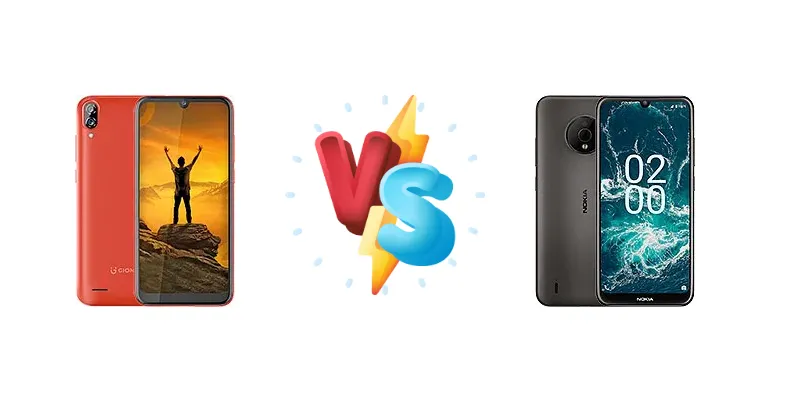
The Gionee Max and Nokia C200 represent the extreme end of the budget smartphone market, targeting users prioritizing affordability above all else. While both aim to deliver basic smartphone functionality, they take different approaches to achieving this, primarily through their chipset choices. This comparison dissects those choices and their implications for everyday use.
🏆 Quick Verdict
For the average user needing a phone for basic tasks, the Gionee Max offers a slight advantage due to its octa-core processor and more modern architecture. While the Nokia C200 benefits from a more efficient manufacturing process, the Gionee Max’s CPU configuration provides better multi-tasking capabilities, making it the better overall value.
| Network |
|---|
| 2G bands | GSM 850 / 900 / 1800 / 1900 | GSM 850 / 900 / 1800 / 1900 |
| 3G bands | HSDPA 900 / 2100 | HSDPA 850 / 1700(AWS) / 1900 |
| 4G bands | 1, 3, 5, 8, 38, 40, 41 | 2, 4, 5, 12, 13, 41, 66, 71 |
| Speed | HSPA, LTE | HSPA, LTE (2CA) |
| Technology | GSM / HSPA / LTE | GSM / HSPA / LTE |
| Launch |
|---|
| Announced | 2020, August 25. Released 2020, August 31 | 2022, January 05 |
| Status | Discontinued | Available. Released 2022, Q2 |
| Body |
|---|
| Dimensions | 148 x 70.9 x 10.8 mm (5.83 x 2.79 x 0.43 in) | 156.5 x 73.1 x 8.8 mm (6.16 x 2.88 x 0.35 in) |
| SIM | Nano-SIM + Nano-SIM | Nano-SIM |
| Weight | 185 g (6.53 oz) | 172.5 g (6.10 oz) |
| | - | Splash protection |
| Display |
|---|
| Resolution | 720 x 1560 pixels, 19.5:9 ratio (~282 ppi density) | 720 x 1560 pixels, 19.5:9 ratio (~282 ppi density) |
| Size | 6.1 inches, 91.3 cm2 (~87.0% screen-to-body ratio) | 6.09 inches, 91.0 cm2 (~79.6% screen-to-body ratio) |
| Type | IPS LCD | IPS LCD |
| Platform |
|---|
| CPU | Octa-core (4x1.6 GHz Cortex-A55 & 4x1.2 GHz Cortex-A55) | Quad-core 2.0 GHz Cortex-A53 |
| Chipset | Unisoc SC9863A (28 nm) | Mediatek MT6761 Helio A22 (12 nm) |
| GPU | IMG8322 | PowerVR GE8320 |
| OS | Android 10 | Android 12 |
| Memory |
|---|
| Card slot | microSDXC (dedicated slot) | microSDXC (dedicated slot) |
| Internal | 32GB 2GB RAM | 32GB 3GB RAM |
| | eMMC 5.1 | eMMC 5.1 |
| Main Camera |
|---|
| Dual | 13 MP, (wide), AF
Auxiliary lens | - |
| Features | LED flash | LED flash |
| Single | - | 13 MP, AF |
| Video | 1080p@24fps | 1080p@30fps |
| Selfie camera |
|---|
| Single | 5 MP | 8 MP |
| Video | - | 1080p@30fps |
| Sound |
|---|
| 3.5mm jack | Yes | Yes |
| 35mm jack | Yes | Yes |
| Loudspeaker | Yes | Yes |
| Comms |
|---|
| Bluetooth | 4.2, A2DP | 5.0, A2DP, LE |
| NFC | No | No |
| Positioning | GPS | GPS |
| Radio | FM radio | FM radio |
| USB | microUSB 2.0, OTG | USB Type-C 2.0, OTG |
| WLAN | Wi-Fi 802.11 a/b/g/n/ac | Wi-Fi 802.11 b/g/n/ac |
| Features |
|---|
| Sensors | Accelerometer, proximity | Accelerometer, proximity, barometer |
| Battery |
|---|
| Charging | - | 10W wired |
| Type | Li-Po 5000 mAh | Li-Ion 4000 mAh |
| Misc |
|---|
| Colors | Black, Red, Royal Blue | Meteor Black |
| Models | - | TA-1437, TA-1510 |
| Price | About 70 EUR | About 60 EUR |
| SAR | 0.41 W/kg (head) 0.90 W/kg (body) | 1.11 W/kg (head) 1.33 W/kg (body) |
Gionee Max
- Octa-core processor offers better multitasking.
- More modern CPU architecture (Cortex-A55).
- Potentially better performance in demanding apps.
- 28nm process may lead to higher power consumption.
- Likely less efficient than the Nokia C200 in idle scenarios.
Nokia C200
- 12nm process offers potential power efficiency.
- Simpler processor may result in lower heat generation.
- 10W charging is standard for this price point.
- Quad-core processor struggles with multitasking.
- Older CPU architecture (Cortex-A53).
- May feel sluggish with multiple apps open.
Display Comparison
Neither Gionee nor Nokia provide display specifications beyond the basic screen size. Given the price point, both likely utilize LCD panels with modest resolutions (likely 720p+). The absence of data prevents a meaningful comparison of brightness, color accuracy, or refresh rates. However, the focus on affordability suggests both displays prioritize cost-effectiveness over visual fidelity.
Camera Comparison
Both phones are expected to feature basic camera setups. Without specific sensor details, it’s safe to assume both rely on low-resolution sensors. Image quality will be heavily dependent on software processing, and neither phone is likely to excel in challenging lighting conditions. The absence of Optical Image Stabilization (OIS) on either device further limits their low-light capabilities. Any claims of advanced camera features should be viewed with skepticism.
Performance
The core difference lies in the chipsets. The Gionee Max’s Unisoc SC9863A is an octa-core processor built on a 28nm process, featuring four Cortex-A55 cores clocked at 1.6GHz and four at 1.2GHz. This configuration allows for better parallel processing compared to the Nokia C200’s MediaTek Helio A22. The Helio A22 is a quad-core processor using Cortex-A53 cores clocked at 2.0GHz, fabricated on a more efficient 12nm process. While the A53 cores have a higher clock speed, the A55 architecture in the SC9863A is more modern and generally more efficient per clock cycle. The 28nm process of the Unisoc chip will likely result in higher power consumption under load, but the eight cores provide a significant advantage in multi-threaded tasks. The Nokia C200 will likely feel sluggish when running multiple apps simultaneously.
Battery Life
Battery capacity data is unavailable for both devices. However, the Nokia C200’s 12nm Helio A22 chipset *potentially* offers better power efficiency than the Gionee Max’s 28nm Unisoc SC9863A. This efficiency is partially offset by the Gionee Max’s larger core count. The Nokia C200 supports 10W wired charging, suggesting a slower charging speed. Without knowing the battery capacity, it’s difficult to estimate 0-100% charge times, but both phones will likely take several hours to fully charge.
Buying Guide
Buy the Gionee Max if you frequently switch between apps, need a phone capable of handling slightly more demanding tasks like light web browsing with multiple tabs, or anticipate using it for basic productivity. Buy the Nokia C200 if battery life is your absolute top priority and your usage is limited to calls, texts, and very occasional, single-app use. The Nokia C200’s 12nm process offers potential efficiency gains, but at the cost of processing power.
Frequently Asked Questions
❓ Will the Unisoc SC9863A in the Gionee Max overheat during prolonged use?
The 28nm process of the SC9863A is less efficient than newer nodes, meaning it will generate more heat under sustained load. However, given the limited processing power of this chipset, significant overheating is unlikely. Expect some warmth during extended gaming or video playback, but not to the point of causing performance throttling or discomfort.
❓ Is the Nokia C200 suitable for playing mobile games like PUBG or Call of Duty?
The MediaTek Helio A22 in the Nokia C200 is not designed for demanding games like PUBG or Call of Duty. While you might be able to run them at the lowest settings, expect significant frame rate drops and a generally poor gaming experience. This phone is best suited for casual games and basic tasks.
❓ How much storage does each phone offer, and is it expandable?
Storage capacity is not specified in the provided data. However, phones in this price range typically offer 16GB or 32GB of internal storage. It's highly probable that both devices feature a microSD card slot for storage expansion, allowing users to add more space for photos, videos, and apps.
❓ What version of Android do these phones run?
The Android version is not specified. However, given the hardware specifications, it's likely both phones run a relatively older version of Android (potentially Android 11 or 12 Go Edition) optimized for low-end devices. Expect limited software updates and a simpler user interface.