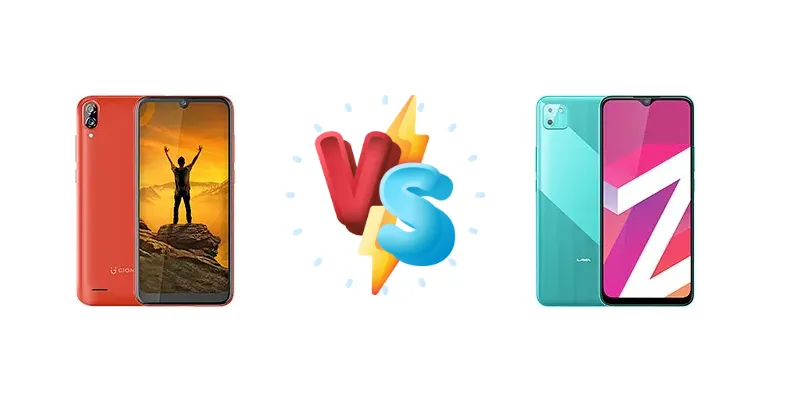
The Gionee Max and Lava Z2 Max represent the ultra-budget end of the smartphone spectrum. Both aim to deliver essential smartphone functionality at the lowest possible price point. However, significant differences in their core processing power suggest a clear performance gap, making this comparison crucial for budget-conscious buyers.
🏆 Quick Verdict
For the average user prioritizing responsiveness and multitasking, the Gionee Max emerges as the better choice. Its Unisoc SC9863A octa-core processor offers a substantial advantage over the Lava Z2 Max’s quad-core CPU, translating to a smoother user experience despite potential compromises elsewhere.
| Network |
|---|
| 2G bands | GSM 850 / 900 / 1800 / 1900 | GSM 850 / 900 / 1800 / 1900 |
| 3G bands | HSDPA 900 / 2100 | HSDPA 900 / 2100 |
| 4G bands | 1, 3, 5, 8, 38, 40, 41 | 1, 3, 5, 8, 40, 41 |
| Speed | HSPA, LTE | HSPA 42.2/5.76 Mbps, LTE Cat4 150/50 Mbps |
| Technology | GSM / HSPA / LTE | GSM / HSPA / LTE |
| Launch |
|---|
| Announced | 2020, August 25. Released 2020, August 31 | 2021, May 11 |
| Status | Discontinued | Available. Released 2021, May 11 |
| Body |
|---|
| Build | - | Glass front, plastic back, plastic frame |
| Dimensions | 148 x 70.9 x 10.8 mm (5.83 x 2.79 x 0.43 in) | 174.7 x 78.6 x 9.1 mm (6.88 x 3.09 x 0.36 in) |
| SIM | Nano-SIM + Nano-SIM | Nano-SIM + Nano-SIM |
| Weight | 185 g (6.53 oz) | 216 g (7.62 oz) |
| Display |
|---|
| Protection | - | Corning Gorilla Glass 3 |
| Resolution | 720 x 1560 pixels, 19.5:9 ratio (~282 ppi density) | 720 x 1640 pixels (~256 ppi density) |
| Size | 6.1 inches, 91.3 cm2 (~87.0% screen-to-body ratio) | 7.0 inches, 116.4 cm2 (~84.7% screen-to-body ratio) |
| Type | IPS LCD | IPS LCD |
| Platform |
|---|
| CPU | Octa-core (4x1.6 GHz Cortex-A55 & 4x1.2 GHz Cortex-A55) | Quad-core 1.8 GHz |
| Chipset | Unisoc SC9863A (28 nm) | - |
| GPU | IMG8322 | - |
| OS | Android 10 | Android 10 (Go edition) |
| Memory |
|---|
| Card slot | microSDXC (dedicated slot) | microSDXC (dedicated slot) |
| Internal | 32GB 2GB RAM | 32GB 2GB RAM |
| | eMMC 5.1 | eMMC 5.1 |
| Main Camera |
|---|
| Dual | 13 MP, (wide), AF
Auxiliary lens | 13 MP, f/1.9, (wide), 1/3.0", 1.12µm, AF
Auxiliary lens |
| Features | LED flash | LED flash |
| Single | - | 8 MP, f/2.0, (wide), 1.12µm |
| Video | 1080p@24fps | 720p@30fps |
| Selfie camera |
|---|
| Single | 5 MP | 8 MP, f/2.0, (wide), 1.12µm |
| Sound |
|---|
| 3.5mm jack | Yes | Yes |
| 35mm jack | Yes | Yes |
| Loudspeaker | Yes | Yes |
| Comms |
|---|
| Bluetooth | 4.2, A2DP | 5.0, A2DP, LE |
| NFC | No | No |
| Positioning | GPS | GPS |
| Radio | FM radio | FM radio |
| USB | microUSB 2.0, OTG | USB Type-C 2.0, OTG |
| WLAN | Wi-Fi 802.11 a/b/g/n/ac | Wi-Fi 802.11 b/g/n, Wi-Fi Direct |
| Features |
|---|
| Sensors | Accelerometer, proximity | Accelerometer |
| Battery |
|---|
| Type | Li-Po 5000 mAh | Li-Po 6000 mAh |
| Misc |
|---|
| Colors | Black, Red, Royal Blue | Stroked Blue, Stroked Cyan |
| Models | - | LS0001 |
| Price | About 70 EUR | About 90 EUR |
| SAR | 0.41 W/kg (head) 0.90 W/kg (body) | - |
Gionee Max
- Octa-core processor offers superior multitasking capabilities.
- More efficient CPU architecture for smoother app switching.
- Potentially better performance in demanding apps.
- Older 28nm process node may lead to higher power consumption.
- Limited information on display quality and camera capabilities.
Lava Z2 Max
- Potentially longer battery life due to less powerful processor.
- Simpler user experience for basic tasks.
- Likely more affordable.
- Quad-core processor will struggle with multitasking.
- Slower performance in demanding apps and games.
- Limited future-proofing.
Display Comparison
Neither Gionee nor Lava provide display specifications beyond size. Given the price point, both likely utilize LCD panels with 720p+ resolution. The absence of details like peak brightness or color gamut suggests neither phone will excel in outdoor visibility or color accuracy. Bezels are expected to be substantial on both devices, maximizing screen real estate within a compact form factor.
Camera Comparison
Detailed camera specifications are unavailable for either device. However, given the market segment, expectations should be tempered. Both phones likely feature a primary camera alongside basic auxiliary sensors. Without knowing sensor sizes or apertures, it’s difficult to assess image quality. The focus should be on functionality rather than photographic excellence. Any claims of advanced features like HDR or night mode should be viewed with skepticism.
Performance
The core differentiator lies in the processors. The Gionee Max’s Unisoc SC9863A is an octa-core chip featuring four Cortex-A55 cores clocked at 1.6 GHz and four at 1.2 GHz. This architecture allows for efficient task distribution, handling background processes without significantly impacting foreground app performance. In contrast, the Lava Z2 Max utilizes a quad-core processor clocked at 1.8 GHz. While the higher clock speed *might* offer a slight advantage in single-core tasks, the Gionee Max’s eight cores will demonstrably outperform it in multi-threaded applications and multitasking. The 28nm process node of the Unisoc chip is older, potentially leading to higher power consumption, but the architectural advantage is likely to outweigh this.
Battery Life
Battery capacity details are missing for both devices. However, the Lava Z2 Max’s less powerful quad-core processor *could* translate to better battery life, as it requires less energy to operate. Conversely, the Gionee Max’s more efficient Cortex-A55 cores might mitigate the power draw of its octa-core configuration. Without specific mAh ratings and charging wattage information, it’s impossible to definitively determine which phone offers superior battery performance. Charging times are likely to be lengthy on both devices.
Buying Guide
Buy the Gionee Max if you need a phone capable of handling multiple apps simultaneously, even if it's just switching between messaging, web browsing, and music. It's ideal for users who occasionally play light games or use moderately demanding apps. Buy the Lava Z2 Max if your primary needs are basic communication – calls, texts, and very light web browsing – and you prioritize simplicity and potentially longer battery life due to the less power-hungry processor.
Frequently Asked Questions
❓ Will the Gionee Max be able to run popular social media apps like Facebook and WhatsApp smoothly?
Yes, the Gionee Max’s octa-core processor and sufficient RAM (though the amount is unspecified) should handle Facebook and WhatsApp without significant lag. However, running multiple apps simultaneously might cause some slowdown.
❓ Is the Lava Z2 Max suitable for someone who primarily uses their phone for making calls and sending texts?
Absolutely. The Lava Z2 Max’s quad-core processor is perfectly adequate for basic communication tasks. Its simplicity and potentially longer battery life make it a good choice for users with minimal smartphone needs.
❓ Can either of these phones handle basic mobile games like Candy Crush or Subway Surfers?
The Gionee Max is more likely to provide a playable experience with these games, though don't expect high frame rates or detailed graphics. The Lava Z2 Max might struggle with even these relatively simple games due to its less powerful processor.