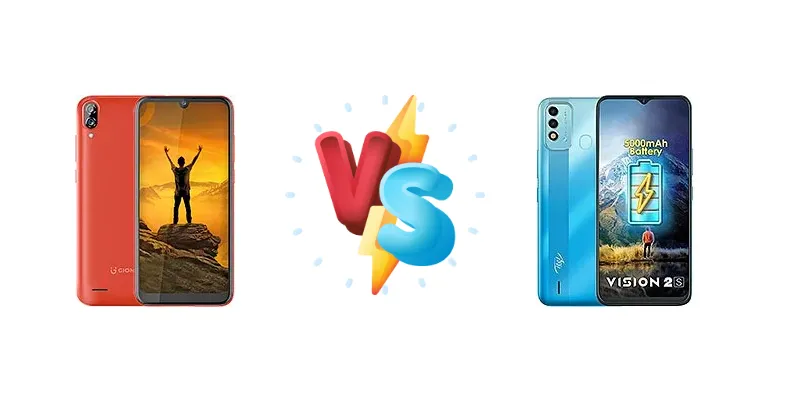
The Gionee Max and itel Vision 2S represent the extreme end of the smartphone price spectrum. Both devices target first-time smartphone buyers or those needing a reliable secondary device. This comparison dissects their similarities and the single key difference – charging speed – to determine which offers the best value.
🏆 Quick Verdict
For the average user prioritizing convenience, the itel Vision 2S is the better choice. While both phones share identical core hardware, the inclusion of 18W wired charging significantly reduces downtime compared to the Gionee Max, which lacks any specified fast charging support.
| Network |
|---|
| 2G bands | GSM 850 / 900 / 1800 / 1900 | GSM 850 / 900 / 1800 / 1900 |
| 3G bands | HSDPA 900 / 2100 | HSDPA 850 / 900 / 2100 |
| 4G bands | 1, 3, 5, 8, 38, 40, 41 | LTE |
| Speed | HSPA, LTE | HSPA, LTE |
| Technology | GSM / HSPA / LTE | GSM / HSPA / LTE |
| Launch |
|---|
| Announced | 2020, August 25. Released 2020, August 31 | 2021 |
| Status | Discontinued | Available. Released 2021 |
| Body |
|---|
| Dimensions | 148 x 70.9 x 10.8 mm (5.83 x 2.79 x 0.43 in) | 166 x 76.3 x 8.9 mm (6.54 x 3.00 x 0.35 in) |
| SIM | Nano-SIM + Nano-SIM | Dual SIM |
| Weight | 185 g (6.53 oz) | - |
| Display |
|---|
| Resolution | 720 x 1560 pixels, 19.5:9 ratio (~282 ppi density) | 720 x 1600 pixels, 20:9 ratio (~269 ppi density) |
| Size | 6.1 inches, 91.3 cm2 (~87.0% screen-to-body ratio) | 6.52 inches, 102.6 cm2 (~81.0% screen-to-body ratio) |
| Type | IPS LCD | IPS LCD |
| Platform |
|---|
| CPU | Octa-core (4x1.6 GHz Cortex-A55 & 4x1.2 GHz Cortex-A55) | Octa-core (4x1.6 GHz Cortex-A55 & 4x1.2 GHz Cortex-A55) |
| Chipset | Unisoc SC9863A (28 nm) | Unisoc SC9863A (28 nm) |
| GPU | IMG8322 | IMG8322 |
| OS | Android 10 | Android 11 (Go edition) |
| Memory |
|---|
| Card slot | microSDXC (dedicated slot) | microSDXC |
| Internal | 32GB 2GB RAM | 32GB 2GB RAM |
| | eMMC 5.1 | - |
| Main Camera |
|---|
| Dual | 13 MP, (wide), AF
Auxiliary lens | 8 MP
0.3 MP |
| Features | LED flash | LED flash |
| Video | 1080p@24fps | 1080p@30fps |
| Selfie camera |
|---|
| Single | 5 MP | 5 MP |
| Video | - | Yes |
| Sound |
|---|
| 3.5mm jack | Yes | - |
| 35mm jack | Yes | Yes |
| Loudspeaker | Yes | Yes |
| Comms |
|---|
| Bluetooth | 4.2, A2DP | Yes |
| NFC | No | No |
| Positioning | GPS | GPS |
| Radio | FM radio | Unspecified |
| USB | microUSB 2.0, OTG | microUSB |
| WLAN | Wi-Fi 802.11 a/b/g/n/ac | Yes |
| Features |
|---|
| Sensors | Accelerometer, proximity | Fingerprint (rear-mounted), accelerometer |
| Battery |
|---|
| Charging | - | 18W wired |
| Type | Li-Po 5000 mAh | 5000 mAh |
| Misc |
|---|
| Colors | Black, Red, Royal Blue | Gradation Purple, Gradation Blue, Deep Blue |
| Price | About 70 EUR | - |
| SAR | 0.41 W/kg (head) 0.90 W/kg (body) | - |
Gionee Max
- Potentially lower price point
- Functional for basic smartphone tasks
- Likely similar battery life to itel Vision 2S (assuming similar capacity)
- No specified fast charging support
- Performance limited by Unisoc SC9863A chipset
- Likely basic camera performance
itel Vision 2S
- 18W wired charging for faster recharge times
- Functional for basic smartphone tasks
- Likely similar battery life to Gionee Max (assuming similar capacity)
- Performance limited by Unisoc SC9863A chipset
- Likely basic camera performance
- Potentially slightly higher price
Display Comparison
Both the Gionee Max and itel Vision 2S are expected to feature LCD panels, typical for this price bracket. Given the lack of specific display specifications, we anticipate resolutions around 720p+ and similar brightness levels. Color accuracy and viewing angles will likely be modest. The absence of features like high refresh rates or Gorilla Glass is standard at this price point, meaning users should consider a screen protector.
Camera Comparison
Camera performance is likely to be similar on both devices, relying on the capabilities of the Unisoc SC9863A's image signal processor. Expect a primary camera, potentially paired with a depth sensor or a low-resolution macro lens. Image quality will be acceptable in well-lit conditions, but will suffer in low light. The absence of optical image stabilization (OIS) means photos and videos will be prone to blur. The marketing materials for these phones often highlight megapixel counts, but sensor size and lens quality are far more important determinants of image quality.
Performance
The core of both devices is the Unisoc SC9863A chipset, a 28nm octa-core processor. This SoC features a cluster of four Cortex-A55 cores clocked at 1.6 GHz and another four at 1.2 GHz. This configuration is designed for efficient handling of everyday tasks like calling, texting, and light social media browsing. While capable of running basic Android apps, demanding games or multitasking will likely result in noticeable slowdowns. The shared chipset means performance will be virtually identical between the two phones; RAM capacity (not specified) will be the limiting factor.
Battery Life
Battery capacity is not specified for either device, but given the target market, we can estimate capacities around 4000-5000 mAh. The key differentiator is the itel Vision 2S's 18W wired charging support. This allows for significantly faster charging times compared to the Gionee Max, which lacks any specified fast charging capability. While a larger battery capacity *could* offset slower charging, the convenience of a quicker recharge is a significant advantage for the itel Vision 2S.
Buying Guide
Buy the Gionee Max if you absolutely need to minimize upfront cost and are comfortable with slower charging speeds. It's a functional device for basic tasks. Buy the itel Vision 2S if you value a quicker recharge time, even if it means a slight price premium. The 18W charging is a tangible benefit for users who rely on their phone throughout the day and don't have hours to spare for a full charge.
Frequently Asked Questions
❓ Will the Unisoc SC9863A chipset struggle with popular apps like WhatsApp and Facebook?
The Unisoc SC9863A is designed for basic smartphone functionality. While it can run apps like WhatsApp and Facebook, expect occasional slowdowns, especially when multitasking or using the apps for extended periods. Keeping background apps to a minimum will improve performance.
❓ How long will it take to fully charge the itel Vision 2S with the 18W charger?
Without knowing the battery capacity, it's difficult to provide an exact time. However, with 18W charging, a full charge from 0% is likely to take between 2.5 and 3.5 hours, a significant improvement over the Gionee Max which lacks fast charging.
❓ Are these phones suitable for gaming?
These phones are not ideal for gaming. The Unisoc SC9863A chipset lacks the graphical power to run demanding games smoothly. Simple, less intensive games may be playable at low settings, but expect frame rate drops and lag.
❓ What type of SIM cards do these phones support?
Given the target market, both phones likely support dual SIM cards (Nano-SIM). However, specific 4G band compatibility may vary depending on the region. Check the product specifications for your region before purchasing.