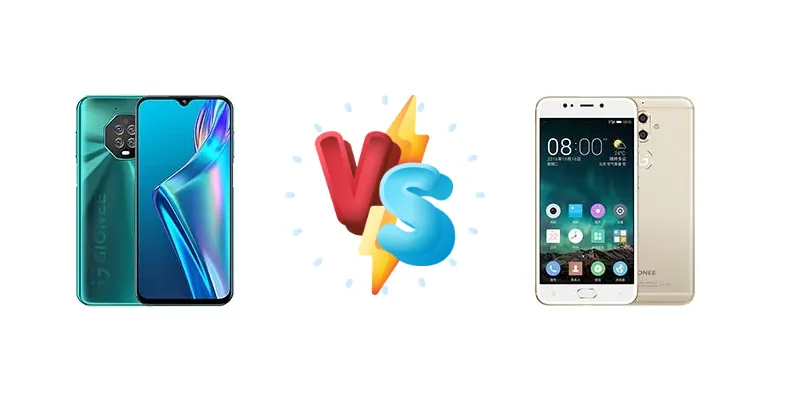
The Gionee M3 and S9 represent different approaches to the budget smartphone market. The M3, with its newer Helio P60 chipset, aims for a performance boost, while the S9 leverages the established Helio P10 for potentially better efficiency. This comparison dissects the key differences to help you determine which Gionee best suits your needs.
🏆 Quick Verdict
For most users, the Gionee M3 is the superior choice. Its Helio P60 chipset, built on a 12nm process, delivers significantly improved CPU and GPU performance compared to the S9’s older 28nm Helio P10. While the S9 might offer slightly better battery life due to the more efficient (though less powerful) chip, the M3’s performance advantage is more impactful for everyday tasks and light gaming.
| Network |
|---|
| 2G bands | GSM 850 / 900 / 1800 / 1900 | GSM 850 / 900 / 1800 / 1900 - SIM 1 & SIM 2 |
| 3G bands | HSDPA 850 / 900 / 2100 | HSDPA 850 / 900 / 1900 / 2100 |
| 4G bands | LTE | 1, 3, 7, 38, 39, 40, 41 |
| Speed | HSPA, LTE | HSPA 42.2/5.76 Mbps, LTE (2CA) Cat6 300/50 Mbps |
| Technology | GSM / HSPA / LTE | GSM / HSPA / LTE |
| Launch |
|---|
| Announced | 2021, April 07. Released 2021, April 14 | 2016, November. Released 2016, November |
| Status | Discontinued | Discontinued |
| Body |
|---|
| Dimensions | 163.2 x 75.9 x 9.3 mm (6.43 x 2.99 x 0.37 in) | 154.2 x 76.4 x 7.4 mm (6.07 x 3.01 x 0.29 in) |
| SIM | Nano-SIM + Nano-SIM | Nano-SIM + Nano-SIM |
| Weight | 201 g (7.09 oz) | 168.2 g (5.93 oz) |
| Display |
|---|
| Protection | - | Corning Gorilla Glass 4 |
| Resolution | 720 x 1600 pixels, 20:9 ratio (~269 ppi density) | 1080 x 1920 pixels, 16:9 ratio (~401 ppi density) |
| Size | 6.53 inches, 102.9 cm2 (~83.1% screen-to-body ratio) | 5.5 inches, 83.4 cm2 (~70.8% screen-to-body ratio) |
| Type | IPS LCD | IPS LCD |
| | - | 3D Touch display |
| Platform |
|---|
| CPU | Octa-core (4x2.0 GHz Cortex-A73 & 4x2.0 GHz Cortex-A53) | Octa-core (4x2.0 GHz Cortex-A53 & 4x1.0 GHz Cortex-A53) |
| Chipset | Mediatek MT6771 Helio P60 (12 nm) | Mediatek MT6755 Helio P10 (28 nm) |
| GPU | Mali-G72 MP3 | Mali-T860MP2 |
| OS | Android | Android 6.0.1 (Marshmallow), Amigo 3.5 |
| Memory |
|---|
| Card slot | microSDXC (uses shared SIM slot) | microSDXC (uses shared SIM slot) |
| Internal | 128GB 6GB RAM, 128GB 8GB RAM, 256GB 8GB RAM | 64GB 4GB RAM |
| | eMMC 5.1 | eMMC 5.1 |
| Main Camera |
|---|
| Dual | - | 13 MP, PDAF
Auxiliary lens |
| Features | LED flash, HDR, panorama | LED flash, panorama, HDR |
| Quad | 16 MP, (wide), PDAF
5 MP, (ultrawide)
2 MP (macro)
Auxiliary lens | - |
| Video | 1080p@30fps | 1080p@30fps |
| Selfie camera |
|---|
| Single | 8 MP | 13 MP |
| Video | 1080p@30fps | - |
| Sound |
|---|
| 3.5mm jack | Yes | Yes |
| 35mm jack | Yes | Yes |
| Loudspeaker | Yes | Yes |
| | - | 24-bit/192kHz audio |
| Comms |
|---|
| Bluetooth | Yes | 4.0, A2DP |
| NFC | No | No |
| Positioning | GPS | GPS |
| Radio | Unspecified | FM radio |
| USB | USB Type-C 2.0, OTG | microUSB 2.0, OTG |
| WLAN | Wi-Fi 802.11 b/g/n, hotspot | Wi-Fi 802.11 b/g/n, Wi-Fi Direct |
| Features |
|---|
| Sensors | Fingerprint (side-mounted), accelerometer, proximity | Fingerprint (rear-mounted), accelerometer, proximity, compass |
| Battery |
|---|
| Charging | 18W wired | - |
| Type | Li-Po 5000 mAh | Li-Ion 3000 mAh, non-removable |
| Misc |
|---|
| Colors | Black, Green, Sky, Gray | Black, Gold, Rose Gold |
| Price | About 120 EUR | About 370 EUR |
Gionee M3
- Significantly faster processor (Helio P60)
- More efficient 12nm manufacturing process
- Faster 18W wired charging
- Improved multitasking capabilities
- Potentially slightly shorter battery life (depending on battery capacity)
- May generate more heat under sustained load
Gionee S9
- Potentially better battery efficiency (due to older, less powerful chip)
- Lower price point (likely, given its age)
- Simpler, more established chipset
- May run slightly cooler during basic tasks
- Significantly slower processor (Helio P10)
- Less efficient 28nm manufacturing process
- Slower charging speeds
- Struggles with demanding apps and games
Display Comparison
Unfortunately, display specifications are not provided. However, given the market positioning of both devices, it's reasonable to assume both utilize IPS LCD panels. The S9, being an older model, may have slightly larger bezels. Color accuracy is likely similar, with neither phone expected to cover a wide color gamut. The absence of high refresh rates is also expected.
Camera Comparison
Camera specifications are not detailed enough for a thorough comparison. It's likely both phones feature similar camera setups geared towards casual photography. Without knowing sensor sizes or apertures, it’s difficult to assess image quality. The presence of a 2MP macro lens on either device is unlikely to significantly impact the overall camera experience. Image processing will likely be similar, focusing on basic scene optimization.
Performance
The core difference lies in the chipsets. The Gionee M3’s Mediatek MT6771 Helio P60 (12nm) features an octa-core CPU with a more modern architecture – 4x2.0 GHz Cortex-A73 and 4x2.0 GHz Cortex-A53 cores. This contrasts with the S9’s MT6755 Helio P10 (28nm), which uses 4x2.0 GHz Cortex-A53 and 4x1.0 GHz Cortex-A53 cores. The P60’s Cortex-A73 cores provide a substantial performance advantage in single-core tasks, while the 12nm manufacturing process offers improved thermal efficiency. The P10’s 28nm process is older and less efficient, leading to potentially more heat generation under load. This translates to a smoother experience on the M3 for demanding apps and games.
Battery Life
Battery capacity isn't specified for either device. However, the Gionee M3’s 18W wired charging is a clear advantage over the S9, which likely supports slower charging speeds. While the S9’s Helio P10 might be slightly more power-efficient, the M3’s faster charging mitigates any potential battery life disadvantage. The 12nm process of the P60 also contributes to better power management compared to the P10’s 28nm process.
Buying Guide
Buy the Gionee M3 if you prioritize responsiveness, multitasking, and a smoother user experience, especially if you occasionally play mobile games. The Helio P60 provides a noticeable performance uplift. Buy the Gionee S9 if your primary concern is maximizing battery life and you primarily use your phone for basic tasks like calling, texting, and light social media browsing. The older chipset may offer a marginal efficiency gain, but at the cost of performance.
Frequently Asked Questions
❓ Will the Gionee M3 handle demanding games like PUBG Mobile smoothly?
The Helio P60 in the Gionee M3 is capable of running PUBG Mobile, but likely at medium settings to maintain a stable frame rate. The older Helio P10 in the S9 will struggle with PUBG, requiring significantly lower settings and potentially experiencing lag.
❓ Is the difference in processor speed noticeable for everyday tasks like browsing and social media?
Yes, the Helio P60’s more powerful cores and efficient architecture will result in snappier app launches, smoother scrolling, and a more responsive overall experience compared to the Helio P10, even during everyday tasks.
❓ Does the Gionee S9 have any advantages for users who primarily make calls and send texts?
The S9 might offer slightly longer battery life during standby and basic usage due to the less power-hungry Helio P10. However, this difference is likely minimal and won't be noticeable for most users.
❓ Which phone is better for taking quick photos in good lighting conditions?
Without detailed camera specifications, it's difficult to say definitively. However, the image processing capabilities are likely similar on both devices, so photo quality in good lighting should be comparable.