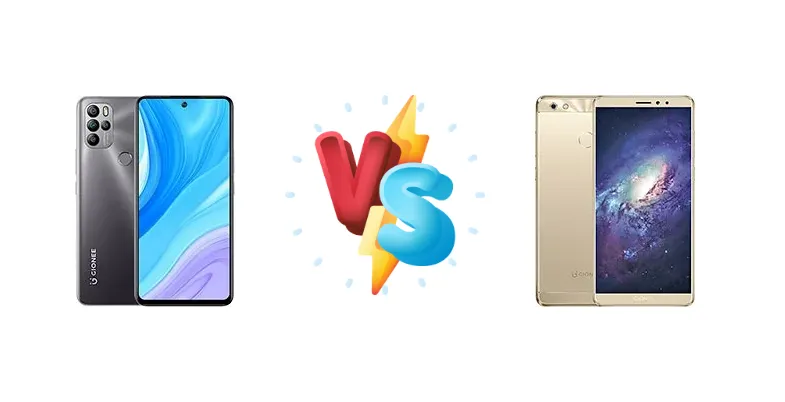
The Gionee M15 and M7 Power represent different eras of Gionee's smartphone strategy. The M7 Power aimed for long battery life and affordability, while the M15 attempts to inject a dose of gaming performance into the budget segment. This comparison dissects the core differences between these two devices, focusing on how their chipsets and design choices impact the user experience.
🏆 Quick Verdict
For most users, the Gionee M15 is the superior choice. Its Mediatek Helio G90 chipset offers a significant performance leap over the Snapdragon 435 in the M7 Power, making it better suited for gaming and demanding applications. While the M7 Power boasts respectable battery life, the M15's improved processing power justifies the trade-off.
| Network |
|---|
| 2G bands | GSM 850 / 900 / 1800 / 1900 | GSM 850 / 900 / 1800 / 1900 - SIM 1 & SIM 2 |
| 3G bands | HSDPA 850 / 900 / 1900 / 2100 | HSDPA 850 / 900 / 1900 / 2100 |
| 4G bands | 1, 2, 3, 5, 7, 8, 20, 28, 40 | 1, 3, 5, 7, 8, 38, 39, 40, 41 |
| Speed | HSPA, LTE | HSPA 42.2/5.76 Mbps, LTE Cat4 150/50 Mbps |
| Technology | GSM / HSPA / LTE | GSM / HSPA / LTE |
| Launch |
|---|
| Announced | 2021, May 24. Released 2021, May 28 | 2017, October. Released 2017, November |
| Status | Discontinued | Discontinued |
| Body |
|---|
| Build | - | Glass front (Gorilla Glass 3), aluminum back, aluminum frame |
| Dimensions | 165.2 x 77 x 9 mm (6.50 x 3.03 x 0.35 in) | 156.4 x 76.7 x 8.6 mm (6.16 x 3.02 x 0.34 in) |
| SIM | Nano-SIM + Nano-SIM | Nano-SIM + Nano-SIM |
| Weight | - | 199 g (7.02 oz) |
| Display |
|---|
| Protection | - | Corning Gorilla Glass 3 |
| Resolution | 1080 x 2400 pixels, 20:9 ratio (~395 ppi density) | 720 x 1440 pixels, 18:9 ratio (~268 ppi density) |
| Size | 6.67 inches, 107.4 cm2 (~84.4% screen-to-body ratio) | 6.0 inches, 92.9 cm2 (~77.4% screen-to-body ratio) |
| Type | IPS LCD | IPS LCD |
| Platform |
|---|
| CPU | Octa-core (2x2.05 GHz Cortex-A76 & 6x2.0 GHz Cortex-A55) | Octa-core 1.4 GHz Cortex-A53 |
| Chipset | Mediatek MT6785 Helio G90 (12 nm) | Qualcomm MSM8940 Snapdragon 435 (28 nm) |
| GPU | Mali-G76 MC4 | Adreno 505 |
| OS | Android 11 | Android 7.1.1 (Nougat), Amigo 5 |
| Memory |
|---|
| Card slot | microSDXC (dedicated slot) | microSDXC (uses shared SIM slot) |
| Internal | 128GB 6GB RAM, 128GB 8GB RAM | 64GB 4GB RAM |
| | - | eMMC 5.1 |
| Main Camera |
|---|
| Features | LED flash, HDR, panorama | LED flash, HDR, panorama |
| Quad | 48 MP, (wide), PDAF
5 MP, (ultrawide)
2 MP (macro)
Auxiliary lens | - |
| Single | 16 MP | 13 MP, f/2.0, AF |
| Video | 1080p@30fps | 1080p@30fps |
| Selfie camera |
|---|
| Single | 16 MP | 8 MP, f/2.2 |
| Video | 1080p@30fps | - |
| Sound |
|---|
| 3.5mm jack | Yes | Yes |
| 35mm jack | Yes | Yes |
| Loudspeaker | Yes | Yes |
| Comms |
|---|
| Bluetooth | Yes | 4.1, A2DP, LE |
| NFC | No | No |
| Positioning | GPS | GPS, GLONASS, BDS |
| Radio | Unspecified | FM radio |
| USB | USB Type-C 2.0, OTG | microUSB 2.0, OTG |
| WLAN | Yes | Wi-Fi 802.11 b/g/n |
| Features |
|---|
| Sensors | Fingerprint (rear-mounted), accelerometer, gyro, proximity | Fingerprint (rear-mounted), accelerometer, proximity, compass |
| Battery |
|---|
| Charging | 18W wired | - |
| Stand-by | - | Up to 625 h (3G) |
| Talk time | - | Up to 56 h (3G) |
| Type | Li-Po 5100 mAh | Li-Po 5000 mAh, non-removable |
| Misc |
|---|
| Colors | Gray | Dark blue, black, gold |
| Models | - | M7 Power |
| Price | About 180 EUR | About 260 EUR |
Gionee M15
- Significantly faster processor for gaming and multitasking
- Faster charging with 18W support
- More modern CPU architecture (Cortex-A76/A55)
- Likely shorter battery life compared to M7 Power
- May run warmer under heavy load
Gionee M7 Power
- Potentially longer battery life due to less demanding chipset
- More affordable price point
- Stable and reliable performance for basic tasks
- Slow processor struggles with demanding apps and games
- Older CPU architecture (Cortex-A53)
- Slower charging speeds
Display Comparison
Neither device's display specifications are provided, so a direct comparison is limited. However, given the M7 Power's focus on value, it likely features a standard IPS LCD panel. The M15, positioned as a slightly more premium option, *may* have a higher resolution or improved color accuracy. The difference in chipsets suggests the M15 could drive a higher refresh rate display if one were present, though this is speculative. Bezels are likely to be larger on both devices, reflecting their budget positioning.
Camera Comparison
Without detailed camera specifications, a precise comparison is difficult. However, it's reasonable to assume the M15 benefits from the increased processing power of the Helio G90 for image processing. This could result in better dynamic range, noise reduction, and faster image capture. The M7 Power's Snapdragon 435 likely relies on more basic image processing algorithms. The presence of a more powerful ISP (Image Signal Processor) within the G90 chipset would further enhance the M15's camera capabilities, even with similar sensor sizes.
Performance
The performance gap between the Gionee M15 and M7 Power is substantial. The M15's Mediatek Helio G90 (12nm) utilizes a modern CPU architecture – Cortex-A76 and A55 cores – compared to the M7 Power's older Snapdragon 435 (28nm) with Cortex-A53 cores. The G90's architecture delivers significantly higher single-core and multi-core performance, translating to faster app loading times, smoother animations, and a more responsive overall experience. The 28nm process of the Snapdragon 435 is less efficient, leading to more heat generation and potential throttling under sustained load. The G90's Mali-G76 MC4 GPU also provides a considerable boost in graphics performance, making the M15 a viable option for casual gaming.
Battery Life
The M7 Power's name explicitly highlights its battery focus. While the exact battery capacity isn't specified, it likely prioritizes a larger battery size. The M15, with its more power-hungry Helio G90, will likely have a smaller battery. However, the G90's 18W wired charging offers a faster charging experience compared to the M7 Power, potentially mitigating the difference in battery capacity. The efficiency gains of the 12nm process in the G90, despite its higher peak power draw, could also result in comparable real-world battery life for moderate usage.
Buying Guide
Buy the Gionee M15 if you prioritize smooth multitasking, mobile gaming, and a more responsive user experience. This phone is ideal for students, casual gamers, and anyone who frequently uses resource-intensive apps. Buy the Gionee M7 Power if your primary need is extended battery life and basic smartphone functionality. It's a solid option for users who primarily make calls, send texts, and browse the web, and who want a phone that can last a full day on a single charge without demanding performance.
Frequently Asked Questions
❓ Will the Gionee M15 be able to run popular games like PUBG Mobile smoothly?
The Helio G90 chipset in the Gionee M15 is capable of running PUBG Mobile at medium settings with reasonable frame rates. While it won't deliver a flagship gaming experience, it's a significant improvement over the Snapdragon 435 in the M7 Power, which would likely struggle with even lower settings.
❓ Is the difference in processor speed noticeable for everyday tasks like browsing and social media?
Yes, the difference is noticeable. The Helio G90's faster CPU cores and improved architecture will result in snappier app launches, smoother scrolling, and a more responsive overall experience when browsing the web, using social media, and performing other everyday tasks. The M7 Power's Snapdragon 435 may exhibit occasional lag or slowdowns.
❓ How much faster is the 18W charging on the Gionee M15 compared to the M7 Power?
Without knowing the M7 Power's charging wattage, a precise comparison is difficult. However, 18W charging is significantly faster than the typical 10W or 15W charging found on budget smartphones like the M7 Power. This means the M15 can replenish its battery much more quickly, reducing downtime.