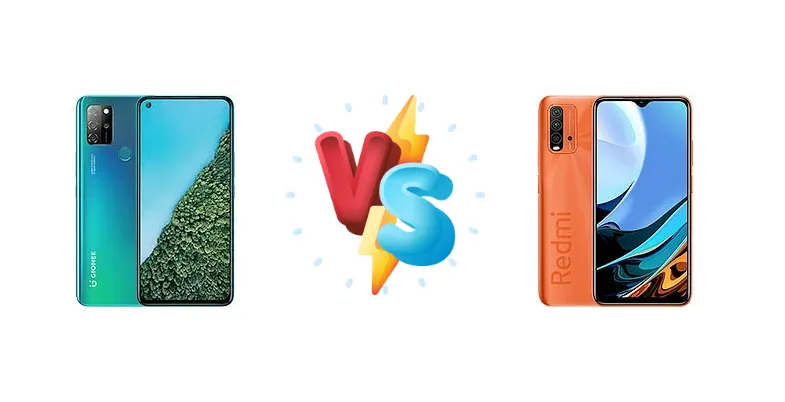
The Gionee M12 and Xiaomi Redmi 9 Power represent two distinct approaches to the ultra-budget smartphone market. The Gionee, available in multiple configurations, aims for affordability, while the Redmi 9 Power attempts to deliver a more well-rounded experience with faster charging and a more modern chipset. This comparison dissects their key differences to determine which device offers the best value.
🏆 Quick Verdict
For the average user, the Xiaomi Redmi 9 Power is the superior choice. Its Qualcomm Snapdragon 662 chipset provides a noticeable performance advantage over both variants of the Gionee M12’s Mediatek processors, and the 18W charging significantly reduces downtime. While the Gionee may be cheaper, the Redmi 9 Power’s improved usability justifies the price difference.
| Network |
|---|
| 2G bands | GSM 850 / 900 / 1800 / 1900 | GSM 850 / 900 / 1800 / 1900 |
| 3G bands | HSDPA 900 / 1900 | HSDPA 850 / 900 / 2100 |
| 4G bands | 1, 2, 3, 5, 7, 8, 20, 28, 40 | 1, 3, 5, 8, 40, 41 |
| Speed | HSPA 42.2/11.5 Mbps, LTE Cat4 150/50 Mbps | HSPA, LTE |
| Technology | GSM / HSPA / LTE | GSM / HSPA / LTE |
| Launch |
|---|
| Announced | 2020, November 16. Released 2020, November 16 | 2020, December 17 |
| Status | Discontinued | Available. Released 2020, December 22 |
| Body |
|---|
| Build | Glass front, plastic frame, plastic back | Glass front (Gorilla Glass 3), plastic frame, plastic back |
| Dimensions | 163.9 x 76.8 x 9.3 mm (6.45 x 3.02 x 0.37 in) | 162.3 x 77.3 x 9.6 mm (6.39 x 3.04 x 0.38 in) |
| SIM | Nano-SIM + Nano-SIM | Nano-SIM + Nano-SIM |
| Weight | 196 g (6.91 oz) | 198 g (6.98 oz) |
| Display |
|---|
| Protection | - | Corning Gorilla Glass 3 |
| Resolution | 720 x 1600 pixels, 20:9 ratio (~268 ppi density) | 1080 x 2340 pixels, 19.5:9 ratio (~395 ppi density) |
| Size | 6.55 inches, 103.6 cm2 (~82.3% screen-to-body ratio) | 6.53 inches, 104.7 cm2 (~83.4% screen-to-body ratio) |
| Type | IPS LCD | IPS LCD, 400 nits (typ) |
| Platform |
|---|
| CPU | Octa-core (4x1.8 GHz Cortex-A53 & 4x1.5 GHz Cortex-A53) - model 1Octa-core 2.0 GHz Cortex-A53 - model 2 | Octa-core (4x2.0 GHz Kryo 260 Gold & 4x1.8 GHz Kryo 260 Silver) |
| Chipset | Mediatek MT6762D Helio A25 (12 nm) - model 1Mediatek MT6762 Helio P22 (12 nm) - model 2 | Qualcomm SM6115 Snapdragon 662 (11 nm) |
| GPU | PowerVR GE8320 | Adreno 610 |
| OS | Android 10 | Android 10, MIUI 12 |
| Memory |
|---|
| Card slot | microSDXC | microSDXC (dedicated slot) |
| Internal | 64GB 4GB RAM, 128GB 6GB RAM | 64GB 4GB RAM, 128GB 4GB RAM, 128GB 6GB RAM |
| | eMMC 5.1 | eMMC 4.5 |
| Main Camera |
|---|
| Features | LED flash, HDR, panorama | LED flash, HDR, panorama |
| Quad | 48 MP, f/1.8, (wide), PDAF
5 MP, f/2.2, 115˚, (ultrawide)
Auxiliary lenses | 48 MP, f/1.8, 26mm (wide), 1/2.0", 0.8µm, PDAF
8 MP, f/2.2, 120˚ (ultrawide), 1/4.0", 1.12µm
2 MP (macro)
Auxiliary lens |
| Single | - | 5 MP, AF |
| Video | 1080p@30fps | 1080p@30fps |
| Selfie camera |
|---|
| Single | 16 MP | 8 MP, f/2.0, 27mm (wide), 1/4.0", 1.12µm |
| Video | 1080p@30fps | 1080p@30fps |
| Sound |
|---|
| 3.5mm jack | Yes | Yes |
| 35mm jack | Yes | Yes |
| Loudspeaker | Yes | Yes, with stereo speakers |
| Comms |
|---|
| Bluetooth | 5.0, A2DP | 5.0, A2DP, LE |
| Infrared port | - | Yes |
| NFC | No | No |
| Positioning | GPS | GPS, GLONASS, BDS |
| Radio | FM radio | FM radio |
| USB | USB Type-C 2.0, OTG | USB Type-C 2.0, OTG |
| WLAN | Wi-Fi 802.11 a/b/g/n, dual-band | Wi-Fi 802.11 a/b/g/n/ac, dual-band, Wi-Fi Direct |
| Features |
|---|
| Sensors | Fingerprint (rear-mounted), accelerometer, proximity | Fingerprint (side-mounted), accelerometer, proximity, compass |
| Battery |
|---|
| Charging | - | 18W wired
2.5W reverse wired |
| Stand-by | - | Up to 350 h (3G) |
| Talk time | - | Up to 8 h (3G) |
| Type | Li-Po 5100 mAh | Li-Po 6000 mAh |
| Misc |
|---|
| Colors | Magic Green, Dazzling Black | Mighty Black, Fiery Red, Electric Green, Blazing Blue |
| Models | - | M2010J19SI, M2010J19SL |
| Price | About 150 EUR | About 120 EUR |
| SAR | - | 0.87 W/kg (head) 0.86 W/kg (body) |
Gionee M12
- Potentially lower price point
- Large 5000mAh battery
- Simple and straightforward software experience
- Weak processor performance (Helio A25/P22)
- Slow charging speeds
- Limited software updates
Xiaomi Redmi 9 Power
- Faster and more efficient Snapdragon 662 processor
- 18W fast charging
- Reverse wired charging capability
- Slightly higher price
- Basic LCD display
- Software can include pre-installed bloatware
Display Comparison
Neither device boasts a particularly impressive display. Details regarding the Gionee M12’s panel (resolution, brightness) are scarce, suggesting a basic LCD. The Redmi 9 Power also utilizes an LCD, but its focus is on size, offering a larger viewing area. The lack of high refresh rates or advanced features like HDR on either phone means display quality won’t be a deciding factor for most users. The Redmi 9 Power’s larger screen is beneficial for media consumption, but both displays are likely to struggle in direct sunlight.
Camera Comparison
Camera performance is likely to be similar on both devices, leaning towards basic functionality. Both phones likely feature a primary camera alongside depth and macro sensors (the latter often being of limited utility). The Redmi 9 Power’s camera system benefits from Qualcomm’s image signal processor (ISP), which generally provides better image processing and noise reduction. Without specific sensor details for the Gionee M12, it’s difficult to make a definitive statement, but the Redmi 9 Power’s ISP gives it an edge in image quality, particularly in low-light conditions. The focus should be on the main sensor performance, as the 2MP macro lenses on both phones are unlikely to deliver significant detail.
Performance
This is where the Redmi 9 Power pulls ahead significantly. The Qualcomm Snapdragon 662 (11nm) is architecturally superior to both the Mediatek MT6762D Helio A25 (12nm) and MT6762 Helio P22 (12nm) found in the Gionee M12. The Snapdragon 662’s Kryo 260 cores, with a mix of Gold and Silver configurations, offer better sustained performance and efficiency compared to the Cortex-A53 cores in the Helio chips. The 11nm process node further contributes to the Snapdragon’s advantage. While the Helio P22 variant of the Gionee M12 has a slightly higher clock speed (2.0 GHz vs 1.8 GHz), the architectural differences mean it won’t close the performance gap. Users will experience noticeably faster app loading times and smoother multitasking on the Redmi 9 Power.
Battery Life
The Gionee M12 typically features a 5000mAh battery, while the Redmi 9 Power also has a 5000mAh battery. However, the Redmi 9 Power’s 18W wired charging is a major advantage. The Gionee M12 lacks fast charging, meaning significantly longer charge times. The Redmi 9 Power can go from 0-100% in approximately 2.5-3 hours, while the Gionee M12 will likely take 4+ hours. The Redmi 9 Power also offers 2.5W reverse wired charging, allowing it to act as a power bank for other devices – a feature absent on the Gionee M12. While battery capacity is similar, the Redmi 9 Power’s charging speed makes it more convenient for daily use.
Buying Guide
Buy the Gionee M12 if your absolute priority is the lowest possible price and you primarily need a phone for basic communication tasks like calls and messaging. Buy the Xiaomi Redmi 9 Power if you value smoother multitasking, a more responsive user experience, and faster charging, even if it means spending a little more. The Redmi 9 Power is better suited for users who consume media or play casual games.
Frequently Asked Questions
❓ Does the Gionee M12 struggle with demanding apps like PUBG Mobile?
Yes, the Mediatek Helio A25 or P22 processors in the Gionee M12 are not powerful enough to run PUBG Mobile smoothly at high settings. You’ll likely experience significant lag and frame drops, even on low settings. The Redmi 9 Power’s Snapdragon 662 will provide a much more playable experience, though still not at maximum settings.
❓ How long does it take to fully charge the Gionee M12?
Due to the lack of fast charging support, the Gionee M12 will take a considerable amount of time to fully charge – likely over 4 hours with a standard 5W charger. This is a significant drawback compared to the Redmi 9 Power’s 18W fast charging, which can fully charge the device in around 2.5-3 hours.
❓ Is the reverse charging feature on the Redmi 9 Power useful?
The 2.5W reverse charging on the Redmi 9 Power is a niche feature, but can be helpful in emergencies. It allows you to top up accessories like wireless earbuds or a smartwatch, or even provide a small charge to a friend’s phone if they’re in a bind. It’s not a fast charging solution, but it adds a layer of convenience.