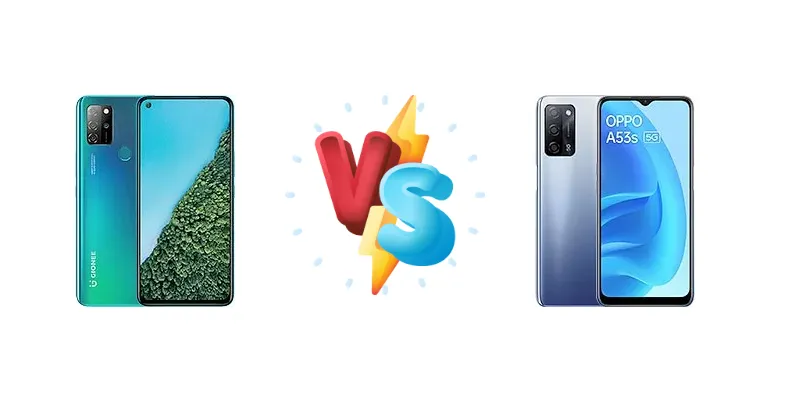
The Gionee M12 and Oppo A53s 5G represent different approaches to the budget smartphone market. The Gionee M12, potentially an older model, focuses on affordability, while the Oppo A53s 5G brings 5G connectivity and a more modern chipset to the table. This comparison dissects their key differences to help you choose the right device for your needs.
🏆 Quick Verdict
For most users, the Oppo A53s 5G is the better choice. Its Mediatek Dimensity 700 chipset offers significantly improved performance and future-proofs your device with 5G support. While the Gionee M12 may be cheaper, the performance gap is substantial.
| Network |
|---|
| 2G bands | GSM 850 / 900 / 1800 / 1900 | GSM 850 / 900 / 1800 / 1900 |
| 3G bands | HSDPA 900 / 1900 | HSDPA 800 / 850 / 900 / 2100 |
| 4G bands | 1, 2, 3, 5, 7, 8, 20, 28, 40 | 1, 3, 5, 8, 34, 38, 39, 40, 41 |
| 5G bands | - | 1, 28, 41, 77, 78 SA/NSA |
| Speed | HSPA 42.2/11.5 Mbps, LTE Cat4 150/50 Mbps | HSPA, LTE, 5G |
| Technology | GSM / HSPA / LTE | GSM / HSPA / LTE / 5G |
| Launch |
|---|
| Announced | 2020, November 16. Released 2020, November 16 | 2021, April 27 |
| Status | Discontinued | Available. Released 2021, May 07 |
| Body |
|---|
| Build | Glass front, plastic frame, plastic back | - |
| Dimensions | 163.9 x 76.8 x 9.3 mm (6.45 x 3.02 x 0.37 in) | 164 x 75.7 x 8.4 mm (6.46 x 2.98 x 0.33 in) |
| SIM | Nano-SIM + Nano-SIM | Nano-SIM + Nano-SIM |
| Weight | 196 g (6.91 oz) | 189.6 g (6.70 oz) |
| Display |
|---|
| Resolution | 720 x 1600 pixels, 20:9 ratio (~268 ppi density) | 720 x 1600 pixels, 20:9 ratio (~269 ppi density) |
| Size | 6.55 inches, 103.6 cm2 (~82.3% screen-to-body ratio) | 6.52 inches, 102.6 cm2 (~82.7% screen-to-body ratio) |
| Type | IPS LCD | IPS LCD, 480 nits (typ) |
| Platform |
|---|
| CPU | Octa-core (4x1.8 GHz Cortex-A53 & 4x1.5 GHz Cortex-A53) - model 1Octa-core 2.0 GHz Cortex-A53 - model 2 | Octa-core (2x2.2 GHz Cortex-A76 & 6x2.0 GHz Cortex-A55) |
| Chipset | Mediatek MT6762D Helio A25 (12 nm) - model 1Mediatek MT6762 Helio P22 (12 nm) - model 2 | Mediatek Dimensity 700 (7 nm) |
| GPU | PowerVR GE8320 | Mali-G57 MC2 |
| OS | Android 10 | Android 11, ColorOS 11.1 |
| Memory |
|---|
| Card slot | microSDXC | microSDXC (dedicated slot) |
| Internal | 64GB 4GB RAM, 128GB 6GB RAM | 128GB 6GB RAM, 128GB 8GB RAM |
| | eMMC 5.1 | UFS 2.2 |
| Main Camera |
|---|
| Features | LED flash, HDR, panorama | LED flash, HDR, panorama |
| Quad | 48 MP, f/1.8, (wide), PDAF
5 MP, f/2.2, 115˚, (ultrawide)
Auxiliary lenses | - |
| Single | - | 8 MP, f/2.0, 26mm (wide) |
| Triple | - | 13 MP, f/2.2, 25mm (wide), 1/3.06", 1.12µm, PDAF
2 MP (macro)
Auxiliary lens |
| Video | 1080p@30fps | 1080p@30fps |
| Selfie camera |
|---|
| Features | - | HDR |
| Single | 16 MP | 8 MP, f/2.0, 26mm (wide) |
| Video | 1080p@30fps | 1080p@30fps |
| Sound |
|---|
| 3.5mm jack | Yes | Yes |
| 35mm jack | Yes | Yes |
| Loudspeaker | Yes | Yes |
| Comms |
|---|
| Bluetooth | 5.0, A2DP | 5.0, A2DP, LE, aptX HD |
| NFC | No | No |
| Positioning | GPS | GPS, GLONASS, GALILEO, BDS, QZSS |
| Radio | FM radio | No |
| USB | USB Type-C 2.0, OTG | USB Type-C 2.0, OTG |
| WLAN | Wi-Fi 802.11 a/b/g/n, dual-band | Wi-Fi 802.11 a/b/g/n/ac, dual-band, Wi-Fi Direct |
| Features |
|---|
| Sensors | Fingerprint (rear-mounted), accelerometer, proximity | Fingerprint (side-mounted), accelerometer, gyro, proximity, compass |
| Battery |
|---|
| Charging | - | 10W wired |
| Type | Li-Po 5100 mAh | Li-Po 5000 mAh |
| Misc |
|---|
| Colors | Magic Green, Dazzling Black | Crystal Blue, Ink Black |
| Models | - | CPH2321 |
| Price | About 150 EUR | About 170 EUR |
Gionee M12
- Potentially lower price point
- Likely larger battery capacity
- Simple and straightforward user experience
- Significantly weaker performance
- No 5G connectivity
- Outdated chipset
Oppo A53s 5G
- 5G connectivity for faster data speeds
- Much more powerful Mediatek Dimensity 700 chipset
- Improved power efficiency
- Slower 10W charging
- Potentially higher price
- Basic LCD display
Display Comparison
Neither device boasts a standout display. Details regarding the Gionee M12's display are scarce, but given its market positioning, it likely features a basic LCD panel. The Oppo A53s 5G also utilizes an LCD, but the focus here is on the chipset. Both are likely 6.5-inch displays, but expect the Oppo to have slightly better color reproduction due to its newer manufacturing process. Neither device is expected to have high brightness or advanced features like HDR support.
Camera Comparison
Camera performance is likely to be similar on both devices, leaning towards basic functionality. Both will likely feature a primary camera around 13MP, accompanied by depth and macro sensors of questionable utility. The Oppo A53s 5G may benefit from slightly better image processing thanks to its newer chipset, but don't expect flagship-level results. The Gionee M12's camera will be adequate for casual snapshots in good lighting conditions, but will struggle in low light. The lack of OIS on either device means image stabilization will rely heavily on software.
Performance
This is where the Oppo A53s 5G truly shines. The Mediatek Dimensity 700 (7nm) is a generational leap over the Gionee M12’s Mediatek MT6762D Helio A25 (12nm) or MT6762 Helio P22 (12nm). The Dimensity 700’s Cortex-A76 cores provide a significant performance boost over the A53 cores found in the Gionee. The 7nm process also translates to better power efficiency. The Gionee M12, even with the slightly faster P22 variant, will struggle with demanding apps and multitasking. The Oppo A53s 5G offers a much smoother experience for gaming and everyday use. The Dimensity 700's integrated 5G modem is a key advantage, enabling faster download and upload speeds where available.
Battery Life
The Gionee M12 likely has a larger battery capacity, potentially around 5000mAh, to compensate for its less efficient chipset. The Oppo A53s 5G, with its more efficient Dimensity 700, can likely achieve comparable battery life with a smaller capacity (around 5000mAh). However, the Oppo A53s 5G is limited to 10W wired charging, which is significantly slower than what some competitors offer. The Gionee M12's charging speed is unknown, but likely similar. Expect both phones to require over 2 hours for a full charge.
Buying Guide
Buy the Gionee M12 if you absolutely need the lowest possible price and 5G connectivity isn't a priority. It's suitable for basic tasks like calling, texting, and light social media use. Buy the Oppo A53s 5G if you want a smoother, more responsive experience, the benefit of 5G, and are willing to spend a little more for a device that will remain usable for longer.
Frequently Asked Questions
❓ Will the Oppo A53s 5G's 5G connectivity actually make a difference in my daily use?
The benefit of 5G depends on your location and carrier coverage. If you live in an area with strong 5G signals, you'll experience significantly faster download and upload speeds, especially for streaming, gaming, and large file transfers. However, if 5G coverage is limited, the difference may be minimal.
❓ Is the Mediatek Helio A25 in the Gionee M12 powerful enough for playing games like PUBG Mobile?
While PUBG Mobile may be playable on the Gionee M12, expect significant compromises. You'll likely need to run the game on the lowest graphics settings and may still experience lag and frame drops, especially during intense action. The Mediatek Dimensity 700 in the Oppo A53s 5G offers a much smoother gaming experience.
❓ How long will it take to fully charge the Oppo A53s 5G with its 10W charger?
With its 10W charging, the Oppo A53s 5G will likely take over 2.5 to 3 hours to fully charge from 0% to 100%. This is considerably slower than phones with fast charging capabilities.