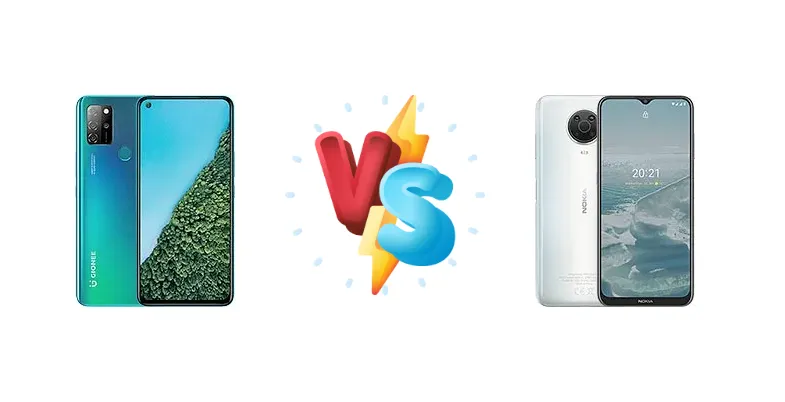
The Gionee M12 and Nokia G20 represent two approaches to the ultra-budget smartphone market. The Gionee, available in multiple configurations, aims for affordability, while the Nokia G20 prioritizes software experience and a slightly more modern chipset. This comparison dissects their key differences to determine which device delivers the best value.
🏆 Quick Verdict
For most users, the Nokia G20 offers a more compelling experience. Its Mediatek Helio G35 chipset, while still entry-level, provides a noticeable performance uplift over the Gionee M12’s Helio A25/P22, translating to smoother multitasking and app loading. The 10W charging is a downside, but the overall package is more balanced.
| Network |
|---|
| 2G bands | GSM 850 / 900 / 1800 / 1900 | GSM 850 / 900 / 1800 / 1900 |
| 3G bands | HSDPA 900 / 1900 | HSDPA 850 / 900 / 1900 / 2100 - International |
| 4G bands | 1, 2, 3, 5, 7, 8, 20, 28, 40 | 1, 3, 5, 7, 8, 20, 28, 38, 40, 41 - International |
| Speed | HSPA 42.2/11.5 Mbps, LTE Cat4 150/50 Mbps | HSPA 42.2/5.76 Mbps, LTE Cat4 150/50 Mbps |
| Technology | GSM / HSPA / LTE | GSM / HSPA / LTE |
| | - | 1, 2, 3, 4, 5, 7, 8, 12, 17, 28, 66 - LATAM |
| Launch |
|---|
| Announced | 2020, November 16. Released 2020, November 16 | 2021, April 08 |
| Status | Discontinued | Available. Released 2021, May 17 |
| Body |
|---|
| Build | Glass front, plastic frame, plastic back | - |
| Dimensions | 163.9 x 76.8 x 9.3 mm (6.45 x 3.02 x 0.37 in) | 164.9 x 76 x 9.2 mm (6.49 x 2.99 x 0.36 in) |
| SIM | Nano-SIM + Nano-SIM | · Nano-SIM· Nano-SIM + Nano-SIM |
| Weight | 196 g (6.91 oz) | 197 g (6.95 oz) |
| | - | Splash protection |
| Display |
|---|
| Resolution | 720 x 1600 pixels, 20:9 ratio (~268 ppi density) | 720 x 1600 pixels, 20:9 ratio (~269 ppi density) |
| Size | 6.55 inches, 103.6 cm2 (~82.3% screen-to-body ratio) | 6.52 inches, 102.6 cm2 (~81.9% screen-to-body ratio) |
| Type | IPS LCD | IPS LCD |
| Platform |
|---|
| CPU | Octa-core (4x1.8 GHz Cortex-A53 & 4x1.5 GHz Cortex-A53) - model 1Octa-core 2.0 GHz Cortex-A53 - model 2 | Octa-core (4x2.3 GHz Cortex-A53 & 4x1.8 GHz Cortex-A53) |
| Chipset | Mediatek MT6762D Helio A25 (12 nm) - model 1Mediatek MT6762 Helio P22 (12 nm) - model 2 | Mediatek MT6765G Helio G35 (12 nm) |
| GPU | PowerVR GE8320 | PowerVR GE8320 |
| OS | Android 10 | Android 11, upgradable to Android 13 |
| Memory |
|---|
| Card slot | microSDXC | microSDXC (dedicated slot) |
| Internal | 64GB 4GB RAM, 128GB 6GB RAM | 64GB 4GB RAM, 128GB 4GB RAM |
| | eMMC 5.1 | - |
| Main Camera |
|---|
| Features | LED flash, HDR, panorama | LED flash, HDR, panorama |
| Quad | 48 MP, f/1.8, (wide), PDAF
5 MP, f/2.2, 115˚, (ultrawide)
Auxiliary lenses | 48 MP, f/1.8, (wide), PDAF
5 MP, (ultrawide)
2 MP (macro)
Auxiliary lens |
| Single | - | 8 MP, (wide) |
| Video | 1080p@30fps | 1080p@30fps |
| Selfie camera |
|---|
| Single | 16 MP | 8 MP, (wide) |
| Video | 1080p@30fps | 1080p@30fps |
| Sound |
|---|
| 3.5mm jack | Yes | Yes |
| 35mm jack | Yes | Yes |
| Loudspeaker | Yes | Yes |
| Comms |
|---|
| Bluetooth | 5.0, A2DP | 5.0, A2DP, LE |
| NFC | No | Yes (market/region dependent) |
| Positioning | GPS | GPS, GLONASS, BDS |
| Radio | FM radio | FM radio |
| USB | USB Type-C 2.0, OTG | USB Type-C 2.0, OTG |
| WLAN | Wi-Fi 802.11 a/b/g/n, dual-band | Wi-Fi 802.11 b/g/n |
| Features |
|---|
| Sensors | Fingerprint (rear-mounted), accelerometer, proximity | Fingerprint (side-mounted), accelerometer, gyro, proximity |
| Battery |
|---|
| Charging | - | 10W wired |
| Type | Li-Po 5100 mAh | Li-Po 5050 mAh |
| Misc |
|---|
| Colors | Magic Green, Dazzling Black | Glacier, Night |
| Models | - | TA-1336, TA-1343, TA-1347, TA-1372, TA-1365 |
| Price | About 150 EUR | About 90 EUR |
| SAR | - | 1.01 W/kg (head) 1.02 W/kg (body) |
| SAR EU | - | 0.49 W/kg (head) 1.13 W/kg (body) |
Gionee M12
- Potentially lower price point
- Large battery (estimated)
- Multiple model options
- Weaker chipset (Helio A25/P22)
- Slower performance
- Uncertain software update schedule
Nokia G20
- More powerful chipset (Helio G35)
- Smoother user experience
- Nokia’s Android update commitment
- Slower 10W charging
- Potentially higher price
- Basic camera system
Display Comparison
Neither device boasts a standout display. Both likely utilize LCD panels, common in this price bracket. Specifics like resolution and brightness are unavailable, but the focus here is on processing power, not visual fidelity. Bezels are expected to be substantial on both, maximizing screen real estate within a budget-friendly form factor. Color accuracy will likely be standard for the segment, prioritizing power efficiency over color calibration.
Camera Comparison
Camera performance is likely to be similar on both devices, leaning towards basic functionality. Details on sensor sizes and apertures are missing, but both will likely feature a primary camera alongside auxiliary lenses of limited utility (potentially a 2MP macro). Image processing will be basic, prioritizing speed over detail. The Nokia G20’s slightly more powerful chipset *may* allow for marginally faster image processing, but don’t expect flagship-level results from either.
Performance
The core difference lies in the chipsets. The Nokia G20’s Mediatek Helio G35 (12nm) features an octa-core CPU clocked up to 2.3 GHz, utilizing Cortex-A53 cores. This is a clear advantage over the Gionee M12, which ships with either the Helio A25 (1.8 GHz) or Helio P22 (2.0 GHz). The G35’s higher clock speeds and slightly more efficient architecture will result in faster app launches, smoother scrolling, and a more responsive overall experience. While neither chipset is a gaming powerhouse, the G35 will handle less demanding titles with greater ease. The Gionee M12’s model variation adds complexity; the P22 version offers a marginal improvement over the A25, but still falls short of the G35.
Battery Life
Both phones likely feature large batteries to compensate for the power-efficient chipsets. While specific mAh ratings are unavailable, battery life should be comparable, easily lasting a full day with moderate use. However, the Nokia G20 is limited to 10W wired charging, meaning a full charge will take considerably longer than a phone with faster charging capabilities. The Gionee M12’s charging speed is also unknown, but the slower charging on the Nokia G20 is a definite drawback for users who prioritize quick top-ups.
Buying Guide
Buy the Gionee M12 if your primary need is absolute lowest cost and you primarily use your phone for basic tasks like calls, texts, and light social media. Be prepared for slower performance and potentially inconsistent software updates. Buy the Nokia G20 if you value a slightly smoother user experience, a more modern chipset, and Nokia’s commitment to Android updates, even if it means paying a small premium.
Frequently Asked Questions
❓ Does the Gionee M12’s Helio A25 chipset struggle with multitasking?
Yes, the Helio A25 is an entry-level chipset. Expect noticeable slowdowns when switching between multiple apps or running demanding applications. It’s best suited for basic tasks like calls, texts, and light browsing.
❓ How does Nokia’s software support compare to Gionee’s on the G20?
Nokia is known for providing regular Android updates and security patches, even on its budget devices. Gionee’s software support is less predictable, and updates may be infrequent or non-existent. This is a significant advantage for the Nokia G20.
❓ Is the 10W charging on the Nokia G20 a major inconvenience?
Yes, 10W charging is quite slow by modern standards. A full charge will take several hours. If you frequently need to top up your phone throughout the day, this could be a significant drawback.
❓ Which phone is better for playing casual games like Candy Crush or Subway Surfers?
The Nokia G20’s Helio G35 chipset will provide a smoother gaming experience for casual titles. While neither phone is designed for demanding games, the G35 offers a noticeable performance boost over the Gionee M12’s Helio A25/P22.