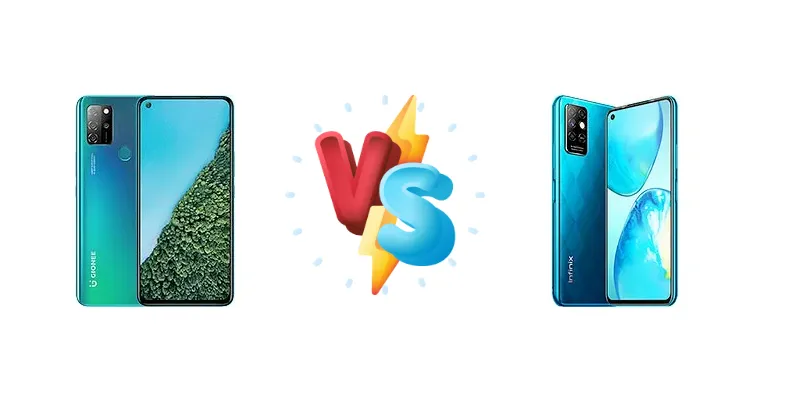
The Gionee M12 and Infinix Note 8i represent two approaches to the ultra-budget smartphone market. The Gionee M12, with its potentially older chipset variants, aims for affordability, while the Infinix Note 8i leverages a more recent MediaTek Helio G80 to offer a boost in performance. This comparison dissects the key differences to determine which device delivers the best value.
🏆 Quick Verdict
For most users, the Infinix Note 8i is the superior choice. Its Helio G80 chipset provides a significant performance uplift over both variants of the Gionee M12’s processor, translating to smoother multitasking and a better gaming experience. While the Gionee M12 may be cheaper, the performance trade-off isn't worth it for all but the most basic users.
| Network |
|---|
| 2G bands | GSM 850 / 900 / 1800 / 1900 | GSM 850 / 900 / 1800 / 1900 |
| 3G bands | HSDPA 900 / 1900 | HSDPA 850 / 900 / 2100 |
| 4G bands | 1, 2, 3, 5, 7, 8, 20, 28, 40 | 1, 3, 5, 7, 8, 20, 38, 40, 41 |
| Speed | HSPA 42.2/11.5 Mbps, LTE Cat4 150/50 Mbps | HSPA 42.2/5.76 Mbps, LTE Cat4 150/50 Mbps |
| Technology | GSM / HSPA / LTE | GSM / HSPA / LTE |
| | - | 1, 3, 7, 8, 20, 28 |
| Launch |
|---|
| Announced | 2020, November 16. Released 2020, November 16 | 2020, October 15. Released 2020, November 15 |
| Status | Discontinued | Discontinued |
| Body |
|---|
| Build | Glass front, plastic frame, plastic back | - |
| Dimensions | 163.9 x 76.8 x 9.3 mm (6.45 x 3.02 x 0.37 in) | 171.4 x 77.7 x 8.9 mm (6.75 x 3.06 x 0.35 in) |
| SIM | Nano-SIM + Nano-SIM | Nano-SIM + Nano-SIM |
| Weight | 196 g (6.91 oz) | - |
| Display |
|---|
| Protection | - | Corning Gorilla Glass |
| Resolution | 720 x 1600 pixels, 20:9 ratio (~268 ppi density) | 720 x 1640 pixels (~264 ppi density) |
| Size | 6.55 inches, 103.6 cm2 (~82.3% screen-to-body ratio) | 6.78 inches, 109.2 cm2 (~82.0% screen-to-body ratio) |
| Type | IPS LCD | IPS LCD, 480 nits (peak) |
| Platform |
|---|
| CPU | Octa-core (4x1.8 GHz Cortex-A53 & 4x1.5 GHz Cortex-A53) - model 1Octa-core 2.0 GHz Cortex-A53 - model 2 | Octa-core (2x2.0 GHz Cortex-A75 & 6x1.8 GHz Cortex-A55) |
| Chipset | Mediatek MT6762D Helio A25 (12 nm) - model 1Mediatek MT6762 Helio P22 (12 nm) - model 2 | Mediatek MT6769V/CU Helio G80 (12 nm) |
| GPU | PowerVR GE8320 | Mali-G52 MC2 |
| OS | Android 10 | Android 10, XOS 7.1 |
| Memory |
|---|
| Card slot | microSDXC | microSDXC (dedicated slot) |
| Internal | 64GB 4GB RAM, 128GB 6GB RAM | 64GB 4GB RAM, 128GB 4GB RAM, 128GB 6GB RAM |
| | eMMC 5.1 | - |
| Main Camera |
|---|
| Features | LED flash, HDR, panorama | Quad-LED flash, HDR, panorama |
| Quad | 48 MP, f/1.8, (wide), PDAF
5 MP, f/2.2, 115˚, (ultrawide)
Auxiliary lenses | 48 MP, (wide), 1/2.0", 0.8µm, PDAF
2 MP (macro)
Auxiliary lenses |
| Video | 1080p@30fps | 1440p@30fps |
| Selfie camera |
|---|
| Features | - | Dual-LED flash |
| Single | 16 MP | 8 MP |
| Video | 1080p@30fps | 1080p@30fps |
| Sound |
|---|
| 3.5mm jack | Yes | Yes |
| 35mm jack | Yes | Yes |
| Loudspeaker | Yes | Yes |
| Comms |
|---|
| Bluetooth | 5.0, A2DP | 5.0, A2DP, LE |
| NFC | No | No |
| Positioning | GPS | GPS |
| Radio | FM radio | FM radio |
| USB | USB Type-C 2.0, OTG | USB Type-C 2.0, OTG |
| WLAN | Wi-Fi 802.11 a/b/g/n, dual-band | Wi-Fi 802.11 a/b/g/n/ac, dual-band, Wi-Fi Direct |
| Features |
|---|
| Sensors | Fingerprint (rear-mounted), accelerometer, proximity | Fingerprint (side-mounted), accelerometer, proximity, compass |
| Battery |
|---|
| Charging | - | 18W wired |
| Type | Li-Po 5100 mAh | 5200 mAh |
| Misc |
|---|
| Colors | Magic Green, Dazzling Black | Gray, Blue, Green |
| Models | - | X683, X683B |
| Price | About 150 EUR | About 150 EUR |
Gionee M12
- Potentially lower price point
- May have longer standby time (depending on battery capacity)
- Simple and straightforward user experience
- Significantly weaker performance
- Slow charging speeds
- Limited gaming capabilities
Infinix Note 8i
- Faster and more responsive performance
- 18W fast charging
- Better gaming experience
- Likely slightly higher price
- May have slightly shorter battery life under heavy load
- Build quality may not be premium
Display Comparison
Neither device boasts a standout display. Both likely utilize LCD panels, common in this price bracket. The focus here isn't on display quality, but rather on the internal hardware driving the experience. We lack specific display specs for the Gionee M12, but given its price point, it's unlikely to match the color accuracy or brightness of even mid-range panels. The Infinix Note 8i's display is adequate for everyday use, but neither phone will impress videophiles.
Camera Comparison
Camera performance is likely to be similar in real-world usage, given the limitations of both devices. Both phones likely feature a primary camera alongside multiple auxiliary lenses (often 2MP macro/depth sensors). The Gionee M12’s camera specs are not detailed enough to make a meaningful comparison. The Infinix Note 8i’s camera system, while not exceptional, benefits from the more powerful ISP within the Helio G80, potentially leading to slightly better image processing and dynamic range. However, don't expect flagship-level results from either device.
Performance
The core difference lies in the chipsets. The Infinix Note 8i’s MediaTek Helio G80 (12nm) is a substantial upgrade over the Gionee M12’s options – either the MT6762D Helio A25 or the MT6762 Helio P22 (both 12nm). The Helio G80 features a combination of 2x Cortex-A75 cores and 6x Cortex-A55 cores, offering significantly better single-core and multi-core performance than the Gionee’s all-Cortex-A53 configuration. The A75 cores provide a noticeable boost in responsiveness for app launching and multitasking. The Gionee M12’s Helio A25 (model 1) and P22 (model 2) are designed for basic functionality, and will struggle with demanding applications. The G80’s GPU is also superior, making the Note 8i the clear winner for gaming.
Battery Life
The Gionee M12’s battery capacity is unknown, but given its focus on affordability, it’s likely to be in the 4000-5000mAh range. The Infinix Note 8i offers 18W wired charging, a significant advantage over the Gionee M12, which likely supports only standard 5W or 10W charging. This means the Note 8i can be topped up much faster, reducing downtime. While a larger battery capacity on the Gionee M12 *could* offset the slower charging, the Helio G80 in the Note 8i is more power-efficient, potentially leading to comparable real-world battery life despite a potentially smaller battery.
Buying Guide
Buy the Gionee M12 if you prioritize absolute minimum cost and only need a phone for essential tasks like calls, texts, and light social media. It's a viable option for first-time smartphone users or as a temporary device. Buy the Infinix Note 8i if you want a more responsive experience, enjoy mobile gaming occasionally, or value faster charging. The G80 chipset and 18W charging make it a more future-proof and enjoyable daily driver.
Frequently Asked Questions
❓ Will the Infinix Note 8i run PUBG Mobile smoothly?
The Helio G80 in the Infinix Note 8i is capable of running PUBG Mobile at medium settings with a playable frame rate. While it won't deliver a flagship-level experience, it's significantly better than the Gionee M12, which would likely struggle even at the lowest settings.
❓ Is the difference in performance between the Helio A25 and Helio G80 noticeable in everyday tasks?
Yes, the difference is very noticeable. The Helio G80’s more powerful cores and improved architecture result in faster app loading times, smoother multitasking, and a more responsive user interface. The Helio A25 will feel sluggish in comparison, especially when switching between apps.
❓ Does the Infinix Note 8i support reverse charging?
No, the Infinix Note 8i does not support reverse charging. It only supports 18W wired charging for its own battery.
❓ Which phone is better for someone who primarily uses WhatsApp and makes calls?
While both phones can handle basic tasks like WhatsApp and calls, the Infinix Note 8i offers a more future-proof experience. The faster processor ensures the phone will remain responsive for longer, even as apps become more demanding.