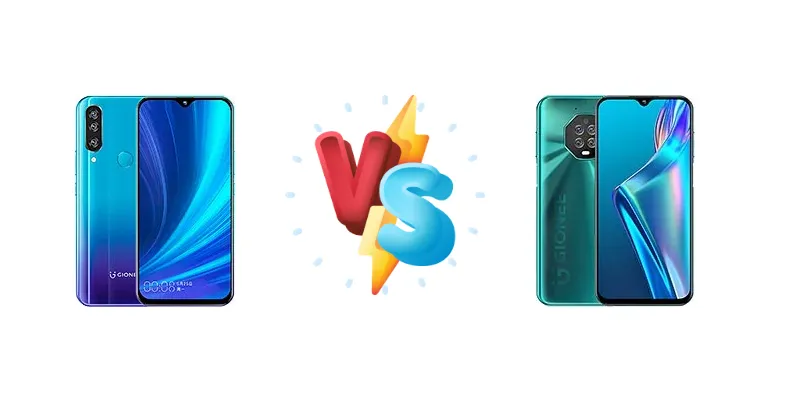
The Gionee K6 and M3 represent Gionee's continued presence in the budget smartphone market. Both devices leverage the Mediatek Helio P60 chipset, making core performance similar. However, a crucial distinction lies in their charging capabilities, with the M3 offering significantly faster 18W charging compared to the K6's 10W. This comparison will dissect these differences and determine which phone best suits your needs.
🏆 Quick Verdict
For the average user prioritizing convenience, the Gionee M3 is the clear winner. Its 18W charging drastically reduces top-up times, offsetting the otherwise identical performance offered by the Helio P60 chipset found in both devices. The K6 remains a viable option for those on a tighter budget, but the charging speed is a significant compromise.
| Network |
|---|
| 2G bands | GSM 850 / 900 / 1800 / 1900 | GSM 850 / 900 / 1800 / 1900 |
| 3G bands | HSDPA 850 / 900 / 1900 / 2100 | HSDPA 850 / 900 / 2100 |
| 4G bands | 1, 3, 5, 7, 8, 38, 39, 40, 41 | LTE |
| Speed | HSPA, LTE | HSPA, LTE |
| Technology | GSM / CDMA / HSPA / LTE | GSM / HSPA / LTE |
| | CDMA 800 & TD-SCDMA | - |
| Launch |
|---|
| Announced | 2020, May 21. Released 2020, May 27 | 2021, April 07. Released 2021, April 14 |
| Status | Discontinued | Discontinued |
| Body |
|---|
| Dimensions | 157.6 x 75.9 x 10.2 mm (6.20 x 2.99 x 0.40 in) | 163.2 x 75.9 x 9.3 mm (6.43 x 2.99 x 0.37 in) |
| SIM | Nano-SIM + Nano-SIM | Nano-SIM + Nano-SIM |
| Weight | 192 g (6.77 oz) | 201 g (7.09 oz) |
| Display |
|---|
| Resolution | 720 x 1560 pixels, 19.5:9 ratio (~277 ppi density) | 720 x 1600 pixels, 20:9 ratio (~269 ppi density) |
| Size | 6.2 inches, 94.4 cm2 (~78.9% screen-to-body ratio) | 6.53 inches, 102.9 cm2 (~83.1% screen-to-body ratio) |
| Type | IPS LCD | IPS LCD |
| Platform |
|---|
| CPU | Octa-core (4x2.0 GHz Cortex-A73 & 4x2.0 GHz Cortex-A53) | Octa-core (4x2.0 GHz Cortex-A73 & 4x2.0 GHz Cortex-A53) |
| Chipset | Mediatek MT6771 Helio P60 (12 nm) | Mediatek MT6771 Helio P60 (12 nm) |
| GPU | Mali-G72 MP3 | Mali-G72 MP3 |
| OS | Android 7.1 (Nougat) | Android |
| Memory |
|---|
| Card slot | microSDXC (dedicated slot) | microSDXC (uses shared SIM slot) |
| Internal | 128GB 6GB RAM, 128GB 8GB RAM | 128GB 6GB RAM, 128GB 8GB RAM, 256GB 8GB RAM |
| | eMMC 5.1 | eMMC 5.1 |
| Main Camera |
|---|
| Features | LED flash, HDR, panorama | LED flash, HDR, panorama |
| Quad | - | 16 MP, (wide), PDAF
5 MP, (ultrawide)
2 MP (macro)
Auxiliary lens |
| Triple | 16 MP, f/2.0, 26mm (wide), 1/3.1", 1.0µm, AF
2 other unknown cameras | - |
| Video | 1080p@30fps | 1080p@30fps |
| Selfie camera |
|---|
| Single | 13 MP, (wide), 1/3.1", 1.12µm | 8 MP |
| Video | 1080p@30fps | 1080p@30fps |
| Sound |
|---|
| 3.5mm jack | Yes | Yes |
| 35mm jack | Yes | Yes |
| Loudspeaker | Yes | Yes |
| Comms |
|---|
| Bluetooth | 4.2, A2DP, LE | Yes |
| NFC | No | No |
| Positioning | GPS | GPS |
| Radio | FM radio | Unspecified |
| USB | microUSB 2.0 | USB Type-C 2.0, OTG |
| WLAN | Wi-Fi 802.11 b/g/n | Wi-Fi 802.11 b/g/n, hotspot |
| Features |
|---|
| Sensors | Fingerprint (rear-mounted), accelerometer, proximity | Fingerprint (side-mounted), accelerometer, proximity |
| Battery |
|---|
| Charging | 10W wired | 18W wired |
| Type | Li-Po 4350 mAh | Li-Po 5000 mAh |
| Misc |
|---|
| Colors | Black, Blue | Black, Green, Sky, Gray |
| Models | 20190418Q | - |
| Price | About 100 EUR | About 120 EUR |
Gionee K6
- Potentially lower price point
- Identical core performance to the M3
- Reliable Mediatek Helio P60 chipset
- Significantly slower 10W charging
- Likely less convenient for frequent charging
- May require longer overnight charging
Gionee M3
- Faster 18W wired charging
- More convenient for quick top-ups
- Reduced downtime compared to the K6
- Potentially higher price than the K6
- Identical core performance to the K6
- May not justify the price increase for all users
Display Comparison
Both the Gionee K6 and M3 likely feature similar LCD panels, typical for their price segment. Given the lack of specific display data, we can assume both offer standard 720p+ resolutions. The absence of features like high refresh rates or AMOLED technology suggests a focus on cost-effectiveness. Bezels are likely to be noticeable on both devices, impacting the overall screen-to-body ratio. Color accuracy will likely be standard for this price point, prioritizing vibrancy over absolute fidelity.
Camera Comparison
Camera performance is likely to be similar on both devices, relying on software processing to enhance image quality. Without specific sensor details, it's reasonable to assume both feature a primary camera and potentially a depth sensor. The absence of Optical Image Stabilization (OIS) suggests images may suffer from blur in low-light conditions. While marketing materials might highlight megapixel counts, the sensor size and lens aperture are more critical factors determining image quality. Expect adequate performance for social media sharing, but not flagship-level photography.
Performance
At the heart of both the Gionee K6 and M3 lies the Mediatek Helio P60 (MT6771) chipset, fabricated on a 12nm process. This octa-core processor, with its configuration of 4x2.0 GHz Cortex-A73 and 4x2.0 GHz Cortex-A53 cores, delivers comparable performance in everyday tasks and moderate gaming. The shared chipset means both phones will exhibit similar app launch times and multitasking capabilities. However, sustained performance could be limited by thermal constraints, and neither device is expected to excel in demanding, graphically intensive games. RAM configurations, not specified, will significantly impact multitasking smoothness.
Battery Life
While battery capacity isn't specified, the key differentiator is charging speed. The Gionee M3's 18W wired charging offers a significant advantage over the K6's 10W charging. This translates to substantially faster top-up times, potentially reducing a full charge from over 3 hours with the K6 to around 1.5-2 hours with the M3. The faster charging is particularly beneficial for users who frequently find themselves needing a quick power boost throughout the day. The actual battery life will depend on usage patterns, but the M3's charging speed provides a more convenient user experience.
Buying Guide
Buy the Gionee K6 if you prioritize absolute lowest cost and are comfortable with slower charging speeds. This phone is ideal for users who primarily charge overnight or don't frequently deplete their battery. Buy the Gionee M3 if you value faster charging and convenience. The 18W charging is a game-changer for users who need quick power boosts throughout the day, even if it means a slightly higher initial investment.
Frequently Asked Questions
❓ How much faster is the charging on the Gionee M3 compared to the K6?
The Gionee M3's 18W charging is significantly faster than the K6's 10W. While exact times depend on battery level and usage, expect the M3 to charge from 0-100% in approximately 1.5-2 hours, while the K6 could take over 3 hours. This difference is particularly noticeable for quick top-ups.
❓ Will I notice a performance difference between the K6 and M3 when playing games?
No, you likely won't notice a significant performance difference in gaming. Both phones utilize the same Mediatek Helio P60 chipset. However, sustained gaming performance may be limited by thermal throttling, and neither device is designed for demanding, high-graphics games. RAM capacity will play a larger role in gaming smoothness.
❓ Does the faster charging on the M3 affect battery health over time?
Modern smartphones employ charging management systems to mitigate the impact of fast charging on battery health. While theoretically, faster charging *could* contribute to slightly faster degradation over several years, the difference is likely negligible for typical usage patterns. The convenience of faster charging generally outweighs this minor potential concern.