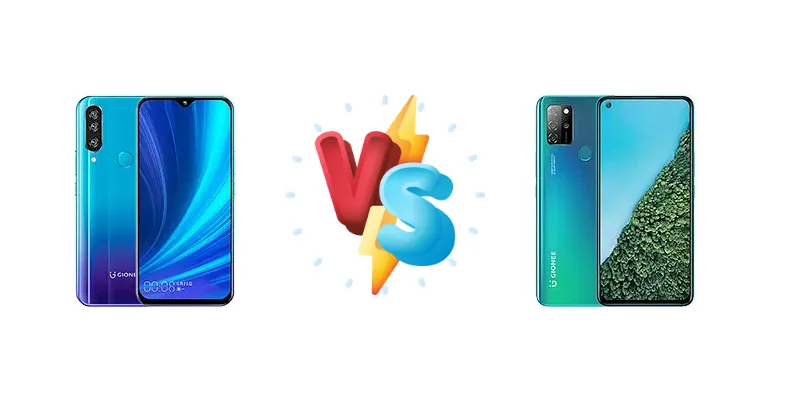
The Gionee K6 and M12 represent Gionee's continued presence in the ultra-budget smartphone market. While both aim to deliver essential smartphone functionality at a low price point, they differ significantly in their internal hardware, particularly in their chipsets. This comparison will dissect those differences to determine which device offers the best value for users prioritizing performance and everyday usability.
🏆 Quick Verdict
For the average user, the Gionee K6 emerges as the stronger choice. Its Helio P60 chipset, featuring more powerful Cortex-A73 cores, provides a noticeable performance advantage over the M12’s Helio A25 (or P22), making it better suited for multitasking and moderately demanding applications. While both offer basic functionality, the K6 delivers a smoother experience.
| Network |
|---|
| 2G bands | GSM 850 / 900 / 1800 / 1900 | GSM 850 / 900 / 1800 / 1900 |
| 3G bands | HSDPA 850 / 900 / 1900 / 2100 | HSDPA 900 / 1900 |
| 4G bands | 1, 3, 5, 7, 8, 38, 39, 40, 41 | 1, 2, 3, 5, 7, 8, 20, 28, 40 |
| Speed | HSPA, LTE | HSPA 42.2/11.5 Mbps, LTE Cat4 150/50 Mbps |
| Technology | GSM / CDMA / HSPA / LTE | GSM / HSPA / LTE |
| | CDMA 800 & TD-SCDMA | - |
| Launch |
|---|
| Announced | 2020, May 21. Released 2020, May 27 | 2020, November 16. Released 2020, November 16 |
| Status | Discontinued | Discontinued |
| Body |
|---|
| Build | - | Glass front, plastic frame, plastic back |
| Dimensions | 157.6 x 75.9 x 10.2 mm (6.20 x 2.99 x 0.40 in) | 163.9 x 76.8 x 9.3 mm (6.45 x 3.02 x 0.37 in) |
| SIM | Nano-SIM + Nano-SIM | Nano-SIM + Nano-SIM |
| Weight | 192 g (6.77 oz) | 196 g (6.91 oz) |
| Display |
|---|
| Resolution | 720 x 1560 pixels, 19.5:9 ratio (~277 ppi density) | 720 x 1600 pixels, 20:9 ratio (~268 ppi density) |
| Size | 6.2 inches, 94.4 cm2 (~78.9% screen-to-body ratio) | 6.55 inches, 103.6 cm2 (~82.3% screen-to-body ratio) |
| Type | IPS LCD | IPS LCD |
| Platform |
|---|
| CPU | Octa-core (4x2.0 GHz Cortex-A73 & 4x2.0 GHz Cortex-A53) | Octa-core (4x1.8 GHz Cortex-A53 & 4x1.5 GHz Cortex-A53) - model 1Octa-core 2.0 GHz Cortex-A53 - model 2 |
| Chipset | Mediatek MT6771 Helio P60 (12 nm) | Mediatek MT6762D Helio A25 (12 nm) - model 1Mediatek MT6762 Helio P22 (12 nm) - model 2 |
| GPU | Mali-G72 MP3 | PowerVR GE8320 |
| OS | Android 7.1 (Nougat) | Android 10 |
| Memory |
|---|
| Card slot | microSDXC (dedicated slot) | microSDXC |
| Internal | 128GB 6GB RAM, 128GB 8GB RAM | 64GB 4GB RAM, 128GB 6GB RAM |
| | eMMC 5.1 | eMMC 5.1 |
| Main Camera |
|---|
| Features | LED flash, HDR, panorama | LED flash, HDR, panorama |
| Quad | - | 48 MP, f/1.8, (wide), PDAF
5 MP, f/2.2, 115˚, (ultrawide)
Auxiliary lenses |
| Triple | 16 MP, f/2.0, 26mm (wide), 1/3.1", 1.0µm, AF
2 other unknown cameras | - |
| Video | 1080p@30fps | 1080p@30fps |
| Selfie camera |
|---|
| Single | 13 MP, (wide), 1/3.1", 1.12µm | 16 MP |
| Video | 1080p@30fps | 1080p@30fps |
| Sound |
|---|
| 3.5mm jack | Yes | Yes |
| 35mm jack | Yes | Yes |
| Loudspeaker | Yes | Yes |
| Comms |
|---|
| Bluetooth | 4.2, A2DP, LE | 5.0, A2DP |
| NFC | No | No |
| Positioning | GPS | GPS |
| Radio | FM radio | FM radio |
| USB | microUSB 2.0 | USB Type-C 2.0, OTG |
| WLAN | Wi-Fi 802.11 b/g/n | Wi-Fi 802.11 a/b/g/n, dual-band |
| Features |
|---|
| Sensors | Fingerprint (rear-mounted), accelerometer, proximity | Fingerprint (rear-mounted), accelerometer, proximity |
| Battery |
|---|
| Charging | 10W wired | - |
| Type | Li-Po 4350 mAh | Li-Po 5100 mAh |
| Misc |
|---|
| Colors | Black, Blue | Magic Green, Dazzling Black |
| Models | 20190418Q | - |
| Price | About 100 EUR | About 150 EUR |
Gionee K6
- More powerful Helio P60 chipset for smoother performance.
- Cortex-A73 cores provide a noticeable advantage in app responsiveness.
- Potentially better multitasking capabilities.
- 10W charging is slow.
- Display specifications are unknown, likely basic.
Gionee M12
- Potentially lower price point.
- Helio A25/P22 chipsets are energy efficient.
- Suitable for very basic smartphone tasks.
- Significantly weaker performance compared to the K6.
- Helio A25/P22 lacks the architectural advantages of the P60.
- Display specifications are unknown, likely basic.
Display Comparison
Neither Gionee specifies display details beyond size, leaving brightness, color accuracy, and panel type largely unknown. Given the price bracket, expect both to utilize IPS LCD panels. The lack of detailed specifications makes a direct comparison impossible, but it's safe to assume both displays are geared towards functional visibility rather than vibrant color reproduction or high peak brightness. Bezels are likely to be substantial on both devices, reflecting their budget nature.
Camera Comparison
Camera specifications are not detailed enough to draw meaningful conclusions. Both phones likely feature a primary camera and potentially a secondary depth sensor. Without knowing sensor sizes, apertures, or image processing capabilities, it’s difficult to assess image quality. The presence of a 2MP macro camera on either device is unlikely to significantly enhance the photography experience; these sensors typically lack the resolution and detail needed for compelling macro shots. Focus should be on real-world image samples, if available, rather than relying on megapixel counts.
Performance
The core difference lies in the chipsets. The Gionee K6’s MediaTek Helio P60 (MT6771) utilizes a 12nm process and an octa-core configuration with four Cortex-A73 cores clocked at 2.0 GHz, paired with four Cortex-A53 cores also at 2.0 GHz. This architecture provides a significant performance boost over the Gionee M12’s options. The M12 comes in two variants: one with the Helio A25 (MT6762D) featuring four Cortex-A53 cores at 1.8 GHz and another four at 1.5 GHz, and another with the Helio P22 (MT6762) with eight Cortex-A53 cores clocked at 2.0 GHz. The A73 cores in the K6 offer substantially higher single-core performance, crucial for responsive app launches and smoother UI navigation. The P22 variant of the M12 is closer in raw clock speed, but lacks the architectural advantage of the A73 cores. Thermal management is unlikely to be a concern on either device given the relatively low power draw of these chipsets.
Battery Life
Battery capacity is not specified for either device. However, both utilize 10W wired charging, indicating a focus on basic functionality rather than rapid charging speeds. Expect a full charge to take several hours. The Helio P60 in the K6 is slightly more power-hungry than the Helio A25/P22 in the M12, but this difference is unlikely to be substantial enough to significantly impact battery life, especially given the likely similar battery capacities. Real-world battery life will depend heavily on usage patterns.
Buying Guide
Buy the Gionee K6 if you need a phone capable of handling more than just basic tasks like calls and messaging. It’s ideal for users who occasionally browse social media, use navigation apps, or play light games. Buy the Gionee M12 if your primary needs are extremely basic – making calls, sending texts, and light web browsing – and you prioritize a potentially lower price point over performance. The M12 is best suited for first-time smartphone users or those needing a simple backup device.
Frequently Asked Questions
❓ Will the Gionee M12 struggle with popular social media apps like Facebook and Instagram?
The Helio A25 (or P22) chipset in the Gionee M12 is relatively weak. While it can run these apps, you may experience noticeable lag when scrolling through feeds or loading images, especially with multiple apps open simultaneously. The K6’s Helio P60 will provide a significantly smoother experience.
❓ Is the Gionee K6 a good option for playing mobile games?
The Gionee K6 is suitable for light gaming, such as casual puzzle games or older titles. However, it will struggle with graphically demanding games like PUBG Mobile or Call of Duty Mobile, even at low settings. The Helio P60’s GPU is not powerful enough for a consistently smooth gaming experience. The M12 will perform even worse in gaming scenarios.
❓ Which phone is better for someone who primarily uses their phone for calls and texts?
For basic communication, the Gionee M12 is sufficient. Its Helio A25/P22 chipset is adequate for making calls, sending texts, and using basic messaging apps. The K6 offers more performance than needed for these tasks, but won't negatively impact the experience.
❓ Does either phone support fast charging?
No, both the Gionee K6 and Gionee M12 only support 10W wired charging. This is a relatively slow charging speed compared to modern smartphones, so expect a full charge to take several hours.