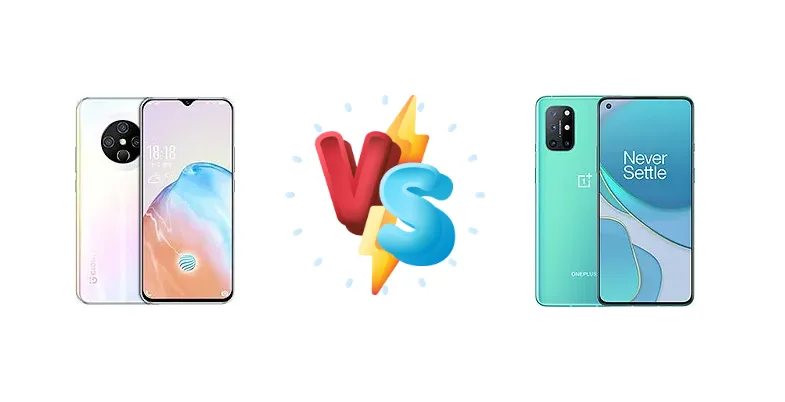
The Gionee K30 Pro and OnePlus 8T+ 5G represent distinct approaches to the mid-range 5G smartphone market. The K30 Pro aims for affordability, while the 8T+ 5G prioritizes a premium experience with faster charging and a more powerful processor. This comparison dissects their key differences to determine which device best suits your needs.
🏆 Quick Verdict
For the average user prioritizing speed and convenience, the OnePlus 8T+ 5G is the clear winner. Its Snapdragon 865 chipset and blazing-fast 65W charging significantly outperform the Gionee K30 Pro. However, budget-conscious users may find the K30 Pro a viable option if raw performance isn't a top priority.
| Network |
|---|
| 2G bands | GSM 850 / 900 / 1800 / 1900 | GSM 850 / 900 / 1800 / 1900 |
| 3G bands | HSDPA 850 / 900 / 2100 | HSDPA 850 / 900 / 1700(AWS) / 1900 / 2100 |
| 4G bands | LTE | 1, 2, 3, 4, 5, 7, 8, 12, 13, 17, 18, 19, 20, 25, 26, 28, 29, 30, 34, 38, 39, 40, 41, 46, 48, 66, 71 |
| 5G bands | - | 2, 25, 41, 66, 71 Sub6/mmWave |
| Speed | HSPA, LTE | HSPA 42.2/5.76 Mbps, LTE (5CA) Cat18 1200/200 Mbps, 5G 7.5 Gbps DL |
| Technology | GSM / HSPA / LTE | GSM / CDMA / HSPA / LTE / 5G |
| Launch |
|---|
| Announced | 2020, December 08. Released 2020, December | 2020, October 14 |
| Status | Discontinued | Available. Released 2020, October 16 |
| Body |
|---|
| Build | Glass front, plastic frame, glass back | Glass front (Gorilla Glass 5), glass back (Gorilla Glass 5), aluminum frame |
| Dimensions | 165 x 76 x 8 mm (6.50 x 2.99 x 0.31 in) | 160.7 x 74.1 x 8.4 mm (6.33 x 2.92 x 0.33 in) |
| SIM | Nano-SIM + Nano-SIM | Nano-SIM |
| Weight | 165 g (5.82 oz) | - |
| Display |
|---|
| Protection | - | Corning Gorilla Glass 5 |
| Resolution | 720 x 1560 pixels, 19.5:9 ratio (~263 ppi density) | 1080 x 2400 pixels, 20:9 ratio (~402 ppi density) |
| Size | 6.53 inches, 104.7 cm2 (~83.5% screen-to-body ratio) | 6.55 inches, 103.6 cm2 (~87.0% screen-to-body ratio) |
| Type | IPS LCD | Fluid AMOLED, 120Hz, HDR10+ |
| Platform |
|---|
| CPU | Octa-core 2.0 GHz | Octa-core (1x2.84 GHz Cortex-A77 & 3x2.42 GHz Cortex-A77 & 4x1.80 GHz Cortex-A55) |
| Chipset | Mediatek | Qualcomm SM8250 Snapdragon 865 5G (7 nm+) |
| GPU | - | Adreno 650 |
| OS | Android | Android 11, OxygenOS 11 |
| Memory |
|---|
| Card slot | microSDXC | No |
| Internal | 128GB 6GB RAM, 128GB 8GB RAM, 256GB 8GB RAM | 256GB 12GB RAM |
| | eMMC 5.1 | - |
| Main Camera |
|---|
| Features | LED flash, HDR, panorama | Dual-LED flash, HDR, panorama |
| Quad | - | 48 MP, f/1.7, 26mm (wide), 1/2.0", 0.8µm, PDAF, OIS
16 MP, f/2.2, 14mm, 123˚ (ultrawide), 1/3.6", 1.0µm
5 MP (macro)
Auxiliary lens |
| Triple | 16 MP, f/1.8, (wide), PDAF
5 MP, 120˚ (ultrawide)
Auxiliary lens | - |
| Video | 1080p@30fps | 4K@30/60fps, 1080p@30/60/240fps, Auto HDR, gyro-EIS |
| Selfie camera |
|---|
| Features | - | HDR |
| Single | 8 MP | 16 MP, f/2.4, (wide), 1/3.06", 1.0µm |
| Video | 1080p@30fps | 1080p@30fps, gyro-EIS |
| Sound |
|---|
| 3.5mm jack | Yes | - |
| 35mm jack | Yes | No |
| Loudspeaker | Yes | Yes, with stereo speakers |
| | 24-bit/192kHz audio | - |
| Comms |
|---|
| Bluetooth | Yes | 5.1, A2DP, LE, aptX HD |
| NFC | No | Yes |
| Positioning | GPS | GPS (L1+L5), GLONASS (G1), BDS (B1), GALILEO (E1+E5a) |
| Radio | FM radio | No |
| USB | USB Type-C 2.0, OTG | USB Type-C 3.1, OTG |
| WLAN | Wi-Fi 802.11 b/g/n, hotspot | Wi-Fi 802.11 a/b/g/n/ac/6, dual-band, Wi-Fi Direct, DLNA |
| Features |
|---|
| Sensors | Fingerprint (rear-mounted), accelerometer, proximity | Fingerprint (under display, optical), accelerometer, gyro, proximity, compass, barometer (market dependant) |
| Battery |
|---|
| Charging | 20W wired | 65W wired, 100% in 39 min |
| Type | Li-Po 4000 mAh | Li-Po 4500 mAh |
| Misc |
|---|
| Colors | Black, Blue, White | Aquamarine Green, Lunar Silver |
| Models | GSE1020 | KB2007 |
| Price | About 100 EUR | About 640 EUR |
Gionee K30 Pro
- More affordable price point
- Potentially longer battery life due to less power-hungry chipset
- Functional 5G connectivity
- Significantly slower charging speed
- Lower processing power for gaming and demanding apps
- Likely inferior display quality
OnePlus 8T+ 5G
- Blazing-fast 65W charging
- Flagship-level Snapdragon 865 performance
- Superior gaming experience
- Higher price tag
- Potentially shorter battery life due to power-hungry chipset
- May run warmer under heavy load
Display Comparison
While display specifications aren't provided for the Gionee K30 Pro, the OnePlus 8T+ 5G likely features a high-refresh-rate AMOLED panel, common for OnePlus devices. The absence of detailed display specs for the K30 Pro suggests a more basic LCD panel. This difference impacts color vibrancy and viewing angles. The OnePlus 8T+ 5G’s higher refresh rate (likely 120Hz) will provide a smoother scrolling experience compared to the K30 Pro’s presumed standard 60Hz.
Camera Comparison
Without specific camera details for the Gionee K30 Pro, it’s difficult to make a direct comparison. However, OnePlus typically equips its 'T' series phones with capable camera systems. The Snapdragon 865’s image signal processor (ISP) also plays a crucial role in image processing, offering faster and more efficient image capture and processing. The OnePlus 8T+ 5G likely features advanced features like OIS (Optical Image Stabilization) and sophisticated computational photography algorithms, resulting in better low-light performance and image quality.
Performance
The core difference lies in the chipsets. The OnePlus 8T+ 5G’s Qualcomm Snapdragon 865 (7nm+) is a flagship-level processor, boasting a prime Cortex-A77 core clocked at 2.84 GHz, alongside additional A77 and A55 cores. This architecture delivers significantly higher CPU and GPU performance than the Gionee K30 Pro’s Mediatek chipset with its 2.0 GHz octa-core configuration. The Snapdragon 865’s advanced process node also contributes to better thermal efficiency, reducing throttling during sustained workloads. Gamers and power users will overwhelmingly benefit from the OnePlus 8T+ 5G’s superior processing capabilities.
Battery Life
The Gionee K30 Pro’s 20W wired charging is considerably slower than the OnePlus 8T+ 5G’s 65W SuperVOOC charging, which can fully charge the device in just 39 minutes. While battery capacity isn’t specified for either device, the OnePlus 8T+ 5G’s rapid charging mitigates the impact of a potentially smaller battery. Users who frequently find themselves needing a quick top-up will greatly appreciate the OnePlus’s charging speed. The K30 Pro will require significantly longer to reach a full charge.
Buying Guide
Buy the Gionee K30 Pro if you need a functional 5G smartphone on a tight budget and prioritize battery life over peak performance. You'll appreciate its affordability and adequate processing power for everyday tasks. Buy the OnePlus 8T+ 5G if you prefer a smoother, faster experience, especially for gaming and demanding applications, and value the convenience of incredibly rapid charging. The premium price reflects a noticeable upgrade in performance and features.
Frequently Asked Questions
❓ Is the Mediatek chipset in the Gionee K30 Pro sufficient for playing modern mobile games?
While the Mediatek chipset can handle many mobile games, it will likely struggle with graphically demanding titles at higher settings. Expect reduced frame rates and potential stuttering compared to the Snapdragon 865 in the OnePlus 8T+ 5G. The K30 Pro is better suited for casual gaming.
❓ How much faster is the 65W charging on the OnePlus 8T+ 5G compared to the 20W charging on the Gionee K30 Pro in real-world use?
The 65W charging on the OnePlus 8T+ 5G can fully charge the phone in approximately 39 minutes. The Gionee K30 Pro’s 20W charging will likely take well over 90 minutes, potentially exceeding two hours, to achieve a full charge. This difference is substantial for users who need a quick power boost.
❓ Will the Snapdragon 865 in the OnePlus 8T+ 5G overheat during extended gaming sessions?
The Snapdragon 865 is known to generate heat under sustained load. However, OnePlus typically implements effective thermal management solutions, such as heat pipes and optimized software, to mitigate overheating. While some throttling may occur, it shouldn't significantly impact the gaming experience.