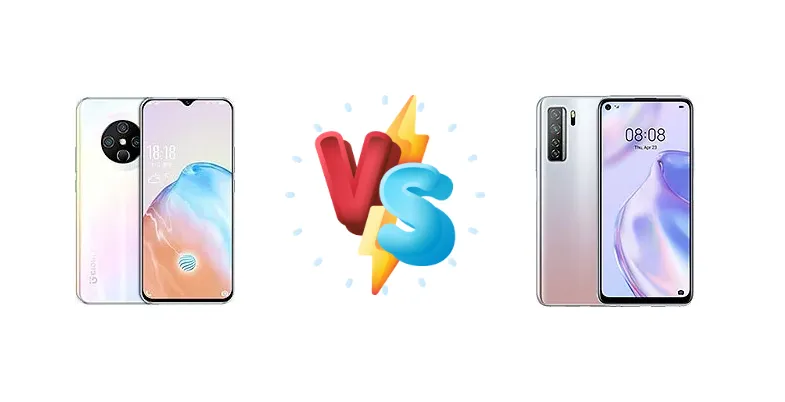
The Gionee K30 Pro and Huawei nova 7 SE 5G Youth represent compelling options in the increasingly competitive mid-range 5G smartphone market. While both devices leverage Mediatek chipsets, they diverge significantly in processing power and charging capabilities, creating a clear distinction for users prioritizing performance versus convenience.
🏆 Quick Verdict
For the average user seeking a balance of performance and value, the Huawei nova 7 SE 5G Youth emerges as the stronger contender. Its Dimensity 800U chipset delivers a noticeable performance uplift, and the 40W fast charging significantly reduces downtime, making it ideal for power users and those on the go.
| Network |
|---|
| 2G bands | GSM 850 / 900 / 1800 / 1900 | GSM 850 / 900 / 1800 / 1900 |
| 3G bands | HSDPA 850 / 900 / 2100 | HSDPA 800 / 850 / 900 / 1700(AWS) / 1900 / 2100 |
| 4G bands | LTE | 1, 2, 3, 4, 5, 8, 18, 19, 26, 34, 38, 39, 40, 41 |
| 5G bands | - | 1, 41, 77, 78 SA/NSA |
| Speed | HSPA, LTE | HSPA, LTE, 5G |
| Technology | GSM / HSPA / LTE | GSM / CDMA / HSPA / LTE / 5G |
| | - | CDMA 800 & TD-SCDMA |
| Launch |
|---|
| Announced | 2020, December 08. Released 2020, December | 2020, October 16. Released 2020, October 16 |
| Status | Discontinued | Discontinued |
| Body |
|---|
| Build | Glass front, plastic frame, glass back | - |
| Dimensions | 165 x 76 x 8 mm (6.50 x 2.99 x 0.31 in) | 162.3 x 75 x 8.6 mm (6.39 x 2.95 x 0.34 in) |
| SIM | Nano-SIM + Nano-SIM | Nano-SIM + Nano-SIM |
| Weight | 165 g (5.82 oz) | 189 g (6.67 oz) |
| Display |
|---|
| Resolution | 720 x 1560 pixels, 19.5:9 ratio (~263 ppi density) | 1080 x 2400 pixels, 20:9 ratio (~405 ppi density) |
| Size | 6.53 inches, 104.7 cm2 (~83.5% screen-to-body ratio) | 6.5 inches, 102.0 cm2 (~83.8% screen-to-body ratio) |
| Type | IPS LCD | IPS LCD, HDR10 |
| Platform |
|---|
| CPU | Octa-core 2.0 GHz | Octa-core (2x2.4 GHz Cortex-A76 & 6x2.0 GHz Cortex-A55) |
| Chipset | Mediatek | Mediatek Dimensity 800U (7 nm) |
| GPU | - | Mali-G57 MC3 |
| OS | Android | Android 10, EMUI 10.1, no Google Play Services |
| Memory |
|---|
| Card slot | microSDXC | No |
| Internal | 128GB 6GB RAM, 128GB 8GB RAM, 256GB 8GB RAM | 128GB 8GB RAM |
| | eMMC 5.1 | - |
| Main Camera |
|---|
| Features | LED flash, HDR, panorama | LED flash, Panorama, HDR |
| Quad | - | 64 MP, f/1.8, 26mm (wide), PDAF
8 MP, f/2.4, 17mm (ultrawide)
2 MP (macro)
Auxiliary lens |
| Triple | 16 MP, f/1.8, (wide), PDAF
5 MP, 120˚ (ultrawide)
Auxiliary lens | - |
| Video | 1080p@30fps | 4K@30fps, 1080p@30fps |
| Selfie camera |
|---|
| Features | - | HDR |
| Single | 8 MP | 16 MP, f/2.0, (wide) |
| Video | 1080p@30fps | 1080p@30fps |
| Sound |
|---|
| 3.5mm jack | Yes | Yes |
| 35mm jack | Yes | Yes |
| Loudspeaker | Yes | Yes |
| | 24-bit/192kHz audio | - |
| Comms |
|---|
| Bluetooth | Yes | 5.1, A2DP, LE |
| NFC | No | No |
| Positioning | GPS | GPS, GLONASS, GALILEO, BDS, QZSS |
| Radio | FM radio | No |
| USB | USB Type-C 2.0, OTG | USB Type-C 2.0, OTG |
| WLAN | Wi-Fi 802.11 b/g/n, hotspot | Wi-Fi 802.11 a/b/g/n/ac, dual-band, Wi-Fi Direct |
| Features |
|---|
| Sensors | Fingerprint (rear-mounted), accelerometer, proximity | Fingerprint (side-mounted), accelerometer, proximity, compass |
| Battery |
|---|
| Charging | 20W wired | 40W wired, 70% in 30 min
5W reverse wired |
| Type | Li-Po 4000 mAh | Li-Po 4000 mAh |
| Misc |
|---|
| Colors | Black, Blue, White | Crush Green, Space Silver, Midnight Black, Purple |
| Models | GSE1020 | CND-AN00 |
| Price | About 100 EUR | About 290 EUR |
Gionee K30 Pro
- Potentially lower price point
- Functional for basic smartphone tasks
- Reliable Mediatek chipset for everyday use
- Slower charging speed (20W)
- Less powerful processor compared to the Dimensity 800U
- Likely inferior camera performance
Huawei nova 7 SE 5G Youth
- Faster Dimensity 800U processor for improved performance
- 40W fast charging with 70% in 30 minutes
- 5W reverse wired charging for accessories
- Higher initial cost
- May not represent a significant upgrade for very basic users
- Potential for software bloat (typical of Huawei)
Display Comparison
Neither device's display specifications are provided, so a direct comparison is limited. However, given the market positioning, we can infer both likely utilize LCD panels. The nova 7 SE's higher price point *suggests* a potentially higher peak brightness and slightly better color accuracy. Bezels are likely comparable, focusing on maximizing screen real estate within the budget constraints of both devices.
Camera Comparison
Without detailed sensor information, a precise camera comparison is difficult. However, the market segment suggests both phones will feature multi-camera setups. The nova 7 SE, being the more expensive device, likely benefits from a larger primary sensor and potentially more sophisticated image processing algorithms. The presence of a 40W charging system suggests Huawei invested more in the overall user experience, which often extends to camera capabilities. We can assume the K30 Pro will offer a functional camera experience, but the nova 7 SE is likely to deliver superior image quality, especially in low-light conditions.
Performance
The Huawei nova 7 SE 5G Youth’s Mediatek Dimensity 800U (7nm) represents a substantial upgrade over the Gionee K30 Pro’s unspecified Mediatek chipset. The Dimensity 800U’s octa-core configuration, featuring 2x2.4 GHz Cortex-A76 cores and 6x2.0 GHz Cortex-A55 cores, provides a significant boost in CPU performance, particularly in demanding applications. The 7nm process node also contributes to improved power efficiency and thermal management. While both are octa-core, the architectural differences and clock speeds favor the nova 7 SE for gaming and multitasking. The K30 Pro's 2.0 GHz octa-core is adequate for everyday tasks, but will struggle with graphically intensive games.
Battery Life
The Gionee K30 Pro’s 20W wired charging is significantly slower than the Huawei nova 7 SE 5G Youth’s 40W wired charging, capable of reaching 70% charge in just 30 minutes. While battery capacity isn't specified for either device, the faster charging of the nova 7 SE effectively mitigates any potential capacity disadvantage. The inclusion of 5W reverse wired charging on the nova 7 SE adds a convenient feature for topping up accessories, a feature absent on the K30 Pro.
Buying Guide
Buy the Gionee K30 Pro if you prioritize a lower initial cost and are comfortable with a more basic user experience. It's a suitable choice for users who primarily engage in light tasks like calling, texting, and social media. Buy the Huawei nova 7 SE 5G Youth if you value faster processing speeds for gaming and multitasking, and appreciate the convenience of significantly quicker charging times – a boon for users who frequently find themselves away from a power outlet.
Frequently Asked Questions
❓ Is the Dimensity 800U in the Huawei nova 7 SE 5G Youth capable of handling demanding games like PUBG Mobile?
Yes, the Dimensity 800U is well-equipped to handle PUBG Mobile at high settings. Its Cortex-A76 cores and Mali-G57 MC3 GPU provide sufficient processing power for smooth gameplay, though sustained performance may be limited by thermal throttling depending on the phone's cooling solution.
❓ How much faster is the 40W charging on the Huawei nova 7 SE 5G Youth compared to the 20W charging on the Gionee K30 Pro in real-world use?
The 40W charging on the nova 7 SE 5G Youth can realistically cut charging times in half. While the K30 Pro might take over 2 hours for a full charge, the nova 7 SE 5G Youth can reach 70% in just 30 minutes, and a full charge in approximately 60-75 minutes. This is a significant convenience for users who need to quickly top up their battery.
❓ Does the Huawei nova 7 SE 5G Youth support Google Mobile Services (GMS)?
Due to ongoing restrictions, the Huawei nova 7 SE 5G Youth does *not* natively support Google Mobile Services (GMS). It utilizes Huawei Mobile Services (HMS) instead, which includes the AppGallery as its app store. While many popular apps are available through HMS or third-party sources, some Google apps may require workarounds.