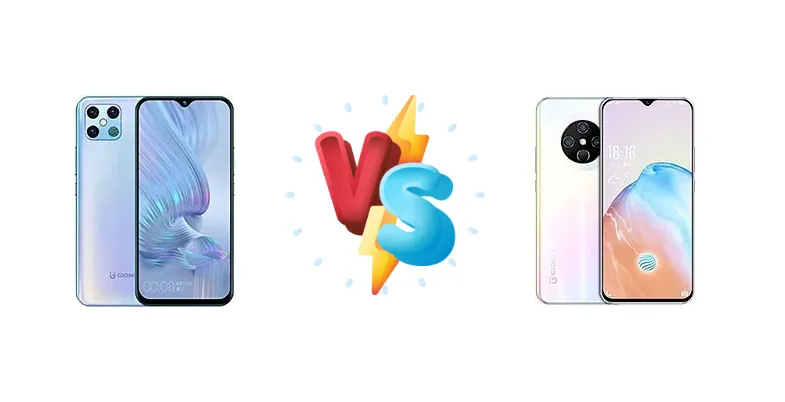
Gionee has positioned both the K3 Pro and K30 Pro as affordable options in a crowded smartphone market. While both aim for value, they differ significantly in their internal hardware, particularly in the chipset and charging capabilities. This comparison dissects these differences to help you determine which Gionee device best suits your needs.
🏆 Quick Verdict
For most users, the Gionee K30 Pro is the better choice. Its 20W charging significantly reduces downtime compared to the K3 Pro’s 10W charging. While the exact Mediatek chipset in the K30 Pro isn't fully specified, the performance uplift implied by the 2.0 GHz octa-core CPU suggests a more responsive user experience.
| Network |
|---|
| 2G bands | GSM 850 / 900 / 1800 / 1900 | GSM 850 / 900 / 1800 / 1900 |
| 3G bands | HSDPA 850 / 900 / 1900 / 2100 | HSDPA 850 / 900 / 2100 |
| 4G bands | 1, 3, 5, 7, 8, 38, 39, 40, 41 | LTE |
| EDGE | Class 10 | - |
| GPRS | Class 10 | - |
| Speed | HSPA, LTE | HSPA, LTE |
| Technology | GSM / CDMA / HSPA / LTE | GSM / HSPA / LTE |
| | CDMA 800 & TD-SCDMA | - |
| Launch |
|---|
| Announced | 2020, August 24. Released 2020, September | 2020, December 08. Released 2020, December |
| Status | Discontinued | Discontinued |
| Body |
|---|
| Build | - | Glass front, plastic frame, glass back |
| Dimensions | 164.3 x 77.6 x 9.7 mm (6.47 x 3.06 x 0.38 in) | 165 x 76 x 8 mm (6.50 x 2.99 x 0.31 in) |
| SIM | Nano-SIM + Nano-SIM | Nano-SIM + Nano-SIM |
| Weight | 205 g (7.23 oz) | 165 g (5.82 oz) |
| Display |
|---|
| Resolution | 720 x 1600 pixels, 20:9 ratio (~269 ppi density) | 720 x 1560 pixels, 19.5:9 ratio (~263 ppi density) |
| Size | 6.53 inches, 102.9 cm2 (~80.7% screen-to-body ratio) | 6.53 inches, 104.7 cm2 (~83.5% screen-to-body ratio) |
| Type | IPS LCD | IPS LCD |
| Platform |
|---|
| CPU | Octa-core (4x2.0 GHz Cortex-A73 & 4x2.0 GHz Cortex-A53) | Octa-core 2.0 GHz |
| Chipset | Mediatek MT6771 Helio P60 (12 nm) | Mediatek |
| GPU | Mali-G72 MP3 | - |
| OS | Android 9.0 (Pie) | Android |
| Memory |
|---|
| Card slot | microSDXC | microSDXC |
| Internal | 128GB 6GB RAM, 128GB 8GB RAM | 128GB 6GB RAM, 128GB 8GB RAM, 256GB 8GB RAM |
| | eMMC 5.1 | eMMC 5.1 |
| Main Camera |
|---|
| Features | LED flash, HDR, panorama | LED flash, HDR, panorama |
| Single | 1.3 MP | - |
| Triple | 16 MP, f/2.0, (wide), 1/3.1", 1.0µm, AF
2 other unknown cameras | 16 MP, f/1.8, (wide), PDAF
5 MP, 120˚ (ultrawide)
Auxiliary lens |
| Video | 1080p@30fps | 1080p@30fps |
| Selfie camera |
|---|
| Single | 13 MP, f/2.0, (wide), 1/3.1", 1.12µm | 8 MP |
| Video | 1080p@30fps | 1080p@30fps |
| Sound |
|---|
| 3.5mm jack | Yes | Yes |
| 35mm jack | Yes | Yes |
| Loudspeaker | Yes | Yes |
| | - | 24-bit/192kHz audio |
| Comms |
|---|
| Bluetooth | 4.0, A2DP | Yes |
| NFC | No | No |
| Positioning | GPS | GPS |
| Radio | FM radio | FM radio |
| USB | USB Type-C 2.0 | USB Type-C 2.0, OTG |
| WLAN | Wi-Fi 802.11 b/g/n | Wi-Fi 802.11 b/g/n, hotspot |
| Features |
|---|
| Browser | WAP 2.0/xHTML, HTML | - |
| Sensors | Fingerprint (rear-mounted), accelerometer, proximity | Fingerprint (rear-mounted), accelerometer, proximity |
| Battery |
|---|
| Charging | 10W wired | 20W wired |
| Stand-by | Up to 666 h | - |
| Talk time | Up to 12 h | - |
| Type | Li-Po 4000 mAh | Li-Po 4000 mAh |
| Misc |
|---|
| Colors | Jade Green, Pearl White | Black, Blue, White |
| Models | - | GSE1020 |
| Price | About 80 EUR | About 100 EUR |
| SAR EU | 0.90 W/kg (head) | - |
| Tests |
|---|
| Audio quality |
Noise -89.1dB / Crosstalk -70.7dB | - |
| Loudspeaker |
Voice 75dB / Noise 68dB / Ring 70dB
| - |
Gionee K3 Pro
- Proven Helio P60 chipset architecture
- Potentially lower price point (depending on market)
- Established driver support
- Slow 10W charging
- Older chipset may struggle with demanding apps
- Limited future software updates likely
Gionee K30 Pro
- Faster 20W charging
- Potentially more modern chipset
- Improved multitasking capabilities
- Chipset details are vague
- Long-term software support is uncertain
- May be slightly more expensive
Display Comparison
Unfortunately, display specifications are absent from the provided data. However, given the price point of both devices, it's reasonable to assume both utilize LCD panels. The absence of details like resolution, refresh rate, or peak brightness makes a direct comparison impossible. Users should research independent reviews for display quality assessments.
Camera Comparison
Without sensor details, a camera comparison is limited. Both phones likely feature multi-camera setups common in this price range. The absence of information regarding sensor size, aperture, or optical image stabilization (OIS) prevents a meaningful assessment. Users should rely on sample photos and reviews to evaluate camera performance. It's probable that both phones include a standard wide lens and potentially a depth sensor, but the image quality will heavily depend on the primary sensor's capabilities.
Performance
The Gionee K3 Pro features the Mediatek MT6771 Helio P60, a 12nm chipset with an octa-core CPU comprised of four Cortex-A73 cores clocked at 2.0 GHz and four Cortex-A53 cores, also at 2.0 GHz. This architecture provides a balance between performance and efficiency. The K30 Pro, while only specified as a Mediatek octa-core 2.0 GHz processor, likely represents a newer generation chipset. The lack of a specific model number hinders precise comparison, but the 2.0 GHz clock speed suggests a similar performance tier, potentially with improvements in CPU efficiency or GPU capabilities. The K3 Pro’s Helio P60 benefits from a well-established driver ecosystem, but the K30 Pro may offer better long-term software support depending on Gionee’s update policy.
Battery Life
The K30 Pro’s 20W wired charging is a significant advantage over the K3 Pro’s 10W charging. This translates to substantially faster charging times, reducing the time spent tethered to a power outlet. While battery capacity isn't specified for either device, the faster charging of the K30 Pro mitigates the impact of a potentially smaller battery. Users who frequently use their phones throughout the day will greatly benefit from the K30 Pro’s quicker top-up times.
Buying Guide
Buy the Gionee K3 Pro if you prioritize a proven, if older, chipset architecture (Helio P60) and are comfortable with slower charging speeds. This phone is ideal for users who primarily use their phone for basic tasks like calls, texts, and light social media. Buy the Gionee K30 Pro if you value faster charging and a potentially more modern processor, making it better suited for multitasking, moderate gaming, and users who are frequently on the go.
Frequently Asked Questions
❓ How much faster is the charging on the Gionee K30 Pro compared to the K3 Pro?
The K30 Pro’s 20W charging is double the speed of the K3 Pro’s 10W charging. This means a significantly reduced charging time, potentially cutting a full charge time in half, depending on battery capacity. This is a crucial benefit for users who need to quickly top up their phone throughout the day.
❓ Will the Gionee K3 Pro struggle with modern mobile games?
The Helio P60 in the K3 Pro is a capable chipset, but it's several generations old. While it can handle less demanding games, you may experience frame drops or reduced graphics settings in newer, more graphically intensive titles. The K30 Pro, with its potentially newer chipset, is likely to offer a smoother gaming experience.
❓ What type of USB port do these phones use?
Given the charging wattage and typical smartphone standards, both the Gionee K3 Pro and K30 Pro likely utilize a USB-C port. However, it's important to verify this with official specifications or reviews, as some budget phones still use Micro-USB.