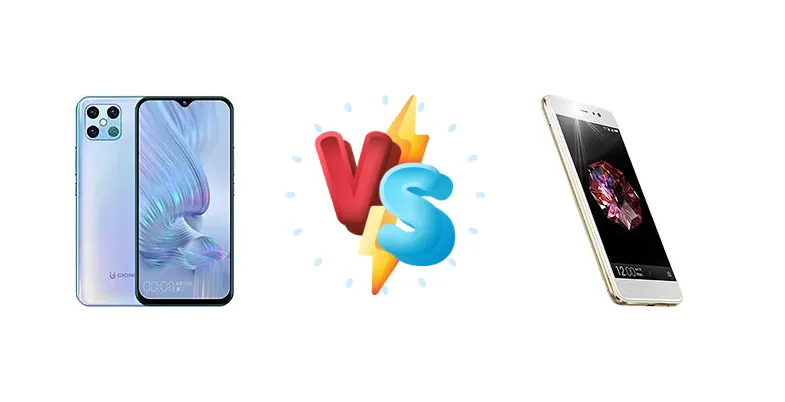
Gionee's K3 Pro and A1 Lite represent different eras of the brand's budget smartphone strategy. The A1 Lite, released earlier, focused on affordability, while the K3 Pro aimed to offer a more modern experience with a more powerful chipset. This comparison dissects the key differences to determine which device best suits your needs in 2024.
🏆 Quick Verdict
For most users, the Gionee K3 Pro is the clear winner. Its Helio P60 chipset provides a significantly more responsive experience for everyday tasks and light gaming, justifying the likely price difference. While the A1 Lite remains a functional device, its older processor struggles to keep pace with modern demands.
| Network |
|---|
| 2G bands | GSM 850 / 900 / 1800 / 1900 | GSM 850 / 900 / 1800 / 1900 - SIM 1 & SIM 2 |
| 3G bands | HSDPA 850 / 900 / 1900 / 2100 | HSDPA 850 / 900 / 1900 / 2100 |
| 4G bands | 1, 3, 5, 7, 8, 38, 39, 40, 41 | LTE |
| EDGE | Class 10 | - |
| GPRS | Class 10 | - |
| Speed | HSPA, LTE | HSPA, LTE |
| Technology | GSM / CDMA / HSPA / LTE | GSM / HSPA / LTE |
| | CDMA 800 & TD-SCDMA | - |
| Launch |
|---|
| Announced | 2020, August 24. Released 2020, September | 2017, June. Released 2017, August |
| Status | Discontinued | Discontinued |
| Body |
|---|
| Dimensions | 164.3 x 77.6 x 9.7 mm (6.47 x 3.06 x 0.38 in) | 150.5 x 74.4 x 8 mm (5.93 x 2.93 x 0.31 in) |
| SIM | Nano-SIM + Nano-SIM | Dual SIM |
| Weight | 205 g (7.23 oz) | 161 g (5.68 oz) |
| Display |
|---|
| Protection | - | Corning Gorilla Glass 3 |
| Resolution | 720 x 1600 pixels, 20:9 ratio (~269 ppi density) | 720 x 1280 pixels, 16:9 ratio (~277 ppi density) |
| Size | 6.53 inches, 102.9 cm2 (~80.7% screen-to-body ratio) | 5.3 inches, 77.4 cm2 (~69.2% screen-to-body ratio) |
| Type | IPS LCD | IPS LCD |
| Platform |
|---|
| CPU | Octa-core (4x2.0 GHz Cortex-A73 & 4x2.0 GHz Cortex-A53) | Octa-core 1.3 GHz Cortex-A53 |
| Chipset | Mediatek MT6771 Helio P60 (12 nm) | Mediatek MT6753 (28 nm) |
| GPU | Mali-G72 MP3 | Mali-T720MP3 |
| OS | Android 9.0 (Pie) | Android 7 (Nougat), Amigo 4 |
| Memory |
|---|
| Card slot | microSDXC | microSDXC (dedicated slot) |
| Internal | 128GB 6GB RAM, 128GB 8GB RAM | 32GB 3GB RAM |
| | eMMC 5.1 | - |
| Main Camera |
|---|
| Features | LED flash, HDR, panorama | Dual-LED flash, HDR |
| Single | 1.3 MP | 13 MP, f/2.0, 1/3.1", 1.12µm, PDAF |
| Triple | 16 MP, f/2.0, (wide), 1/3.1", 1.0µm, AF
2 other unknown cameras | - |
| Video | 1080p@30fps | 1080p@30fps |
| Selfie camera |
|---|
| Features | - | LED flash |
| Single | 13 MP, f/2.0, (wide), 1/3.1", 1.12µm | 20 MP, f/2.0, (wide), 1/2.8", 1.0µm |
| Video | 1080p@30fps | - |
| Sound |
|---|
| 3.5mm jack | Yes | Yes |
| 35mm jack | Yes | Yes |
| Loudspeaker | Yes | Yes |
| Comms |
|---|
| Bluetooth | 4.0, A2DP | 4.1, A2DP, LE |
| NFC | No | No |
| Positioning | GPS | GPS |
| Radio | FM radio | FM radio |
| USB | USB Type-C 2.0 | microUSB 2.0 |
| WLAN | Wi-Fi 802.11 b/g/n | Wi-Fi 802.11 b/g/n |
| Features |
|---|
| Browser | WAP 2.0/xHTML, HTML | - |
| Sensors | Fingerprint (rear-mounted), accelerometer, proximity | Fingerprint (rear-mounted), accelerometer, gyro, proximity, compass |
| Battery |
|---|
| Charging | 10W wired | - |
| Stand-by | Up to 666 h | - |
| Talk time | Up to 12 h | - |
| Type | Li-Po 4000 mAh | Li-Ion 4000 mAh, non-removable |
| Misc |
|---|
| Colors | Jade Green, Pearl White | Gold, Black |
| Models | - | A1 lite |
| Price | About 80 EUR | About 15000 INR |
| SAR EU | 0.90 W/kg (head) | - |
| Tests |
|---|
| Audio quality |
Noise -89.1dB / Crosstalk -70.7dB | - |
| Loudspeaker |
Voice 75dB / Noise 68dB / Ring 70dB
| - |
Gionee K3 Pro
- Significantly faster processor (Helio P60)
- More efficient 12nm process
- Improved multitasking capabilities
- Likely better camera image processing
- 10W charging is relatively slow
- Detailed display specs unknown
Gionee A1 Lite
- Lower price point (likely)
- Functional for basic tasks
- Simple and easy to use
- Potentially longer standby time (due to lower power demands)
- Outdated and slow processor (MT6753)
- 28nm process is inefficient
- Struggles with multitasking and modern apps
- Likely inferior camera performance
Display Comparison
Unfortunately, detailed display specifications are unavailable for either device. However, given the A1 Lite's age and market positioning, it likely features a lower resolution and less vibrant panel compared to the K3 Pro. The K3 Pro, being a later model, likely benefits from improved color reproduction and viewing angles, though neither is expected to compete with modern AMOLED displays. Bezels are also expected to be larger on the A1 Lite, reflecting its older design.
Camera Comparison
Camera details are limited. However, it's safe to assume the K3 Pro benefits from more advanced image processing capabilities thanks to its more powerful chipset. While both phones likely feature similar sensor resolutions in their primary cameras, the K3 Pro’s ISP (Image Signal Processor) within the Helio P60 will enable better noise reduction, dynamic range, and overall image quality. The A1 Lite’s camera will likely produce softer images with less detail, particularly in low-light conditions. Any secondary cameras on both devices (likely 2MP depth or macro sensors) are unlikely to offer significant value.
Performance
The core difference lies in the chipsets. The Gionee K3 Pro's Mediatek MT6771 Helio P60, built on a 12nm process, is a substantial upgrade over the A1 Lite's MT6753 (28nm). The P60’s octa-core CPU, featuring four Cortex-A73 cores clocked at 2.0 GHz alongside four Cortex-A53 cores, delivers significantly faster processing speeds than the A1 Lite’s all-Cortex-A53 setup running at 1.3 GHz. This translates to quicker app launches, smoother multitasking, and a more responsive user interface. The 12nm process also contributes to better power efficiency, potentially offsetting the K3 Pro’s higher performance demands. The A1 Lite will struggle with demanding applications and may exhibit noticeable lag during everyday use.
Battery Life
Battery capacity data is missing for both devices. However, the K3 Pro’s more efficient 12nm Helio P60 chipset will likely result in comparable or better battery life despite potentially having a similar capacity to the A1 Lite. The K3 Pro’s 10W wired charging is a standard offering for its class, but the A1 Lite’s charging speed is unknown. Given its age, it’s likely to be slower, meaning longer times to reach a full charge.
Buying Guide
Buy the Gionee K3 Pro if you need a phone capable of handling multitasking, social media, and occasional gaming without significant lag. It's ideal for users who want a smoother, more future-proof experience. Buy the Gionee A1 Lite if you prioritize extreme affordability and only require a phone for basic communication – calls, texts, and very light web browsing. It's a suitable option for first-time smartphone users or as a backup device.
Frequently Asked Questions
❓ Will the Gionee K3 Pro run modern apps like WhatsApp and Facebook smoothly?
Yes, the Helio P60 chipset in the K3 Pro is capable of running these apps without significant lag. The A1 Lite’s MT6753 may struggle, leading to slow loading times and a less responsive experience.
❓ Is the Gionee A1 Lite still a viable option for making calls and sending texts?
Absolutely. The A1 Lite excels at basic communication tasks. If your primary need is a reliable phone for calls and texts, and you're on a very tight budget, it remains a functional option.
❓ Can the Gionee K3 Pro handle light gaming, like Candy Crush or Subway Surfers?
Yes, the K3 Pro’s Helio P60 can handle casual games like Candy Crush and Subway Surfers without issue. However, don’t expect to play graphically demanding games at high settings.
❓ What kind of storage options are available on each device?
Storage details are unavailable. However, given the market segment, both devices likely offer limited internal storage (e.g., 16GB or 32GB) and support for microSD card expansion.