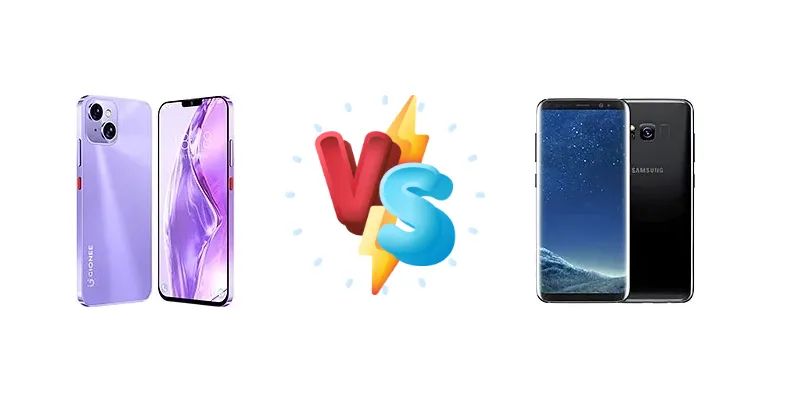
The smartphone landscape is vast, with options for every budget. Today, we're pitting a modern budget contender, the Gionee G13 Pro, against a classic flagship, the Samsung Galaxy S8. Can a newer, cheaper phone truly compete with a device that once set the standard?
🏆 Quick Verdict
The Samsung Galaxy S8 decisively wins this comparison. Despite its age, the S8's superior chipset, display, and camera quality far outweigh the G13 Pro's potential cost savings. The G13 Pro is a basic phone for essential tasks, while the S8 remains a capable and enjoyable device.
| Network |
|---|
| 2G bands | GSM 850 / 900 / 1800 / 1900 | GSM 850 / 900 / 1800 / 1900 - SIM 1 & SIM 2 (dual-SIM model only) |
| 3G bands | HSDPA 850 / 900 / 1900 / 2100 | HSDPA 850 / 900 / 1700(AWS) / 1900 / 2100 |
| 4G bands | LTE | 1, 2, 3, 4, 5, 7, 8, 12, 13, 17, 18, 19, 20, 25, 26, 28, 32, 66, 38, 39, 40, 41 |
| Speed | HSPA, LTE | HSPA 42.2/5.76 Mbps, LTE (5CA) Cat16 1024/150 Mbps |
| Technology | GSM / HSPA / LTE | GSM / HSPA / LTE |
| Launch |
|---|
| Announced | 2022, January 28 | 2017, March 29. Released 2017, April 24 |
| Status | Available. Released 2022, January 30 | Discontinued |
| Body |
|---|
| Build | Glass front, plastic frame, glass back | Glass front (Gorilla Glass 5), glass back (Gorilla Glass 5), aluminum frame |
| Dimensions | 158 x 76 x 9.2 mm (6.22 x 2.99 x 0.36 in) | 148.9 x 68.1 x 8 mm (5.86 x 2.68 x 0.31 in) |
| SIM | Nano-SIM + Nano-SIM | · Nano-SIM· Nano-SIM + Nano-SIM |
| Weight | 195 g (6.88 oz) | 155 g (5.47 oz) |
| | - | IP68 dust/water resistant (up to 1.5m for 30 mins) |
| Display |
|---|
| Protection | - | Corning Gorilla Glass 5 |
| Resolution | 720 x 1600 pixels, 20:9 ratio (~280 ppi density) | 1440 x 2960 pixels, 18.5:9 ratio (~570 ppi density) |
| Size | 6.26 inches, 94.6 cm2 (~78.8% screen-to-body ratio) | 5.8 inches, 84.8 cm2 (~83.6% screen-to-body ratio) |
| Type | IPS LCD | Super AMOLED, HDR10 |
| | - | 3D Touch (home button only)
Always-on display |
| Platform |
|---|
| CPU | Quad-core (1x2.0 GHz Cortex-A75 & 3x1.8 GHz Cortex-A55) | Octa-core (4x2.3 GHz Mongoose M2 & 4x1.7 GHz Cortex-A53) - EMEAOcta-core (4x2.35 GHz Kryo & 4x1.9 GHz Kryo) - USA & China |
| Chipset | Unisoc Tiger T310 (12 nm) | Exynos 8895 (10 nm) - EMEAQualcomm MSM8998 Snapdragon 835 (10 nm) - USA & China |
| GPU | PowerVR GE8300 | Mali-G71 MP20 - EMEAAdreno 540 - USA & China |
| OS | HarmonyOS 2.0 | Android 7.0 (Nougat), upgradable to Android 9.0 (Pie), One UI |
| Memory |
|---|
| Card slot | Unspecified | microSDXC (uses shared SIM slot) - dual SIM model only |
| Internal | 32GB 4GB RAM | 64GB 4GB RAM |
| | - | UFS 2.0 or UFS 2.1 |
| Main Camera |
|---|
| Dual | 13 MP, (wide), PDAF
2 MP | - |
| Features | LED flash | LED flash, auto-HDR, panorama |
| Single | - | 12 MP, f/1.7, 26mm (wide), 1/2.55", 1.4µm, dual pixel PDAF, OIS |
| Video | 1080p@30fps | 4K@30fps, 1080p@30/60fps, 720p@240fps, HDR, stereo sound rec., gyro-EIS, OIS |
| Selfie camera |
|---|
| Dual | - | 8 MP, f/1.7, 25mm (wide), 1/3.6", 1.22µm, AF
2 MP (dedicated iris scanner camera) |
| Features | - | HDR |
| Single | 5 MP | - |
| Video | - | 1440p@30fps |
| Sound |
|---|
| 3.5mm jack | Yes | Yes |
| 35mm jack | Yes | Yes |
| Loudspeaker | Yes | Yes |
| | - | 32-bit/384kHz audio
|
| Comms |
|---|
| Bluetooth | Yes | 5.0, A2DP, LE, aptX |
| NFC | No | Yes |
| Positioning | GPS | GPS, GLONASS, BDS, GALILEO |
| Radio | Unspecified | No |
| USB | USB Type-C 2.0 | USB Type-C 3.1 |
| WLAN | Yes | Wi-Fi 802.11 a/b/g/n/ac, dual-band, Wi-Fi Direct |
| Features |
|---|
| Sensors | Accelerometer, proximity | Iris scanner, fingerprint (rear-mounted), accelerometer, gyro, proximity, compass, barometer, heart rate, SpO2 |
| | - | Samsung DeX (desktop experience support)
ANT+
Bixby natural language commands and dictation
Samsung Pay (Visa, MasterCard certified) |
| Battery |
|---|
| Charging | - | 15W wired, QC2
Wireless (Qi) (market dependent) |
| Music play | - | Up to 67 h |
| Talk time | - | Up to 20 h (3G) |
| Type | Li-Ion 3500 mAh | Li-Ion 3000 mAh, non-removable (11.55 Wh) |
| Misc |
|---|
| Colors | Black, Blue, Silver, Purple | Midnight Black, Orchid Gray, Arctic Silver, Coral Blue, Maple Gold, Rose Pink, Burgundy Red |
| Models | GNV5221 | SM-G950FD, SM-G950W, SM-G950S, SM-G950K, SM-G950L, SM-G9500, SM-G950A, SM-G950P, SM-G950T, SM-G950U, SM-G950V, SM-G950F, SM-G950U1, SM-G950N, SC-02J, SCV36, SM-G950, G950F |
| Price | About 80 EUR | About 230 EUR |
| SAR | - | 0.44 W/kg (head) 0.75 W/kg (body) |
| SAR EU | - | 0.32 W/kg (head) 1.27 W/kg (body) |
| Tests |
|---|
| Audio quality | - |
Noise -92.5dB / Crosstalk -92.8dB |
| Battery life | - | Endurance rating 84h |
| Camera | - |
Photo / Video |
| Display | - |
Contrast ratio: Infinite (nominal), 4.768 (sunlight) |
| Loudspeaker | - |
Voice 66dB / Noise 70dB / Ring 72dB |
| Performance | - |
AnTuTu: 199022 (v7)
GeekBench: 6656 (v4.4)
GFXBench: 13fps (ES 3.1 onscreen) |
Gionee G13 Pro
- Very affordable
- Decent battery life (potentially)
- Lightweight
- Weak performance
- Basic camera
- Low-resolution display
- Outdated software
Samsung Galaxy S8
- Excellent display
- Powerful processor
- Good camera
- Compact size
- Premium build quality
- Older device
- Limited software updates
- Battery age (potential degradation)
Display Comparison
The Samsung Galaxy S8 boasts a stunning AMOLED display with vibrant colors, deep blacks, and excellent viewing angles. Its 'Infinite' contrast ratio is a significant advantage. The Gionee G13 Pro likely has a more basic LCD panel, offering acceptable but less impressive visuals. The S8's smaller size also makes it more pocketable.
Camera Comparison
The Galaxy S8's camera was highly regarded for its image quality and features. While the Gionee G13 Pro's camera might offer decent results in good lighting, it won't match the S8's dynamic range, detail, and low-light performance. The S8 also likely has better video recording capabilities.
Performance
Here, the S8 truly shines. The Exynos 8895/Snapdragon 835 chipset (depending on region) was flagship-level when released and still outperforms the Unisoc Tiger T310. Expect smoother multitasking, faster app loading, and better gaming performance on the S8. The G13 Pro will struggle with demanding tasks.
Battery Life
Both phones are reported to have an endurance rating of 84h, which is exceptionally high. However, this rating is likely based on very light usage. In real-world scenarios, the S8's more efficient chipset and optimized software might give it a slight edge in battery life, despite the G13 Pro's potentially larger battery capacity.
Buying Guide
Who should buy the Gionee G13 Pro? Users needing a very basic, ultra-budget phone for calls, texts, and light social media. Who should buy the Samsung Galaxy S8? Anyone seeking a reliable, compact phone with a great screen, camera, and performance, even if it's a few years old.
Frequently Asked Questions
❓ Is the Samsung Galaxy S8 still worth buying?
Yes, the Galaxy S8 remains a compelling option for those seeking a compact phone with a great screen and camera at a reasonable price. However, be mindful of its age and potential battery degradation.
❓ What are the main differences between the Gionee G13 Pro and the Samsung Galaxy S8?
The primary differences lie in performance, display quality, and camera capabilities. The S8 offers a significantly better experience across the board, while the G13 Pro focuses on affordability.